
Veterans
County Veterans Service Officers: Free, Accredited Help With VA Claims
Last reviewed August 3, 2026
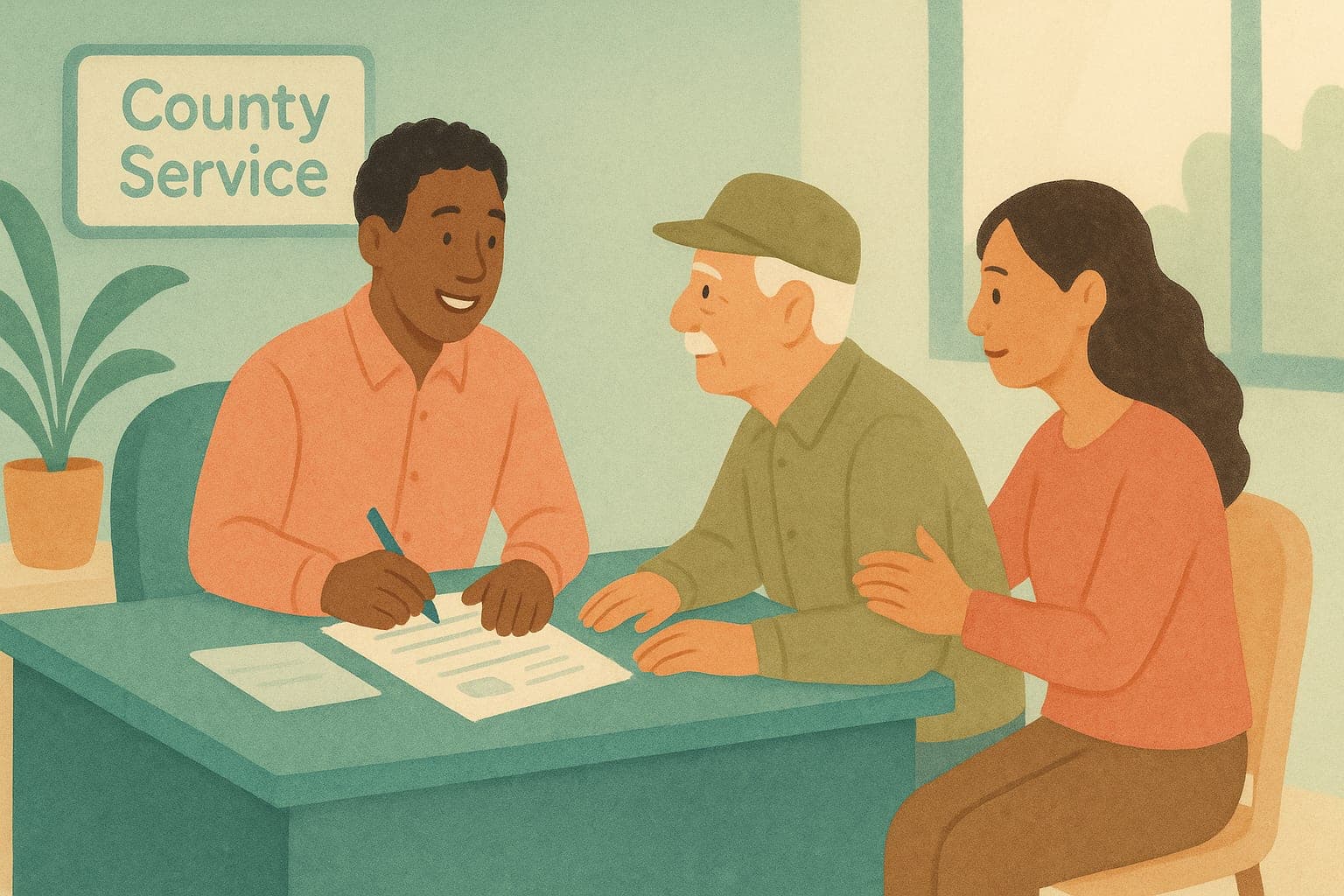
County Veterans Service Offices operate across California, and their staff are VA-accredited representatives who help veterans, spouses, and survivors file VA claims at no charge. They assist with disability compensation, pension and Aid and Attendance, health care enrollment, survivor benefits, appeals, and records requests. VA-recognized organizations and their accredited representatives are barred from charging fees for claims representation. If a company asks you to pay to file an initial claim, stop and find a CVSO instead.
Key points
- County Veterans Service Offices operate across California, and their staff are VA-accredited representatives who help with VA claims at no charge. Call CalVet at 1-844-737-8838 (1-844-SERV-VETS) or use its online directory to find the office serving your county.
- Federal regulation 38 CFR 14.636(b) bars recognized organizations and their accredited representatives from receiving fees for claims representation. Free is the rule, not a favor.
- Even a VA-accredited attorney or claims agent may not charge for an initial claim — fees are only permitted after the VA issues notice of an initial decision. Anyone charging to file a first claim is outside the rules.
- Verify anyone before sharing records: search the VA Office of General Counsel accreditation database at va.gov/ogc/apps/accreditation/index.asp. If the name does not come back, that person is not currently accredited. The data refreshes Monday, Wednesday, and Friday evenings.
- Unaccredited "claim consultants" and "coaches" are a documented and growing problem. The CFPB has warned about them, and California's SB 694, chaptered February 10, 2026, makes charging unauthorized fees for VA claims help a misdemeanor.
- A CVSO also helps survivors — spouses, children, and sometimes parents — with DIC, Survivors Pension, accrued benefits, and Aid and Attendance added to a Survivors Pension. Families miss this constantly. Eligibility rules differ for each; a CVSO checks them for free.
- Bring what you have and go anyway. A missing DD214 is not a reason to wait; basic military records are generally free to request for veterans and next of kin, and the CVSO can help you get them.
What do most veteran families miss?
These are the easy-to-miss angles — the early-eligibility rules and quiet ways veteran families leave help on the table. Each one is explained in full below.
- Aid and Attendance for a SURVIVING SPOUSE, not just the veteran. Families often assume the benefit died with the veteran. A surviving spouse receiving or eligible for a Survivors Pension who needs help with daily activities may qualify for Aid and Attendance on top of it. Ask about VA Form 21P-534EZ and VA Form 21-2680.
- Ask about an intent to file (VA Form 21-0966) at the very first appointment. It can lock in an earlier effective date while you spend weeks or months gathering medical records, which can mean meaningful back pay. It matters most for paper filers — the VA sets the date automatically once you begin a disability application online.
- Unreimbursed medical and care costs can count. For pension and Aid and Attendance, out-of-pocket medical expenses — including what you pay a home-care agency each month — are part of the income picture the VA looks at. Bring twelve months of care invoices, not just tax returns.
- A worsening condition can support a new claim. Older veterans frequently sit at a rating set decades ago while the condition has progressed. A CVSO can file for an increase, and there is no charge to try.
- Housebound and Aid and Attendance are different standards, and you cannot receive both at once. A veteran who spends most of their time at home because of a permanent disability may qualify for Housebound even without needing hands-on help. Ask the CVSO which one fits.
- A denial from 1995 is not necessarily the end. A Supplemental Claim with new and relevant evidence can reopen a case. Many families never reapply because someone said no a long time ago.
- Ask the CVSO to check VA health care enrollment separately from the disability claim. The VA says it decides health care applications in less than a week, and enrollment can be the doorway to VA home-based care programs.
- Bring the paid claims contract you already signed. CVSOs see these regularly and can tell you what the contract actually obligates you to, and where to report it.
- Adult children can start the process. You can call, gather documents, and ask questions on a parent's behalf, even though the veteran or spouse must sign the appointment form and the application.
What is a County Veterans Service Officer, and why have I never heard of one?
A County Veterans Service Officer, usually shortened to CVSO, is a county employee whose job is helping veterans and their families claim the benefits they earned. County Veterans Service Offices are county agencies, and CalVet — the California Department of Veterans Affairs — helps coordinate and train them across the state. CalVet keeps a public directory so you can find the office that serves your county, and a statewide phone line that will point you to it.
Most families never hear about CVSOs, because nobody advertises them. There is no marketing budget behind a county office. Meanwhile, private companies buy ads on social media and television offering to "maximize" a VA rating for a fee. The county office does much of the same work, is federally accredited to do it, and charges nothing.
The scale is not small. The Governor of California's office reported on February 10, 2026 that California's County Veteran Service Officers filed 316,000 claims and secured an estimated $687 million in new or increased federal benefits for California veterans and their dependents in 2024–2025.
Nothing here is official VA guidance, and SoCal Home Health is not affiliated with, endorsed by, or acting on behalf of the VA, CalVet, or any county. This is a plain-language starting point, not a promise that you qualify for anything. Your CVSO gives you the official answer for your situation.
What can a County Veterans Service Officer actually help with?
A CVSO is not just a form-filler. Because they are VA-accredited, they can prepare, present, and pursue a claim on your behalf, correspond with the VA about it, and represent you if the decision goes the wrong way.
For families caring for an older veteran at home, the pension and Aid and Attendance side of the work is often the most valuable — and the least understood. Eligibility for every benefit below depends on the specific rules for that program, so treat this as a list of things to ask about rather than a list of things you are owed.
- VA disability compensation — filing a first claim, adding conditions, or asking for an increase when a condition worsens with age (VA Form 21-526EZ)
- VA pension, Aid and Attendance, and Housebound benefits — extra monthly money added to a VA pension for veterans and surviving spouses who need help with daily activities or rarely leave home, if they meet the VA's rules
- VA health care enrollment — help completing VA Form 10-10EZ and gathering the income and insurance information the application asks for
- Survivor benefits — Dependency and Indemnity Compensation (DIC), Survivors Pension, accrued benefits, and burial benefits for an eligible surviving spouse, child, or parent
- Decision reviews and appeals — Supplemental Claims, Higher-Level Reviews, and Board Appeals to the Board of Veterans' Appeals
- Military records — help requesting a DD214 or service records from the National Personnel Records Center, online or with form SF-180
- Intent to file — submitting VA Form 21-0966 to protect an earlier effective date while you gather evidence, which mainly matters for paper filers (the VA sets the date automatically when you start a disability application online)
- Referrals to state, county, and community programs a veteran or caregiver may qualify for
Is it really free, or is there a catch somewhere?
It is genuinely free, and that is not a courtesy — it is the law. Federal regulation 38 CFR 14.636(b) provides that recognized organizations and their accredited representatives may not receive fees for representation on VA claims; only properly designated accredited agents and attorneys may charge a claimant at all.
The VA says the same thing in plain words. Its accredited representatives page states that VSOs always provide their representation on VA claims free of charge, and its page on getting help from an accredited representative says the services an accredited VSO representative provides on your VA benefit claims are always free.
County Veterans Service Offices are funded publicly, not by taking a cut of your award. There is no percentage, no contingency, no "success fee," and no charge if your claim is denied.
Orange County's Veterans Service Office, for example, describes what it offers as free benefits claims counseling and information and referral assistance to veterans, their dependents, and survivors, and says its staff can complete the forms, provide technical advice, package and submit your claims, and be your advocate on your claims.
What does "VA-accredited" mean, and how do I check someone before handing over my records?
VA accreditation is a formal authorization from the VA Office of General Counsel to represent claimants before the VA. It is not a certificate someone buys. Applicants file VA Form 21 (service organization representatives) or VA Form 21a (attorneys and claims agents) and must meet character and fitness standards. Claims agents must also pass a written examination with a score of 75 percent or more, covering compensation and pension programs, claim procedures, appeals, agents' fees, and waiver of indebtedness. Attorneys are not required to sit that exam; their competence is presumed from state bar membership in good standing.
Only three categories of people are accredited: representatives of VA-recognized Veterans Service Organizations, VA-accredited attorneys, and VA-accredited claims agents. County Veterans Service Officers fall in the first group — they are recommended for accreditation through their state department of veterans affairs, which the VA recognizes for the purpose of representing claimants. Anyone outside those three categories is not authorized to prepare, present, or pursue your VA claim.
Checking takes about two minutes, and it is worth doing before you share a Social Security number or a medical record. The VA's Accreditation and Recognition Search returns only people currently accredited and organizations currently recognized. If a name does not come back, that person is not currently authorized.
- Open the VA Office of General Counsel Accreditation Search at va.gov/ogc/apps/accreditation/index.asp
- Choose the type: attorney, claims agent, VSO representative, or recognized VSO
- Search by last name, first name, city, state, or postal code — you can use one field or several
- If the search returns nothing, treat that as a no. The VA notes the data behind the page refreshes every Monday, Wednesday, and Friday evening
- Separately, make sure the form appointing your representative is actually on file with the VA: VA Form 21-22 for a VSO, or VA Form 21-22a for an attorney or claims agent
Who is allowed to charge me for claims help, and who is not?
This is the rule most families never learn, and it is the one that protects the most money.
A VA-accredited attorney or claims agent may charge a fee — but not for your initial claim. Under 38 CFR 14.636(c), fees may only be charged after an agency of original jurisdiction has issued notice of an initial decision on the claim, and only if power-of-attorney and fee-agreement requirements are met. Under 38 CFR 14.636(f), a fee of 20 percent or less of past-due benefits is presumed reasonable, and a fee above 33⅓ percent is presumed unreasonable.
A VSO or CVSO representative may never charge a fee at any stage. Not before the decision, not after, not for an appeal.
So if anyone asks you for money to file a first VA claim, that alone tells you something is wrong — regardless of how professional the website looks or how confident the person on the phone sounds.
What about the paid "claim consultants" and "coaches" I see advertised?
This is a real and growing problem, and federal regulators have said so directly. The Consumer Financial Protection Bureau has warned that unaccredited individuals and organizations aggressively solicit veterans and try to coerce them into paying illegal fees — often asking a veteran to sign a contract for a percentage of retroactive or future benefits — and that when those bills go unpaid they are sent to third-party debt collectors. The CFPB notes that these operators often insist they are not bound by the laws governing practice before the VA because they are merely "coaches" or "consultants."
California acted on this in 2026. Senate Bill 694 (Archuleta) was signed by Governor Newsom and chaptered on February 10, 2026. It provides that a person shall not directly or indirectly solicit, contract for, charge, or receive any fee or compensation for preparing, presenting, or prosecuting a claim for VA benefits, except as expressly permitted under federal law. It also bars practices such as sharing login credentials, using another person's credentials to access secure government systems, and requiring a veteran to hand over a PIN. A violation is a misdemeanor punishable by imprisonment not to exceed one year, a fine not to exceed $1,000, or both.
The harm is concrete. CalMatters reported the case of a Vietnam-era veteran billed $5,500 for claim help after being awarded roughly $1,100 a month in benefits — for work a CVSO would have done for nothing.
If you have already signed something, do not panic and do not assume you are stuck. Bring the contract to your CVSO and ask. You can also report the company to the VA Office of Inspector General hotline at 1-800-488-8244, to the VA's accreditation program, to the California Attorney General, or to the FTC.
What should I bring to a first appointment?
Bring what you have and do not delay the appointment over what you are missing. A CVSO can help you request records you cannot find — including a lost DD214 — and the National Archives says there is generally no charge for basic military personnel and medical record information provided to veterans, next of kin, and authorized representatives from non-archival federal records.
If you are the adult child or caregiver making the call, that is fine. Many CVSOs will speak with you, though the veteran or surviving spouse will need to sign the appointment form and the application.
- The veteran's DD214 or other discharge papers, if you have them
- Photo ID for the person applying
- Social Security numbers for the veteran, spouse, and any dependents
- Marriage certificate, and divorce or death certificates where relevant — these are commonly needed for pension and survivor claims
- Current medical records, doctors' reports, and a list of diagnoses and medications
- For pension or Aid and Attendance: last year's gross household income, out-of-pocket medical and care expenses, and information about assets
- Health insurance cards, including Medicare and any private or employer plan
- If care is already in place: the care facility or home-care agency name, and what you pay each month
- Any letters you have received from the VA, and any contract you signed with a paid claims company
How do I find my local County Veterans Service Office in Southern California?
Southern California counties — Los Angeles, Orange, San Diego, Riverside, San Bernardino, Ventura, Santa Barbara, and Imperial — are served by County Veterans Service Offices. Many have several locations, and some send staff to VA medical centers, senior centers, and community sites.
The fastest route is the phone. CalVet publishes a statewide line for finding the County Veterans Service Office that serves your area, and also keeps an online directory.
- Call CalVet at 1-844-737-8838 (1-844-SERV-VETS) and follow the prompts to reach the office serving your county
- Or use CalVet's County Veterans Service Office directory at calvet.ca.gov to look up your county's office, address, and phone number
- Or use the VA's own accredited representative search at va.gov/get-help-from-accredited-representative/ and filter to VSO representatives near you
- Call and ask for an appointment — Orange County's office, for example, takes appointments online or by email at ocvso@occr.ocgov.com, or by phone at 714-480-6555, Monday through Friday, 8 a.m. to 4 p.m.
- Ask when you call whether the office has a translator, or bring a family member who can interpret
- At the appointment, expect to sign VA Form 21-22 appointing the organization as your representative. This costs nothing and you can change it later
What if the veteran has already died, or I'm the spouse or adult child?
Survivors can get CVSO help too, and this is a place where families very often leave money unclaimed. A surviving spouse, dependent child, or in some cases a parent may qualify for Dependency and Indemnity Compensation, Survivors Pension, accrued benefits the veteran was owed but never received, and burial benefits. Each has its own eligibility rules — a CVSO checks them against your actual records at no charge.
A surviving spouse who is receiving or eligible for a Survivors Pension and who needs help with daily activities, or who is housebound, may also qualify for Aid and Attendance or Housebound added to that pension. That extra monthly amount is often what makes home care affordable.
Applications for DIC, Survivors Pension, and accrued benefits generally run through VA Form 21P-534EZ; the medical evidence for Aid and Attendance or Housebound is usually documented on VA Form 21-2680. The rest of the evidence typically includes the veteran's service records, the death certificate, the marriage certificate, and medical documentation. A CVSO will tell you which pieces your situation needs and will handle the filing.
If a first application was denied years ago, ask anyway. Rules, evidence, and family circumstances change, and a CVSO can tell you whether a Supplemental Claim with new and relevant evidence makes sense. Free help from a VA-accredited representative is available at every one of these steps.
Frequently asked questions
Do I have to be low income or already receiving VA benefits to see a CVSO?
No. County Veterans Service Offices help veterans, spouses, and survivors in the county whether or not you currently receive anything from the VA. There is no income test to get the help itself. Income does matter for some benefits, such as VA pension and Aid and Attendance, and the CVSO will walk you through those rules.
Is a CVSO the same thing as a VSO?
They overlap. "VSO" usually means a Veterans Service Organization such as the VFW, DAV, or American Legion, and its VA-accredited representatives. A County Veterans Service Officer is a county employee who is also VA-accredited, recommended for accreditation through the state department of veterans affairs that the VA recognizes. Both can represent you before the VA, and neither may charge you a fee for that representation.
Can a CVSO help if my loved one served but never deployed or was never in combat?
Yes. Many benefits do not require combat service, and some do not require wartime service. Eligibility depends on the specific benefit — VA pension and Survivors Pension have a wartime service requirement, while disability compensation does not. Do not rule yourself out, and do not assume you qualify either. Ask the CVSO and let them check the actual rules against the service record.
I already hired a paid claims company. Can I still go to a CVSO?
Yes, and you should. Bring the contract with you. You can change who represents you before the VA by filing a new appointment form. If the company charged you for preparing an initial claim, ask the CVSO about it and consider reporting it to the VA Office of Inspector General hotline at 1-800-488-8244, the California Attorney General, or the FTC.
What if we can't find the DD214?
That is one of the most common reasons families delay, and it should not stop you. The National Personnel Records Center in St. Louis holds military personnel records. The National Archives says there is generally no charge for basic records provided to veterans, next of kin, and authorized representatives from non-archival federal records; older "archival" records — generally those from more than 62 years after separation — carry a flat fee of $25 for five pages or less, or $70 for six or more. Requests can be made online or with form SF-180, and a CVSO can help you file one. The Archives asks that you wait about 90 days before following up.
Does going to a CVSO slow my claim down compared with filing online myself?
No. An accredited representative can file the same way you would, and they know which evidence the VA will ask for, which often prevents a round of delays. If you are worried about the effective date, ask about an intent to file (VA Form 21-0966). The VA notes that if you start a disability application online your effective date is set automatically, so the separate intent-to-file form matters most for paper filers.
Can a CVSO help with California state and county benefits too, not just federal VA benefits?
Often, yes. County offices routinely point families to state and local programs — such as veteran property tax exemptions, DMV benefits, and county aging services — and can refer you to other local resources. Ask directly during your appointment; it costs nothing to ask.
Need care at home? We will connect you.
Skilled nursing, therapy, personal care, and recovery help — right at home, from trusted local providers. Tell us what you need and we will take it from there. Free, no obligation.
Get home-health careSources
- VA — Get help from a VA-accredited representative or VSO
- VA Office of General Counsel — Accreditation program (Forms 21 and 21a, claims agent exam)
- VA Office of General Counsel — Accreditation and Recognition Search
- VA — Accredited representatives: VSO representation is free of charge
- 38 CFR 14.636 — Payment of fees for representation before VA
- 38 CFR 14.629 — Requirements for accreditation of service organization representatives, agents, and attorneys
- CFPB — Warning: "coaches" and "consultants" who may not be VA-accredited
- California SB 694 (Archuleta) — Deceptive practices: service members and veterans (chaptered 2026-02-10)
- Office of the Governor of California — SB 694 signing and CVSO statistics (2026-02-10)
- CalMatters — Newsom signs law banning fees for help with VA claims
- CalVet — County Veterans Service Office locations
- CalVet — How do I find a County Veteran Service Office?
- CalVet — County Veterans Service Offices overview
- VA — Aid and Attendance and Housebound benefits (VA Form 21-2680)
- VA — Veterans Pension rates (MAPR, effective December 1, 2025)
- VA — Survivors Pension rates (effective December 1, 2025)
- VA — How to apply for VA health care (VA Form 10-10EZ)
- VA — How to file a VA disability claim (VA Forms 21-526EZ, 21-0966)
- VA — About VA Form 21-0966 (Intent to File)
- VA — Decision reviews and appeals
- VA — Survivor benefits: DIC, Survivors Pension, accrued and burial benefits
- VA — Dependency and Indemnity Compensation (VA Form 21P-534EZ)
- National Archives — Requesting military service records (DD214, SF-180, fees)
- VA Office of Inspector General — Hotline (1-800-488-8244)
- Orange County Veterans Service Office — About Us (free benefits claims counseling)
- Orange County Veterans Service Office — Benefits (what staff can do)
- Orange County Veterans Service Office — Schedule an appointment
Related guides
- VA Aid and Attendance: Extra Monthly Money for Veterans and Spouses Who Need Help at Home
- The VA Housebound Benefit: What It Pays, and Why You Cannot Get It With Aid and Attendance
- VA Health Care for Older Veterans: Who Qualifies and How to Enroll
- CHAMPVA: Health Coverage for a Veteran's Spouse, Survivors and Children
- VA Caregiver Support: The PCAFC Stipend and Free PGCSS Help, Explained
- Avoiding Home-Care Fraud and Scams: A Caregiver's Guide
- Where to Start: California Aging & Disability Help
This guide is educational and is not medical advice. In an emergency, call 911.