
Veterans
Benefits for Surviving Spouses of Veterans: DIC, Survivors Pension, and Aid & Attendance
Last reviewed August 3, 2026
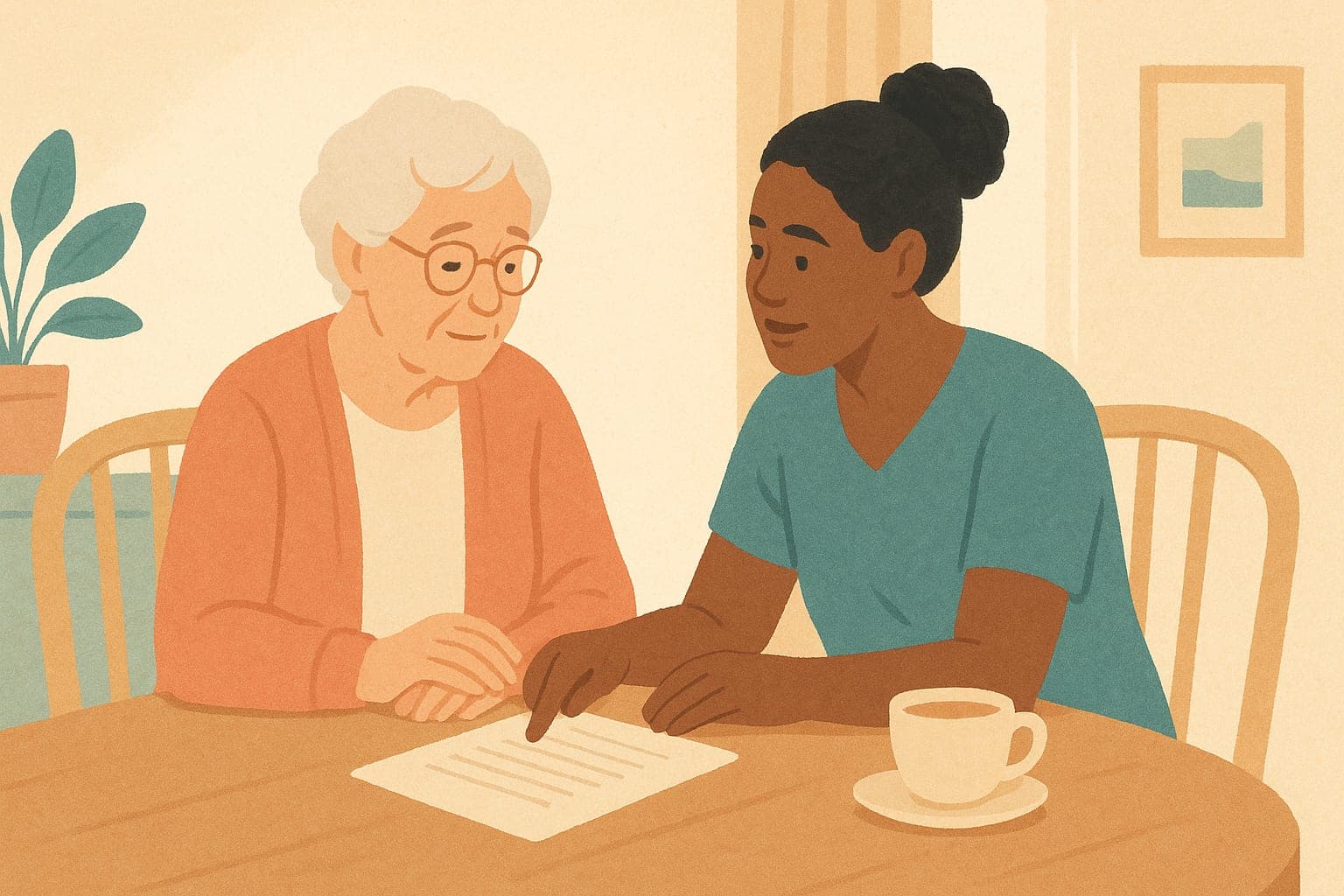
If your husband or wife was a veteran, you may be eligible for a monthly, tax-free payment from the VA — and many surviving spouses never apply because no one told them. There are two main programs: DIC, tied to the veteran's service-connected condition, and Survivors Pension, based on wartime service and financial need. Aid and Attendance can be added if you need help with daily care. Accredited help with your claim is free, and this site is not affiliated with the VA.
Key points
- There are two separate monthly benefits for surviving spouses — DIC (based on the veteran's service-connected condition, not your income) and Survivors Pension (based on wartime service and financial need). One form, VA Form 21P-534EZ, applies for both, and the VA does not pay both at once.
- You may qualify for DIC even if the veteran died of something unrelated to service, as long as the veteran carried a total VA disability rating for 10 years before death, or 5 years since release from active duty, or 1 year for a former prisoner of war.
- Aid and Attendance and Housebound add-ons exist in both programs. Effective December 1, 2025, Aid and Attendance adds $421.00 a month to DIC, and raises the Survivors Pension MAPR for a spouse with no dependents from $11,699 to $18,697 a year.
- Unreimbursed medical expenses — including in-home caregiver costs and Medicare premiums — can be subtracted from your income for Survivors Pension. Do not rule yourself out based on gross income alone.
- Remarriage does not always end benefits. DIC may continue if you remarried at 57 or older on or after December 16, 2003, or at 55 or older on or after January 5, 2021, and may be reinstated in some cases if a later marriage ends.
- File an intent to file (VA Form 21-0966) first — it can protect an earlier payment start date while you gather documents, and you then have one year to file the full claim.
- All VA benefit amounts change every December 1 with the cost-of-living adjustment. Confirm current figures on VA.gov before you plan around any number.
- Surviving spouses are targeted by pension-poaching scams. The VA says you should never pay a fee to file an initial claim. Accredited VSOs and County Veterans Service Officers help free of charge, and no private company can promise you a VA approval.
What do most veteran families miss?
These are the easy-to-miss angles — the early-eligibility rules and quiet ways veteran families leave help on the table. Each one is explained in full below.
- The 10-year total rating rule: if the veteran held a 100 percent VA rating (including TDIU) for the 10 years before death, DIC may be payable even though the death itself had nothing to do with military service. This is the single most-missed survivor benefit.
- The 8-year provision adds $360.85 a month (effective December 1, 2025) on top of base DIC when the veteran was rated totally disabling for 8 years before death and you were married throughout — a separate add-on that has to be identified in the claim.
- Aid and Attendance can be added to DIC, not just to Survivors Pension. Spouses receiving DIC who now need help bathing, dressing, or eating often never think to ask for the extra $421.00 a month.
- Unreimbursed medical expenses reduce countable income for Survivors Pension. A spouse paying $2,000 a month for in-home care may be worth screening even when their gross income looks far too high.
- The intent to file (VA Form 21-0966) can protect an earlier effective date and gives you a full year to complete the claim — potentially worth months of retroactive payments.
- SBP and DIC are no longer offset against each other. The reduction was fully eliminated as of January 1, 2023, so eligible surviving spouses can receive both. Anyone working from pre-2021 information is out of date.
- CHAMPVA is not only for spouses of veterans who died OF a service-connected condition — a spouse of a veteran who was rated permanently and totally disabled from a service-connected disability at the time of death may also qualify, even if the death was unrelated.
- If the veteran died of a service-connected disability on or after September 11, 2001, the burial allowance may be up to $2,000 rather than the standard $1,002 — ask for the service-connected allowance specifically.
- Your primary home, your car, and most basic household furnishings do not count toward the $163,699 Survivors Pension net worth limit (December 1, 2025 – November 30, 2026).
- A surviving spouse remains eligible for burial in a VA national cemetery even after remarrying — a rule many widows and widowers assume they have forfeited.
- CHAMPVA covers skilled nursing care and hospice, with a $3,000 household catastrophic cap per calendar year. For a survivor facing serious illness, that cap alone can matter more than the monthly payment.
- Your County Veterans Service Office in Los Angeles, Orange, San Diego, Riverside, San Bernardino, or Ventura County will complete the entire claim with you at no charge — there is no reason to pay a private firm to file an initial claim.
What benefits can a surviving spouse of a veteran receive?
When a veteran dies, the benefits do not always die with them. The VA runs several programs for surviving spouses, and awareness is low — families often find out years later, or never.
There are two main monthly payments, and they work very differently. Dependency and Indemnity Compensation (DIC) is tied to service: if the veteran's death was connected to their military service, or the veteran carried a total disability rating long enough, you may qualify no matter what your income is. Survivors Pension is needs-based: it is for the surviving spouse of a wartime veteran whose income and assets are below limits set in law.
The VA does not pay both at the same time. If you qualify for both, the VA generally pays whichever one gives you more. One application form covers both, so you do not have to guess which one fits — you apply once and the VA decides. If anyone tells you something different, ask a VA-accredited representative to explain your specific case.
On top of the monthly payment, surviving spouses may also be eligible for CHAMPVA health coverage, burial and memorial benefits, grief counseling in certain situations, and in some cases a VA-backed home loan. Each has its own rules, so it is worth asking about all of them.
This article is general information, not a decision about your case, and this website is not part of or endorsed by the U.S. Department of Veterans Affairs. Only the VA can decide whether you qualify. A VA-accredited representative will review your situation with you free of charge.
- Dependency and Indemnity Compensation (DIC) — tax-free monthly payment tied to the veteran's service-connected condition
- Survivors Pension — tax-free monthly payment for the surviving spouse of a wartime veteran with limited income and assets
- Aid and Attendance or Housebound — an added amount if you need help with daily activities or cannot leave home
- CHAMPVA — health coverage for certain surviving spouses
- Burial allowance, plot allowance, burial in a VA national cemetery, headstone or marker, and memorial items
- Bereavement (grief) counseling through a Vet Center, free, for survivors who meet VA's criteria
- VA-backed home loan eligibility for some surviving spouses
What is DIC, and how much does it pay?
Dependency and Indemnity Compensation is a tax-free monthly payment for the surviving spouse, children, or parents of a service member who died in the line of duty, or of a veteran who died from a service-connected illness or injury. It is not based on your income or your savings.
Effective December 1, 2025, the base monthly DIC rate for a surviving spouse is $1,699.36 where the veteran died on or after January 1, 1993. If the veteran died before January 1, 1993, the VA uses a different method based on the veteran's pay grade, so your amount may differ — check the pay-grade tables on VA.gov or ask an accredited representative. Several amounts can be added on top of the base. VA benefit rates change every December 1 with the cost-of-living adjustment, so always confirm the current figure on VA.gov before you plan around it.
To qualify as a surviving spouse, the VA generally looks at two things. First, that you lived with the veteran without a break until their death — or, if you were separated, that the separation was not your fault. Second, that one of these is true: you married within 15 years of the veteran's discharge from the period of service when the qualifying condition began or worsened, or you were married for at least one year, or you had a child together. A valid marriage entered into before January 1, 1957 can also qualify.
- Base rate for a surviving spouse: $1,699.36 a month (effective December 1, 2025; veteran died on or after January 1, 1993)
- 8-year provision: add $360.85 a month if the veteran was rated totally disabling for the 8 years before death and you were married that whole time
- Aid and Attendance: add $421.00 a month if you need help with daily activities such as eating, bathing, or dressing
- Housebound: add $197.22 a month if a disability keeps you largely at home
- Each child under 18: add $421.00 a month
- Transitional benefit: add $359.00 a month for the first 2 years after the veteran's death, if you have one or more children under 18
Can I get DIC if my spouse didn't die from a service-connected condition?
This is the rule almost no one knows about, and it leaves real money on the table. Even if the veteran died of something unrelated — a heart attack, cancer, a fall, old age — you may still qualify for DIC if the veteran carried a total VA disability rating long enough before death.
The VA explains that a surviving spouse may be eligible if the veteran was eligible to receive compensation for a service-connected disability rated as totally disabling for a certain length of time. A total rating can include what the VA calls total disability based on individual unemployability (TDIU) — so a veteran rated at 70 percent but paid at the 100 percent rate for unemployability may count. How the VA applies this in a particular case can be technical, so have it reviewed rather than guessing.
If your spouse had a 100 percent VA rating for many years, do not assume you are shut out because the death certificate says something else. Bring the VA rating letters to a VA-accredited representative and ask them to look at this specific rule.
- Rated totally disabling for at least 10 years immediately before death, or
- Rated totally disabling continuously since release from active duty and for at least 5 years immediately before death, or
- Rated totally disabling for at least 1 year before death, if the veteran was a former prisoner of war. VA's public page still adds the words "who died after September 30, 1999"; Congress removed that date from the law in 2010, so if the death was earlier, ask an accredited representative rather than assuming you are excluded.
- In all cases, the death must not have resulted from the veteran's own willful misconduct
What is Survivors Pension, and who qualifies?
Survivors Pension — once called Death Pension — is a tax-free monthly payment for the surviving spouse of a veteran who served during a wartime period, when income and assets are limited and the spouse has not remarried after the veteran's death. It is not about how the veteran died. It is about wartime service and financial need. The veteran must also not have received a dishonorable discharge.
The veteran did not have to see combat or serve overseas. They only needed to serve at least one day during a recognized wartime period, plus meet a minimum length-of-service rule: generally at least 90 days of active service for those whose active duty began before September 8, 1980, or 24 months (or the full period called to active duty) for those whose service began on or after that date, with some exceptions. Recognized wartime periods include World War II (December 7, 1941 – December 31, 1946), the Korean conflict (June 27, 1950 – January 31, 1955), the Vietnam War era (November 1, 1955 – May 7, 1975 for veterans who served in the Republic of Vietnam; August 5, 1964 – May 7, 1975 for those who served elsewhere), and the Gulf War (August 2, 1990 through a future date to be set by law or presidential proclamation). Earlier periods, including World War I and the Mexican Border period, are also recognized.
The VA sets a Maximum Annual Pension Rate (MAPR) and pays the difference between that limit and your countable income. Effective December 1, 2025, the MAPR for a surviving spouse with no dependents is $11,699 a year — roughly $975 a month if you had no countable income at all. The net worth limit for the period December 1, 2025 through November 30, 2026 is $163,699, and your primary home, your car, and most basic household furnishings do not count toward it.
Here is the part families miss: unreimbursed medical expenses can be subtracted from your income. Things like in-home caregiver costs, assisted living, Medicare premiums, and prescriptions may lower your countable income enough to qualify you — or raise your payment. Only the amount above 5 percent of your MAPR counts. Effective December 1, 2025, that threshold is $584 for a surviving spouse with no dependents and $765 for a surviving spouse with one dependent.
- Surviving spouse, no dependents: $11,699 a year (effective December 1, 2025)
- Surviving spouse, no dependents, Housebound: $14,298 a year
- Surviving spouse, no dependents, Aid and Attendance: $18,697 a year — about $1,558 a month
- Surviving spouse with 1 dependent child: $15,311 a year; with Housebound $17,902; with Aid and Attendance $22,304
- Add $2,984 a year for each additional dependent child
- Net worth limit: $163,699 (December 1, 2025 – November 30, 2026)
Can a surviving spouse get Aid and Attendance or Housebound?
Yes — and this is where a modest benefit can become a meaningful one for a family paying for care at home.
Aid and Attendance is an added amount for someone who needs help with the ordinary activities of daily life: eating, bathing, dressing, using the toilet, or getting safely in and out of bed. Housebound is a smaller added amount for someone whose disability keeps them substantially confined to their home. You are generally paid one or the other, not both.
Importantly, this add-on exists in both programs. If you receive DIC, Aid and Attendance adds $421.00 a month and Housebound adds $197.22 a month (effective December 1, 2025). If you receive Survivors Pension, Aid and Attendance raises the annual MAPR for a surviving spouse with no dependents from $11,699 to $18,697, and Housebound raises it to $14,298 (effective December 1, 2025).
You will need a doctor, nurse practitioner, or other qualifying medical provider to describe your condition and what help you need. The VA form for this is the Examination for Housebound Status or Permanent Need for Regular Aid and Attendance (VA Form 21-2680). Many families qualify but never ask, because no one mentioned it. If your health has changed since you were first approved, you can ask the VA to look again.
Does remarriage end my benefits?
It depends on the benefit and on your age when you remarried — and the rules are more generous than most people assume.
For DIC, you may keep or restart payments if you remarried on or after December 16, 2003 and were 57 or older at the time, or if you remarried on or after January 5, 2021 and were 55 or older. If you remarried younger than that and the later marriage has since ended by death, divorce, or annulment, DIC may be reinstated in some situations — so ask, do not assume.
For Survivors Pension, the rule is stricter: you generally must not have remarried after the veteran's death.
For CHAMPVA health coverage, a surviving spouse who remarries before age 55 loses eligibility on the date of remarriage; if that later marriage ends before you turn 55, you may qualify again. A surviving spouse who remarries at or after 55 can keep CHAMPVA. And for burial in a VA national cemetery, a surviving spouse remains eligible even if they remarried after the veteran's death. These are all separate rules, so a change in one benefit does not automatically change the others. A VA-accredited representative can check all of them for you at no cost.
How do I apply, and what forms do I need?
One form covers most of it. VA Form 21P-534EZ, "Application for DIC, Survivors Pension, and/or Accrued Benefits," is the application a surviving spouse or child of a veteran uses. You do not have to choose between DIC and Survivors Pension — the VA will look at both. (Surviving parents seeking DIC use a different form, VA Form 21P-535. If the death happened while the service member was on active duty, the form is VA Form 21P-534a, and a military casualty assistance officer usually helps with it.)
Before you gather every document, consider filing an intent to file first, using VA Form 21-0966. That notifies the VA you plan to apply and can protect an earlier start date for your payments. You then have one year to complete and file the claim. For a benefit paid monthly, that can be worth a great deal.
You can apply online at VA.gov, by mail to the VA Pension Intake Center, PO Box 5365, Janesville, WI 53547-5365, in person at a VA regional office, or — the option we recommend most — with a VA-accredited representative, attorney, or claims agent who can do the paperwork with you. Accredited Veterans Service Organization representatives do this at no charge.
- Step 1: File an intent to file (VA Form 21-0966) to protect your potential effective date.
- Step 2: Gather documents — the veteran's death certificate, your marriage certificate, the veteran's DD214 or separation papers, and any VA rating letters.
- Step 3: If you need daily care, ask your doctor to complete VA Form 21-2680 for an Aid and Attendance or Housebound claim.
- Step 4: If you are applying for Survivors Pension, collect proof of income and unreimbursed medical expenses, including caregiver invoices and insurance premiums.
- Step 5: Complete VA Form 21P-534EZ with a VA-accredited representative, a Veterans Service Organization, or your County Veterans Service Officer — free of charge.
- Step 6: Submit online, by mail, or in person, and keep a copy of everything you send.
What about health coverage, burial help, and grief counseling?
CHAMPVA is health coverage for certain spouses, dependents, and survivors. It includes the surviving spouse of a veteran who died from a service-connected disability, and — a category many families overlook — the surviving spouse of a veteran who was rated permanently and totally disabled from a service-connected disability at the time of death, even if the death itself was unrelated. Certain survivors of a service member who died in the line of duty may also qualify. You cannot get CHAMPVA if you qualify for TRICARE. CHAMPVA is a cost-sharing plan: a $50 calendar-year deductible per person ($100 maximum per family) for outpatient care, a 25 percent share of the CHAMPVA allowable amount, and a $3,000 catastrophic cap per household per calendar year, after which CHAMPVA pays 100 percent of covered services. Covered care includes skilled nursing care and hospice. You apply with VA Form 10-10d. If you are eligible for Medicare, you generally must have both Part A and Part B (a Medicare Advantage plan also meets this requirement).
For burial, the VA may pay a burial allowance and a plot allowance. For deaths on or after October 1, 2025, the VA pays $1,002 for burial and $1,002 for a plot. (For deaths on or after October 1, 2024 but before October 1, 2025, each was $978.) If the veteran died of a service-connected disability on or after September 11, 2001, the VA may instead pay a service-connected burial allowance of up to $2,000 — a higher amount that families entitled to DIC should specifically ask about. You apply with VA Form 21P-530EZ. When the death was service-connected there is no filing deadline; for other deaths the burial-allowance claim is generally due within 2 years after the veteran's burial, though the plot or interment allowance and transportation reimbursement have no such deadline.
Spouses and surviving spouses may also be buried in a VA national cemetery — including a surviving spouse who remarried after the veteran's death — and the VA provides headstones, markers, medallions, urns, plaques, burial flags, and Presidential Memorial Certificates for eligible family members.
Grief support through a Vet Center is free, but it is not open to every survivor. VA bereavement counseling is generally for the surviving spouse, child, or parent of a service member who died while on active duty, a Reservist or National Guard member who died while on active duty, a veteran who was receiving Vet Center services at the time of death, or a veteran who died by suicide. It is provided in a community setting rather than a hospital. If you are not sure whether you qualify, call and ask — the Vet Center call line is 877-927-8387 (TTY: 711), available 24 hours a day, and they can point you to other grief resources if you do not.
How do I avoid pension-poaching scams and find free help?
Surviving spouses are a common target for benefits scams. The VA warns about what it calls "pension poaching" — people who profit by claiming they can help a claimant artificially qualify for VA pension benefits.
The pattern is almost always the same. Someone calls, mails a glossy letter, or shows up at a senior center or assisted living facility offering to "get you approved" for VA benefits. Then they steer you into an annuity, an irrevocable trust, or a transfer of your assets so you look poor enough to qualify — and they collect a commission or a fee. These moves can trigger a VA look-back penalty, cost you your savings, and delay or damage your claim.
Here is the rule that protects you: the VA says you should never pay anyone a fee to file an initial claim for benefits. Only a VA-accredited attorney or claims agent may charge a fee, and only for work such as reviewing or appealing a claim after an initial decision. VA-accredited Veterans Service Organization representatives are always free.
In Southern California, your County Veterans Service Office is a good first call — Los Angeles, Orange, San Diego, Riverside, San Bernardino, and Ventura counties all have one, and their help is free. Organizations like the VFW, DAV, and American Legion also have accredited representatives. You can verify anyone's accreditation using the VA's search tool at va.gov before you sign anything. No private company, including this one, speaks for the VA or can promise you an approval.
- Red flag: someone charges a fee, or asks for a percentage of your back pay, to file an initial claim.
- Red flag: someone tells you to move money into a trust or annuity so you will "qualify."
- Red flag: pressure to sign today, or a claim that they have a special relationship with the VA.
- Red flag: they ask for your direct deposit information, Social Security number, or VA login.
- Do this instead: verify accreditation at va.gov/get-help-from-accredited-representative/find-rep/
- Report suspected fraud to VSAFE at 833-38V-SAFE (833-388-7233), the VA OIG hotline at 800-488-8244, or the FTC at reportfraud.ftc.gov
Frequently asked questions
My husband had a 100 percent VA rating but died of cancer that wasn't service-connected. Can I still get DIC?
You may be able to. The VA can pay DIC as if the death were service-connected when the veteran was rated totally disabling for at least 10 years immediately before death, or continuously since release from active duty and for at least 5 years before death, or for at least 1 year before death if the veteran was a former prisoner of war. The death must not have resulted from the veteran's own willful misconduct. Bring the rating letters to a VA-accredited representative and ask them to check this rule for you. Only the VA can decide.
Can I receive both DIC and Survivors Pension?
The VA does not pay both at once. If you are eligible for both, it generally pays whichever one gives you more money — often DIC. You do not have to pick. VA Form 21P-534EZ covers both, so you apply one time and the VA works out which benefit applies to you.
I make too much money for Survivors Pension. Is it worth applying anyway?
Often, yes. The VA subtracts unreimbursed medical expenses from your income — in-home caregiver costs, assisted living, Medicare premiums, and prescriptions can all count. Only the amount above 5 percent of your MAPR is deductible ($584 for a surviving spouse with no dependents, effective December 1, 2025), but for a family paying for daily care that can be a large number. Many spouses who look over the limit on paper still qualify once care costs are counted. Ask a County Veterans Service Officer to run the numbers with you at no charge.
I receive a Survivor Benefit Plan (SBP) annuity from the military. Will DIC reduce it?
No longer. The SBP-DIC offset was phased out under the Fiscal Year 2020 National Defense Authorization Act and fully eliminated as of January 1, 2023. Eligible surviving spouses can now receive both SBP and DIC. SBP is run by the Department of Defense, not the VA, so if you were told years ago that you had to choose, contact DFAS to confirm your current payment.
I remarried after my wife died. Have I lost everything?
Not necessarily. For DIC, you may keep or restart payments if you remarried on or after December 16, 2003 at age 57 or older, or on or after January 5, 2021 at age 55 or older. If you remarried younger and that marriage has since ended by death, divorce, or annulment, DIC may be reinstated in some situations. Survivors Pension is stricter and generally requires that you not have remarried. Burial in a VA national cemetery remains available to a surviving spouse even after remarriage. Ask the VA or an accredited representative about your specific situation.
How much does it cost to have someone file my claim?
Nothing, if you use the right help. The VA says you should never pay anyone a fee to file an initial claim for benefits. VA-accredited Veterans Service Organization representatives and County Veterans Service Officers help for free. Only a VA-accredited attorney or claims agent may charge, and only for work after an initial decision, such as a review or appeal. If someone wants money up front to get you approved, walk away and report it.
How long does a survivors claim take, and can I get back pay?
Processing times vary and the VA does not promise a set timeline. That is exactly why you should file an intent to file (VA Form 21-0966) as soon as you decide to apply — it can protect an earlier start date, and you then have one year to submit the full application. If your claim is approved, you may be able to receive retroactive payments back to that protected date. Check current processing times on VA.gov.
Need care at home? We will connect you.
Skilled nursing, therapy, personal care, and recovery help — right at home, from trusted local providers. Tell us what you need and we will take it from there. Free, no obligation.
Get home-health careSources
- VA — Survivors Pension and DIC (survivor compensation overview)
- VA — About VA DIC for spouses, dependents, and parents (eligibility, marriage and remarriage rules)
- VA — Current DIC rates for spouses and dependents (effective December 1, 2025)
- VBA — Dependency and Indemnity Compensation (surviving spouse eligibility, including pre-1957 marriage)
- VA — Survivors Pension eligibility and wartime service periods
- VA — Survivors Pension rates (MAPR, net worth limit, 5% medical deductible, effective December 1, 2025)
- U.S. Code — 38 U.S.C. 1318, benefits for survivors of certain veterans rated totally disabled at time of death
- VA — About VA Form 21P-534EZ (Application for DIC, Survivors Pension, and/or Accrued Benefits)
- VA — About VA Form 21P-535 (DIC by Parents)
- VA — About VA Form 21P-534a (DIC, in-service death only)
- VA — About VA Form 21-2680 (Examination for Housebound Status or Permanent Need for Regular Aid and Attendance)
- VA — Your intent to file a VA claim (VA Form 21-0966)
- VA — Evidence to support VA pension, DIC, or accrued benefits claims
- VA — CHAMPVA eligibility, remarriage rules, and how to apply
- VA — CHAMPVA care, costs, and covered services
- VA — Veterans burial allowance and transportation benefits
- VA — Eligibility for burial in a VA national cemetery and memorial items
- VA — Burial and memorial benefits for family members
- VA — Bereavement counseling through Vet Centers
- VA — Home loans for surviving spouses
- VA — Get help from a VA-accredited representative or VSO
- VA — Find a VA-accredited representative or VSO (search tool)
- VBA — Fraud prevention and pension poaching warnings
- VSAFE — federal veterans fraud prevention resource and hotline
- VA Office of Inspector General — Hotline
- VA Office of Survivors Assistance — FAQs (DIC vs. Survivors Pension vs. SBP)
- DFAS — SBP-DIC Offset Elimination News
- FTC — Report fraud
Related guides
- VA Aid and Attendance: Extra Monthly Money for Veterans and Spouses Who Need Help at Home
- CHAMPVA: Health Coverage for a Veteran's Spouse, Survivors and Children
- The VA Housebound Benefit: What It Pays, and Why You Cannot Get It With Aid and Attendance
- Avoiding Home-Care Fraud and Scams: A Caregiver's Guide
- SSI and SSDI Explained: A Southern California Family's Guide to Social Security Disability Benefits
- Where to Start: California Aging & Disability Help
- Property Tax and Housing Help for Older Californians
This guide is educational and is not medical advice. In an emergency, call 911.