
Paying for care
In-Home Care vs. Assisted Living vs. Nursing Home: How to Choose the Right Level
Last reviewed July 29, 2026
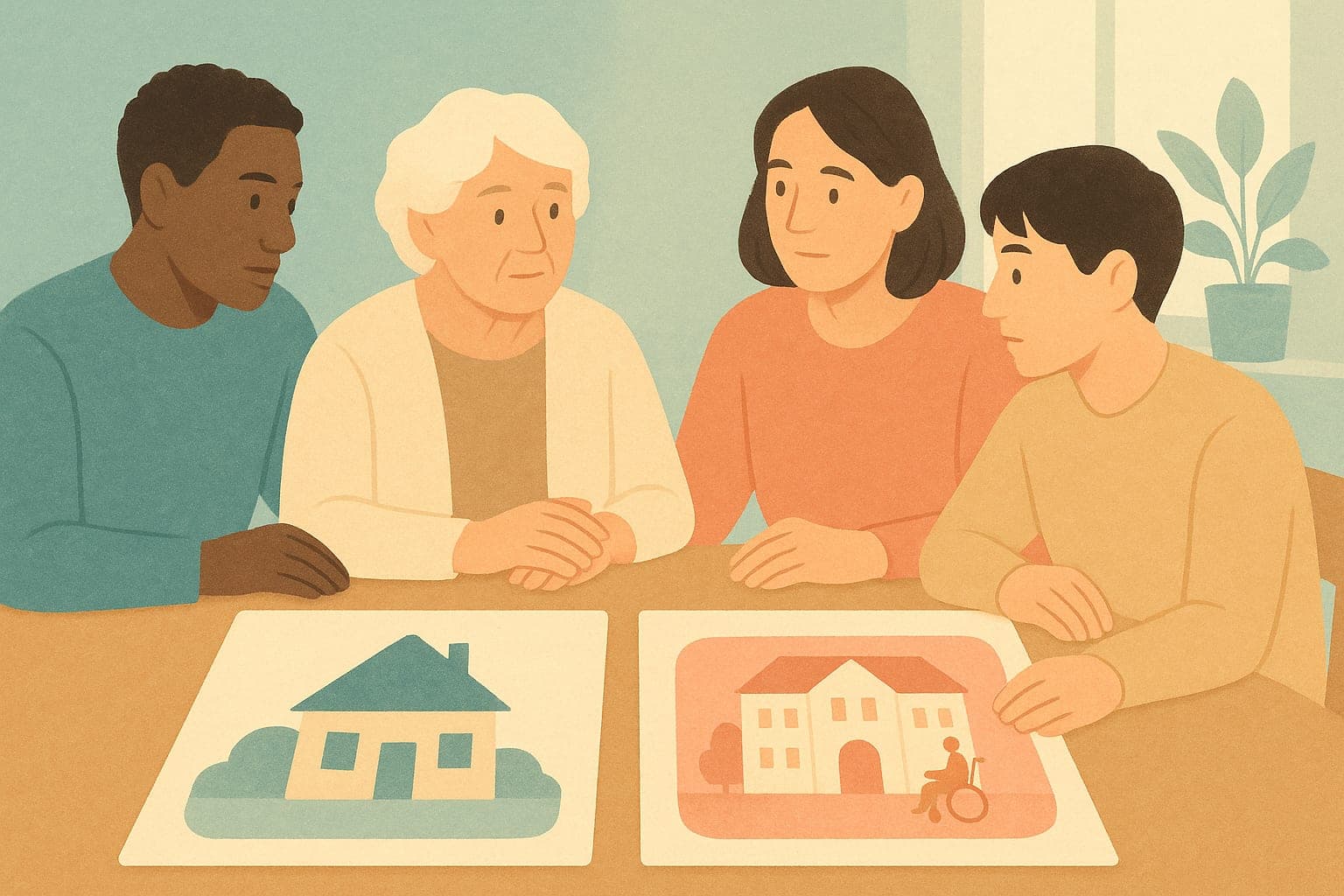
In-home care brings help to your loved one's own home — from a few hours a week to around-the-clock. Assisted living adds housing, meals, and daily help in a community. A skilled nursing home adds 24-hour medical and nursing care. The right choice depends on their health needs, safety, budget, and wishes.
Key points
- In-home care keeps a person in their own home; assisted living adds housing and community; a nursing home adds round-the-clock skilled medical care. Match the setting to the level of need.
- Medicare does NOT pay for long-term custodial care in any setting — not ongoing help at home, not assisted living room and board, and not a long nursing home stay. It only covers short-term skilled home health and short-term skilled or rehab nursing.
- In California, Medi-Cal is the main payer for long-term nursing home care, and as of January 1, 2024 the asset limit was removed — though income and 'share of cost' rules still apply.
- IHSS (In-Home Supportive Services) can pay a caregiver, often a family member, to help an eligible low-income person stay safely at home.
- Around-the-clock in-home care can cost as much as or more than a facility — compare the total monthly cost, not just the hourly rate.
- Care needs change. Pick a setting that can flex, and reassess after any hospital stay, fall, or dementia progression.
What are in-home care, assisted living, and a nursing home?
When someone you love needs more help than family can manage alone, the choices usually come down to three: bring care to them at home, move them to an assisted living community, or move them to a skilled nursing home. They can sound similar, but they differ a great deal in what they provide, who they suit, and how they are paid for.
Here is the difference between the three.
- In-home care: Help comes to the person in their own home, ranging from a few hours a week up to around-the-clock support. It splits into two kinds — non-medical personal care (bathing, dressing, meals, errands, medication reminders, companionship, supervision) and skilled home health (a nurse or therapist, ordered by a doctor, usually short-term).
- Assisted living: A residential community — in California, licensed as a Residential Care Facility for the Elderly (RCFE) — that provides a room or apartment, meals, housekeeping, activities, and staff who help with daily tasks and medications. It is not a medical facility; there is no nurse on duty around the clock. Options run from small six-bed 'board and care' homes to large communities, and many offer a secured 'memory care' area for dementia.
- Skilled nursing home: A licensed medical facility (often called a nursing home or SNF) with nurses on duty 24 hours a day. It serves people who need constant nursing or medical care, very heavy help with everyday activities, or short-term rehabilitation after a hospital stay.
Which level of care fits your loved one?
The right setting depends less on age and more on three things: how much help they need with everyday activities, how much medical or nursing care they need, and whether they can be kept safe where they are now.
A helpful rule of thumb is to choose the least restrictive setting that still keeps them safe. Most people prefer to stay in their own home as long as that is realistic — but 'safe' has to come first.
- In-home care usually fits when they want to stay in their own home, the home can be made safe, they need help with some daily tasks but not constant medical care, and family or paid caregivers can cover the hours needed.
- Assisted living usually fits when living alone has become unsafe or isolating (missed meals, missed medications, falls, loneliness), they need daily help and supervision but not 24-hour nursing, and they would benefit from meals, activities, and people nearby.
- A skilled nursing home is usually needed when they require skilled nursing or medical care around the clock (wound care, feeding tubes, IVs, complex conditions), need heavy hands-on care that assisted living cannot safely provide, or need short-term rehab after a hospital stay before going home.
What does each option cost in California?
Cost is often the deciding factor, so it helps to compare honestly. The ranges below are approximate for Southern California — actual prices vary widely by city and by how much care a person needs. For current figures in your own county, look up the CareScout (formerly Genworth) Cost of Care Survey.
Notice the pattern: a little help at home is the cheapest path, but once you need overnight coverage, hourly care adds up fast. That is why many families who start with in-home care eventually weigh it against assisted living — not because home is worse, but because the math changes.
- In-home care: roughly $35–$45 an hour for a non-medical caregiver in Southern California. A few hours a day is the most affordable option — but 24-hour or live-in care can run $15,000–$25,000+ a month, often more than a facility.
- Assisted living: commonly around $5,000–$7,000+ a month for room, board, and daily help; memory care and higher care levels cost more. Small board-and-care homes vary and can sometimes be more affordable.
- Skilled nursing home: often $10,000–$15,000+ a month for a shared room in California, and more for a private room, because you are paying for 24-hour licensed nursing.
Who pays — Medicare, Medi-Cal, IHSS, or private funds?
There is no single program that covers everything, and the biggest misunderstanding is about Medicare. Medicare is health insurance — it does not pay for long-term custodial care (help with everyday living) in any setting. Here is who typically pays for what.
In-home care: Medicare covers short-term skilled home health (nursing or therapy) when a doctor orders it, the person is homebound, and the care comes from a Medicare-certified agency — but not ongoing personal care by itself. For non-medical help, families usually pay privately or, if income-eligible, use California's In-Home Supportive Services (IHSS), which pays a caregiver — often a family member — through Medi-Cal so someone can stay safely at home. Long-term care insurance and VA benefits can also help.
Assisted living: This is mostly private pay. Medicare does not cover the room-and-board cost. Medi-Cal's Assisted Living Waiver can cover care services (not room and board) in participating facilities in 15 counties, including several in Southern California — but spots are limited and waitlists are common. Low-income residents may also get help through SSI/SSP toward a licensed board-and-care home, and VA Aid and Attendance or long-term care insurance can offset costs.
Skilled nursing home: Medicare covers a short skilled or rehab stay — up to 100 days per benefit period after a qualifying 3-day inpatient hospital stay, with no daily charge for days 1–20 and a daily coinsurance (about $217 a day in 2026) for days 21–100. It does not cover a long custodial stay. For long-term nursing home care, Medi-Cal is the main payer in California. As of January 1, 2024, California removed the Medi-Cal asset limit, so savings and property no longer count against eligibility — though income and 'share of cost' rules still apply. Check medicare.gov for current dollar amounts.
How do you choose the right option — and check quality?
Start with the person's needs, not the brochure. A good sequence is: (1) get an honest assessment of what help they actually need, (2) match that to the lowest level of care that keeps them safe, (3) compare the total monthly cost across options, and (4) weigh their own wishes — most people want to stay home as long as it is safe.
You do not have to figure this out alone. A hospital discharge planner, their doctor, or a geriatric care manager can assess needs. Your local Area Agency on Aging (find it through the Eldercare Locator) offers free guidance, and California's HICAP program gives free, unbiased Medicare and long-term care counseling.
Before you commit, check quality — the difference between facilities is real.
- Home health agencies and nursing homes: compare star ratings and inspection results on Medicare's Care Compare.
- Assisted living and board-and-care homes (RCFEs): review the facility's inspection and complaint history through California's Community Care Licensing, and visit in person at different times of day.
- Ask hard questions: What is the staff-to-resident ratio? What care levels can you handle, and what would trigger a move-out? What are the extra fees? Is a nurse ever on site?
- If you ever have concerns about care in a facility, contact the local Long-Term Care Ombudsman.
What happens when care needs change?
Whatever you choose now is not forever. Needs change — a fall, a stroke, or dementia that progresses can all shift the right setting. Build in flexibility where you can: some communities offer both assisted living and memory care, so a move is down the hall rather than across town, and in-home care can scale up hours as needs grow — until the point where 24/7 coverage costs more than a facility.
Reassess after any hospital stay, a new diagnosis, repeated falls, or when a caregiver is burning out. Planning the next step before a crisis — instead of during one — gives you better choices and far less stress. Put the legal pieces in place early too (an advance directive and power of attorney) so the right person can act when decisions are needed.
This guide is educational and not medical, legal, or financial advice. For a life-threatening emergency, call 911.
Frequently asked questions
Does Medicare pay for assisted living or a nursing home?
Medicare does not pay the room-and-board cost of assisted living, and it does not pay for a long-term (custodial) nursing home stay. It does cover a short skilled or rehab stay in a nursing facility — up to 100 days per benefit period after a qualifying 3-day inpatient hospital stay, with no daily charge for days 1–20 and a daily coinsurance for days 21–100. For a long stay, families usually rely on private funds, long-term care insurance, or Medi-Cal.
What's the difference between assisted living and a nursing home?
Assisted living (licensed in California as a Residential Care Facility for the Elderly) helps with daily activities like bathing, dressing, meals, and medications in a home-like community — but it is not a medical facility and has no 24-hour nurse. A skilled nursing home provides round-the-clock licensed nursing and medical care for people with serious health needs or very heavy care needs. If your loved one needs constant nursing, assisted living usually cannot keep them.
Is in-home care cheaper than assisted living?
It depends on how many hours you need. A few hours of help a day is usually cheaper than assisted living. But once you need overnight or around-the-clock coverage, in-home care often costs as much as — or more than — assisted living or even a nursing home, because you are paying by the hour for one-on-one care. Compare the total monthly cost, not just the hourly rate.
What is a 'board and care' home in California?
A board and care home is a small assisted living residence — typically six or fewer residents in a converted house — licensed as a Residential Care Facility for the Elderly (RCFE). These homes offer meals, personal care, and supervision in a quieter, more homelike setting, and are often more affordable than large communities. Memory care versions exist for people with dementia.
Can Medi-Cal help pay for care at home or in assisted living?
Yes, in limited ways. IHSS pays a caregiver to help an eligible low-income person with personal care at home. Medi-Cal's Assisted Living Waiver can cover care services (not room and board) in participating facilities in 15 counties, including several in Southern California — but spots are limited and there are waitlists. In assisted living, the resident still pays room and board, often from SSI.
Need care at home? We will connect you.
Skilled nursing, therapy, personal care, and recovery help — right at home, from trusted local providers. Tell us what you need and we will take it from there. Free, no obligation.
Get home-health careSources
- Medicare — Home health services coverage
- Medicare — Skilled nursing facility care coverage
- Medicare — Care Compare (find & compare agencies and nursing homes)
- Eldercare Locator (Administration for Community Living)
- CareScout Cost of Care Survey (formerly Genworth)
- California DHCS — Assisted Living Waiver
- California CDSS — In-Home Supportive Services (IHSS)
Related guides
This guide is educational and is not medical advice. In an emergency, call 911.