
Veterans
VA Home Modification Grants: HISA, SAH, SHA and TRA
Last reviewed August 3, 2026
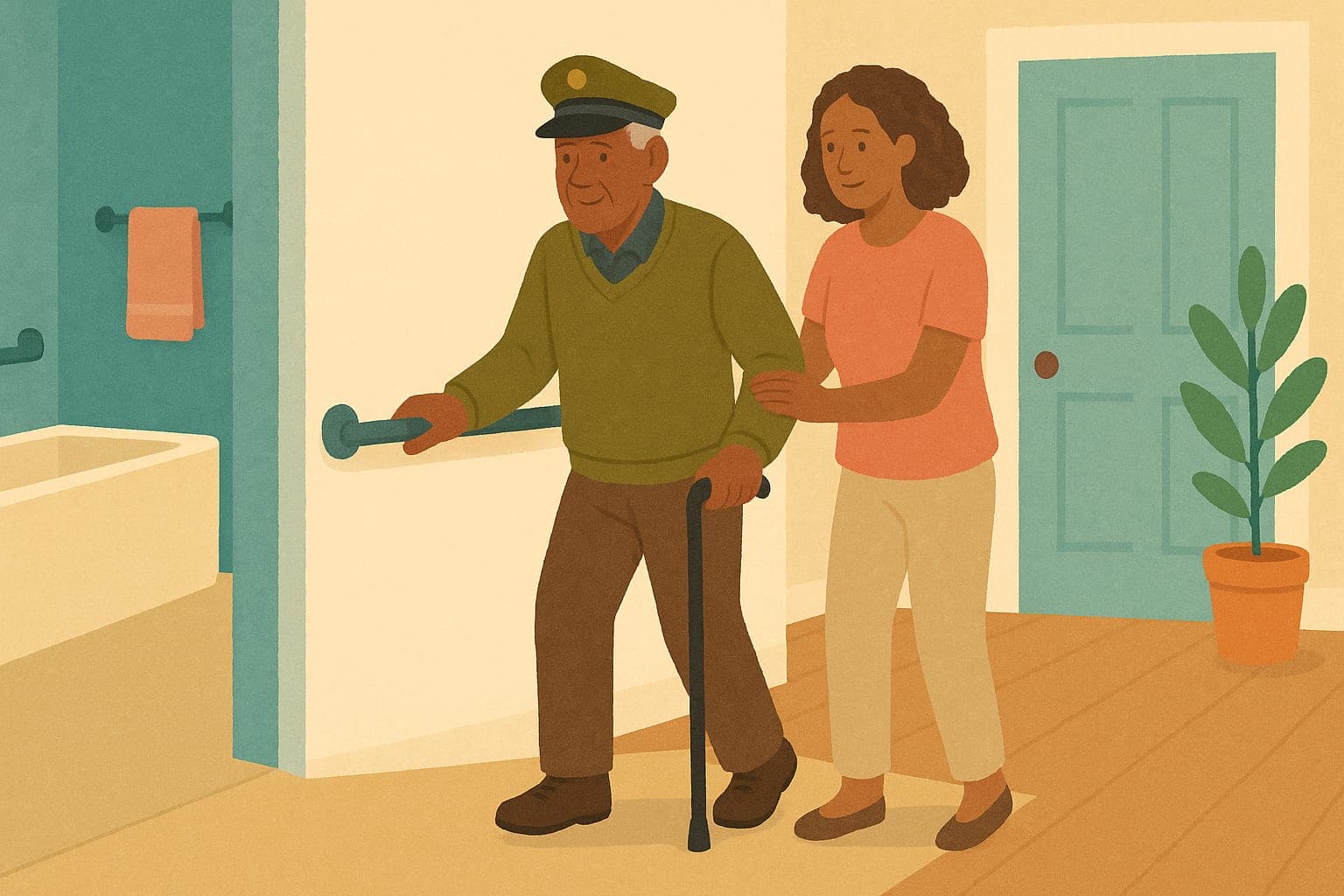
The VA has several separate grants that pay to make a veteran's home safer and easier to move around in. HISA, run by VA health care, is a lifetime benefit of up to $6,800 or $2,000 depending on the disability, and it covers things like roll-in showers, permanent ramps and wider doorways. SAH and SHA are much larger housing grants for veterans with certain severe service-connected disabilities. Medicare does not pay for permanent home modifications, so these grants often fill a real gap.
Key points
- HISA is the grant most home-care families will actually use: a lifetime benefit of up to $6,800 for service-connected conditions, or for a non-service-connected condition when the veteran is rated at least 50 percent service-connected, and up to $2,000 otherwise, under 38 CFR 17.3105. These amounts are set by regulation and do not change every December.
- HISA can work in a rented home with the property owner's notarized written permission. SAH and SHA require that the veteran, or a family member in the case of SHA, owns or will own the home.
- For fiscal year 2026, effective October 1, 2025 and running through September 30, 2026, VA published maximums of $126,526 for SAH and $25,349 for SHA, plus TRA maximums of $50,961 and $9,099. VA's website rounds SHA to $25,350 and the SHA-category TRA to $9,100. These adjust on October 1 each year, not December 1 — confirm the current amount with VA.
- Original Medicare does not pay for permanent home modifications. Federal rules at 42 CFR 414.202 define covered durable medical equipment as items that withstand repeated use and serve a medical purpose, which excludes permanent changes to the house itself. Some Medicare Advantage plans offer home safety items as an extra benefit — check the specific plan's Evidence of Coverage.
- HISA starts with a VA or fee-basis physician's prescription that includes the specific items, the diagnosis and the medical justification, not with a form mailed to a regional office. An occupational therapist's home safety evaluation makes that justification much stronger, and VA offers occupational therapy in the home and by tele-rehabilitation.
- Help filing is free. VA states that accredited VSO representative services on benefit claims are always free, and 38 CFR 14.636 bars recognized organizations and their accredited representatives from receiving fees. Be cautious about paying anyone to prepare a claim before VA has issued a decision.
- Ask VA for your remaining lifetime HISA balance before you collect contractor bids. The regulation says HISA benefits approved for a project but unused remain available for future use, so it is a lifetime pot you can spend in pieces.
- Nothing here is an eligibility decision. VA alone decides who qualifies, and the statutory criteria are more detailed than any plain-language list. This guide is not affiliated with or endorsed by the VA.
What do most veteran families miss?
These are the easy-to-miss angles — the early-eligibility rules and quiet ways veteran families leave help on the table. Each one is explained in full below.
- HISA does not require home ownership. A veteran living in a rented apartment or in an adult child's house may still be able to get bathroom and entry modifications paid for, as long as the owner signs a notarized permission letter. Families who assume they must own the home skip this entirely.
- The $2,000 tier is for non-service-connected conditions. You do not need a service-connected rating to be considered for the smaller HISA amount — you need to be a veteran eligible for VA medical services under 38 U.S.C. 1710(a). Plenty of older veterans with age-related mobility loss never apply because they assume it is only for combat injuries. Ask VA whether you qualify for that care eligibility.
- If a service-connected rating later reaches 50 percent, the HISA lifetime limit can move from $2,000 up to $6,800, minus what was already used — the regulation lets you apply for the increase. Nobody at VA calls to tell you this. Ask after any rating increase.
- HISA covers plumbing and electrical upgrades made necessary by installing medical equipment at home — VA names dialysis specifically. Families arranging for equipment rarely think to ask VA to pay for the wiring or plumbing it needs.
- VA states SAH and SHA money can be used up to six separate times over a lifetime, within the total cap. Veterans who did one project decades ago often still have entitlement left.
- SAH, SHA and TRA maximums reset October 1, not December 1. If a project is being planned in late summer and you are near the cap, ask whether waiting for the new fiscal year figure makes sense.
- Temporary Residence Adaptation exists specifically for a veteran living in a family member's home. This is exactly the multigenerational-household situation common across Southern California, and it is the least-known of the four grants. Ask VA first how it affects future SAH or SHA entitlement.
- Veteran Readiness and Employment's Independent Living track (VA Form 28-1900) can include home adaptations and guidance on VA's adaptive-housing programs. It is a completely separate door that most families have never heard of.
- Ask for a VA occupational therapy home safety evaluation before applying — VA delivers occupational therapy in veterans' homes and through tele-rehabilitation. The OT's specific findings are what turn a vague request into a well-documented prescription.
- Call your VA Prosthetic and Sensory Aids Service and ask for your exact remaining HISA balance in writing before you ask contractors for bids. Bidding a project larger than your remaining benefit wastes weeks.
- VA's printed HISA brochure still shows the old $4,100 and $1,200 limits. If a contractor or a well-meaning relative quotes those numbers at you, point them to 38 CFR 17.3105 and VA's current HISA page.
- Everything in a VA claim can be done with free help. A County Veterans Service Officer costs nothing, and 38 CFR 14.636 bars accredited VSO representatives from charging you. Check anyone who asks for money against VA's accredited representative search first.
What are the VA's home modification grants, and which one fits my family?
The VA does not have one home modification program. It has several, run by different parts of the VA, with very different dollar amounts and very different eligibility rules. Families often hear about only one of them and assume that is all there is.
The Home Improvements and Structural Alterations grant, usually called HISA, is run by the Veterans Health Administration through your local VA medical center's Prosthetic and Sensory Aids Service. It is the smaller, more widely available grant, and it is the one most older veterans getting care at home end up using.
Specially Adapted Housing (SAH) and Special Home Adaptation (SHA) are run by the Veterans Benefits Administration on the housing side. They are far larger, but they are limited to veterans with certain severe service-connected disabilities. Temporary Residence Adaptation (TRA) is a related option for a veteran who is living temporarily in a family member's home. There is also a fourth, quieter door: the Veteran Readiness and Employment Independent Living track, which can include housing adaptations.
One naming note that trips people up in searches: VA's current website calls the second grant Special Home Adaptation, while some older VA fact sheets call the same program Special Housing Adaptation. Both mean SHA.
These programs are not necessarily either-or. VA's own HISA brochure states that a veteran may receive both a HISA grant and either a Special Home Adaptation grant or a Specially Adapted Housing grant. Ask your VA prosthetics office and, if you are applying for SAH or SHA, your assigned VA representative how the pieces fit together in your situation. A free accredited Veterans Service Organization representative can help you sort this out at no cost.
This guide is written by a home care education team. It is not produced by, affiliated with, or endorsed by the U.S. Department of Veterans Affairs. Only VA can decide eligibility or approve a grant.
- HISA — VA health care side, lifetime benefit, home you own or rent, medically prescribed changes
- SAH — large housing grant, certain severe service-connected disabilities, home you own or will own
- SHA — smaller housing grant, other specified severe service-connected disabilities
- TRA — for adapting a family member's home you are living in temporarily
- VR&E Independent Living — separate track that can include home adaptations (VA Form 28-1900)
What does the HISA grant pay for, and what will it not cover?
HISA pays for medically necessary improvements and structural alterations to a veteran's or service member's primary residence. VA describes the purpose as allowing a person to get in and out of the home, to use essential lavatory and sanitary facilities, and to reach kitchen or bathroom sinks and counters.
In plain terms, this is the money that turns a step-over bathtub into a roll-in shower, builds a permanent wooden or concrete ramp to the front door, widens a bedroom or bathroom doorway for a wheelchair, lowers a sink or counter, and upgrades plumbing or electrical work when medical equipment such as home dialysis is being installed. VA also lists improving entrance paths or driveways in the immediate area of the home.
There is a real list of things HISA will not pay for, and knowing it up front saves families a wasted application. VA's Prosthetic and Sensory Aids Service materials exclude exterior decking, spas, hot tubs and Jacuzzi-type tubs, home security systems, walkways to exterior buildings, new construction, routine home maintenance such as a new roof or furnace, and — this one surprises people — removable equipment or appliances such as portable ramps, porch lifts and stair glides.
Local VA medical centers can apply these rules with some variation, and older VA brochures include size caps on items such as driveway widening and decking. Before you commit to a design, ask your local Prosthetic and Sensory Aids Service to confirm in writing that the specific work you are planning is covered.
- Covered: roll-in or walk-in showers and accessible bathroom fixtures
- Covered: permanent wooden or concrete ramps to the home
- Covered: widening doorways to bedrooms and bathrooms
- Covered: lowering kitchen or bathroom counters and sinks
- Covered: improving entrance paths or driveways in the immediate area of the home
- Covered: plumbing or electrical upgrades needed to install medical equipment, such as home dialysis
- Not covered: exterior decking, spas or hot tubs, home security systems
- Not covered: stair glides, porch lifts, portable ramps and other removable equipment
- Not covered: walkways to exterior buildings, new construction, routine repairs such as roof or furnace replacement
How much is the HISA grant, and who gets the higher amount?
HISA is a lifetime benefit with two tiers, and the amounts are written into federal regulation at 38 CFR 17.3105 rather than being adjusted every year. That is why they do not move with the December 1 cost-of-living increase.
For a veteran who first applies on or after May 5, 2010, the lifetime HISA limit is $6,800 if the request addresses a service-connected disability, a compensable disability treated as if it were service-connected, or a non-service-connected disability when the veteran already has a service-connected disability rated at least 50 percent disabling. For other eligible veterans, the lifetime limit is $2,000. The same $6,800 and $2,000 tiers apply to eligible service members.
Veterans who first applied before May 5, 2010 are held to the older limits of $4,100 and $1,200 respectively. Note that VA's printed HISA brochure still shows those older $4,100 and $1,200 figures, so do not be alarmed if you see them — the current regulation and VA's HISA web page both show $6,800 and $2,000.
We confirmed these figures against 38 CFR 17.3105 and VA's HISA page in August 2026. Because regulations can change, confirm the current amount with your VA prosthetics office before you sign a contract.
Two practical points. First, this is a lifetime pot you can spend in pieces. The regulation says HISA benefits approved by VA for a particular home alteration but unused by the beneficiary remain available for future use. Second, the regulation allows a veteran who moves from the lower benefit category into the higher one to apply for the increased lifetime amount, reduced by whatever HISA money was already used. If your service-connected rating has gone up since your last project, ask about this.
How do I apply for a HISA grant through VA prosthetics?
HISA is a medical benefit, so it starts with a VA clinician, not with a form you mail to a regional office. The application package must include a prescription from a VA or fee-basis physician that names the veteran, describes the specific items required, and gives the diagnosis with medical justification for the prescribed improvement.
That medical justification matters more than anything else in the file. VA's own guidance ties approval to medical justification for the service-connected or non-service-connected disability. A vague note saying the veteran has trouble bathing is weaker than a note that explains the fall risk, the transfer limitation and why a roll-in shower is the appropriate answer.
Under 38 CFR 17.3102, HISA benefits are available to a veteran who is eligible for medical services under 38 U.S.C. 1710(a), and to a service member undergoing medical discharge from the Armed Forces for a permanent disability incurred or aggravated in the line of duty. In practice that means being connected to VA health care. VA decides eligibility case by case — nothing here guarantees approval.
At many VA medical centers the process now begins when your provider places a HISA consult, and you receive a form asking you to upload photos of the area of the home you want altered. Ask your local Prosthetic and Sensory Aids Service how their process works and what your remaining lifetime HISA balance is before you start collecting bids.
You never have to pay anyone to help with this. A County Veterans Service Officer or an accredited VSO representative can help you at no cost.
- Talk to your VA primary care provider, physical therapist or occupational therapist about the safety problem at home
- Ask for a HISA consult and a written prescription with the specific items, the diagnosis and the medical justification
- Complete VA Form 10-0103, Veterans Application for Assistance in Acquiring Home Improvements and Structural Alterations
- If you rent, get signed and notarized written permission from the property owner
- Gather itemized cost estimates for materials, labor, permits and inspections — VA materials ask for quotes from up to three licensed contractors where state law requires licensing, with contractor name, address and phone
- Take clear color photos of the unimproved area before any work begins
- Submit the package to your local VA Prosthetic and Sensory Aids Service and ask them to confirm your remaining lifetime balance in writing
- Ask a free County Veterans Service Officer or accredited VSO representative to review the package before you send it
What are the SAH and SHA grants, and how much are they for fiscal year 2026?
SAH and SHA are the big housing grants. They exist so that veterans with certain severe service-connected disabilities can live in a barrier-free home — building one, remodeling one, buying one already adapted, or applying the money against the mortgage on an adapted home.
For fiscal year 2026, VA published maximum aggregate amounts of $126,526 for SAH and $25,349 for SHA. Those figures took effect October 1, 2025 and reflect a 3.87 percent increase. VA's own web page rounds the SHA figure to $25,350. If you are planning right up against the cap, confirm the exact number with VA.
These are fiscal year 2026 figures, in effect through September 30, 2026. They do not follow the December 1 cost-of-living increase that changes disability compensation and pension. Congress allows VA to adjust SAH grant amounts each year based on a residential cost-of-construction index, and the change takes effect October 1, at the start of the federal fiscal year. If you are reading this on or after October 1, 2026, new figures will have been published — always confirm the current amount with VA before budgeting.
One rule families routinely get wrong: VA states that if you are eligible for an SAH or SHA grant, you can use money from your grant up to six different times over your lifetime, within the maximum aggregate amount. It is not necessarily a single one-shot payment.
The lists below are VA's plain-language summary of who may qualify. The actual criteria live in 38 U.S.C. 2101 and are more detailed than any summary, and VA — not a website — makes the determination. Do not rule your family out based on a bullet list. Apply, and let a free accredited VSO representative help you.
- SAH (you must own or will own the home) — VA lists: loss, or loss of use, of more than one limb; loss, or loss of use, of a lower leg along with the residuals of an organic disease or injury; blindness in both eyes with 20/200 visual acuity or less; certain severe burns
- SAH also covers loss, or loss of use, of one lower extremity after September 11, 2001 that makes it so you cannot balance or walk without braces, crutches, canes or a wheelchair — but VA states only 120 veterans and service members each fiscal year can qualify on this basis, as set by Congress
- SHA (you or a family member must own or will own the home) — VA lists: loss or loss of use of both hands; certain severe burns; certain respiratory or breathing injuries
- Apply with VA Form 26-4555, online at VA.gov, by mail to Department of Veterans Affairs, Claims Intake Center, PO Box 4444, Janesville, WI 53547-4444, or in person at a VA regional office
- To have a claim form mailed to you, VA lists 800-827-1000. Free help with the application is available from a County Veterans Service Officer or accredited VSO representative
What is the Temporary Residence Adaptation (TRA) grant?
TRA is for a veteran or service member who qualifies for SAH or SHA but is living temporarily in a home owned by a family member — often an adult child's house after a hospital stay or during recovery.
For fiscal year 2026, VA published a maximum TRA amount of $50,961 for someone eligible under the SAH criteria and $9,099 for someone eligible under the SHA criteria, both effective October 1, 2025. VA's website rounds the second figure to $9,100. Like the SAH and SHA maximums, these are fiscal year figures that can change each October 1 — confirm the current amount with VA.
TRA lets the family member's home be adapted so the veteran can actually live there safely, rather than forcing a choice between an unsafe house and a facility. Because TRA is charged against your SAH or SHA entitlement, ask VA directly how using TRA now would affect a future SAH or SHA grant before you commit, and get the answer in writing if you can.
Does Medicare pay for home modifications, and what about California programs?
No, Original Medicare does not pay for permanent home modifications. This is the single biggest misunderstanding families bring to us. Medicare Part B pays for durable medical equipment, and the federal definition of durable medical equipment at 42 CFR 414.202 is narrow: it must withstand repeated use, have an expected life of at least three years for items classified as DME after January 1, 2012, be primarily and customarily used to serve a medical purpose, generally not be useful to someone in the absence of an illness or injury, and be appropriate for use in the home. A walker or a wheelchair fits that definition. A tiled roll-in shower, a widened doorway or a poured concrete ramp does not — those are part of the house, not equipment.
Medicare Advantage plans are a different story. Federal rules let these plans offer supplemental benefits, including special supplemental benefits for the chronically ill that need not be primarily health related, as long as they can reasonably be expected to improve or maintain the enrollee's health or overall function. Some plans have used that flexibility to offer home safety items such as grab bars or bathroom safety devices. This varies enormously by plan, county and year. If your loved one is in an Advantage plan, call the plan directly and ask what the Evidence of Coverage actually says. Do not assume.
California does not have a single statewide grant that pays for home modifications. The California Department of Aging points people toward their local Area Agency on Aging, which it says may also be able to refer families to non-profit groups in the area, and it names Rebuilding Together as one nonprofit that helps older adults make relatively simple home modifications using trained volunteers. Many Southern California cities and counties also run their own housing rehabilitation or minor home repair programs using federal housing block grant money — the amounts and rules are set locally, so ask your city's housing department.
For a veteran, this is exactly why HISA is worth pursuing. It is often the only program that will actually write a check for structural work.
How does an occupational therapist's home assessment support the application?
An occupational therapist is trained to look at a home the way your loved one's body has to move through it, and that is precisely the evidence a HISA prescription needs. VA lists home safety and accessibility, and productive aging and aging in place, among the areas its occupational therapists work in, and VA occupational therapy services are provided in outpatient clinics, inpatient settings, Community Living Centers, veterans' homes and communities, and through tele-rehabilitation.
VA has also expanded telehealth occupational therapy, so a therapist can observe a veteran moving through their own home by video — which matters a great deal if getting to the medical center is difficult. Ask your VA team whether a home safety evaluation, in person or by video, is available before you apply.
A good OT assessment turns a general request into a specific, defensible one. Instead of asking for a bathroom remodel, the record shows that the veteran cannot step over a high tub wall, has fallen twice transferring, and needs a zero-threshold shower with a fold-down seat and grab bars at a specified height. That is the kind of medical justification a HISA reviewer can act on.
The same assessment also helps you spend the grant well. HISA has a hard lifetime cap, so an OT's judgment about what actually needs to change — and what does not — protects money you may need for a different room in three years.
Who can help me apply for free, and who should I be careful about paying?
Help with VA claims is free, and you should almost never pay for it. VA states plainly that the services an accredited VSO representative provides on your VA benefit claims are always free. County Veterans Service Officers, VSO representatives from organizations like DAV, VFW, Paralyzed Veterans of America and the American Legion, and VA's own staff can all help you at no cost.
Federal regulation backs this up. Under 38 CFR 14.636, recognized organizations, including their accredited representatives when acting as such, are not permitted to receive fees. Accredited attorneys and claims agents may charge fees, but generally only for representation provided after an agency of original jurisdiction has issued notice of an initial decision on the claim — not for helping you file it in the first place.
So be cautious with any business that offers, for a percentage or an up-front fee, to prepare or file a VA claim for you before there is a decision. Ask whether they are VA-accredited, and check for yourself using VA's accredited representative search. If someone pressures you, asks for a share of your back pay, or discourages you from talking to a County Veterans Service Officer, walk away.
For HISA specifically, the person who can move things fastest is usually not a lawyer at all — it is your VA prosthetics office and the clinician who writes the prescription. Start there.
- Free help: your County Veterans Service Officer (every California county has one)
- Free help: accredited VSO representatives — DAV, VFW, Paralyzed Veterans of America, American Legion and others
- Free help: your VA medical center's Prosthetic and Sensory Aids Service, for HISA questions and your remaining balance
- Verify anyone before paying: use VA's accredited representative search at va.gov
- Red flags: up-front fees to file a claim, a cut of your back pay, pressure to sign quickly, or discouraging you from using a free VSO
Frequently asked questions
Can I get a HISA grant if my parent rents instead of owning the home?
Yes, home ownership is not a HISA requirement the way it is for the SAH and SHA grants. If the property is leased or rented, VA's HISA materials say the application package must include written permission from the property owner, and VA's HISA page describes this as notarized owner authorization. This is one of the most useful differences between HISA and the larger housing grants, and many renting families never find out about it. Ask your local VA Prosthetic and Sensory Aids Service exactly what form the permission letter needs to take.
Do the HISA amounts go up every December like VA disability compensation?
No. The $6,800 and $2,000 lifetime limits are set in federal regulation at 38 CFR 17.3105 and apply to applications filed on or after May 5, 2010. They do not follow the December 1 cost-of-living adjustment. The SAH, SHA and TRA grant maximums are different — those can be adjusted each year based on a residential construction cost index, effective October 1. Always confirm the current figure with VA before budgeting.
My father used part of his HISA years ago and his rating has since gone to 70 percent. Can he get more?
Possibly. The regulation allows a veteran who was in the lower benefit category and later qualifies for the higher one to apply for the increased lifetime benefit amount, reduced by the amount of HISA benefits already used. It is VA's decision, not automatic. Ask your VA Prosthetic and Sensory Aids Service to look up exactly how much of the lifetime benefit remains before you get contractor estimates.
Will HISA pay for a stair lift so my mother can get to her upstairs bedroom?
VA's Prosthetic and Sensory Aids Service materials exclude removable equipment and appliances such as stair glides, porch lifts and portable ramps from HISA. Permanent wooden or concrete ramping is listed as covered, but a stair lift is not. If a stair lift is what the situation calls for, ask your VA team about other options and talk to your local Area Agency on Aging about community or nonprofit programs.
Do we have to be enrolled in VA health care to get HISA?
In practice, yes. Under 38 CFR 17.3102, HISA is available to a veteran who is eligible for medical services under 38 U.S.C. 1710(a), and to a service member undergoing medical discharge for a permanent line-of-duty disability. The prescription has to come from a VA or fee-basis physician, so you need to be connected to VA health care. If your loved one is not enrolled, that is the first step, and a free accredited VSO representative can help with enrollment.
Can a veteran receive both a HISA grant and an SAH or SHA grant?
VA's HISA brochure states that a veteran may receive both a HISA grant and either a Special Home Adaptation grant or a Specially Adapted Housing grant. They are administered by different parts of VA, so no one office automatically coordinates them. Ask your prosthetics office and your VA housing grant representative how they would work together in your case, and get the answer in writing if you can.
How many times can an SAH or SHA grant be used?
VA states that if you are eligible for an SAH or SHA grant, you can use money from your grant up to six different times over your lifetime, within the maximum aggregate amount for that fiscal year. Many families assume it is a one-time payment and never come back after a first project, leaving entitlement unclaimed.
Are the fiscal year 2026 SAH and SHA numbers still current?
They are current for federal fiscal year 2026, which runs October 1, 2025 through September 30, 2026. VA published maximums of $126,526 for SAH and $25,349 for SHA for FY 2026, a 3.87 percent increase effective October 1, 2025. New figures are published for each fiscal year and take effect October 1, so if you are reading this after September 30, 2026, confirm the current amount with VA or a free accredited VSO representative before you plan around it.
Need care at home? We will connect you.
Skilled nursing, therapy, personal care, and recovery help — right at home, from trusted local providers. Tell us what you need and we will take it from there. Free, no obligation.
Get home-health careSources
- VA — Disability housing grants for Veterans (SAH, SHA, TRA amounts and eligibility, FY 2026; page last updated Nov. 18, 2025)
- VA — How to apply for an adapted housing grant (VA Form 26-4555, Claims Intake Center mailing address)
- VA — Apply for a housing grant online (VA Form 26-4555)
- Federal Register — Loan Guaranty: Specially Adapted Housing Cost-of-Construction Index for Fiscal Year 2026 (90 FR 51820, Nov. 18, 2025)
- govinfo — Full text of the FY 2026 SAH cost-of-construction notice (90 FR 51820)
- VA Prosthetic and Sensory Aids Service — Home Improvements and Structural Alterations (HISA)
- VA — Housing Adaptation Programs fact sheet (HISA amounts, inclusions and exclusions, SAH/SHA/TRA, VR&E Independent Living), August 2019
- VA — HISA brochure (application requirements; note: the dollar figures in this brochure are the pre-2010 $4,100 / $1,200 amounts and are out of date)
- VA Fayetteville Coastal Health Care — Home Improvements/Structural Alterations (HISA) program page (consult and photo-upload process)
- 38 CFR 17.3105 — HISA benefit lifetime limits (Cornell LII)
- 38 CFR 17.3102 — Eligibility for HISA benefits (Cornell LII)
- VA — About VA Form 10-0103 (Veterans Application for Assistance in Acquiring Home Improvements and Structural Alterations)
- VA — Veteran Readiness and Employment: Independent Living track (VA Form 28-1900)
- VA — Get help from an accredited representative (VSO services are always free)
- VA — Find a VA accredited representative or VSO
- 38 CFR 14.636 — Payment of fees for representation by agents and attorneys (Cornell LII)
- 42 CFR 414.202 — Medicare definition of durable medical equipment (Cornell LII)
- 42 CFR 422.102(f) — Medicare Advantage special supplemental benefits for the chronically ill (Cornell LII)
- Medicare.gov — Durable medical equipment (DME) coverage
- VA Rehabilitation and Prosthetic Services — Occupational Therapy (settings, home safety and accessibility, tele-rehabilitation)
- VA News — Integrated TeleOT provides virtual occupational therapy (March 26, 2024)
- California Department of Aging — Make Home Modifications So I Can Safely Stay in My Own Home (Area Agency on Aging referrals, Rebuilding Together)
- VA — Housing assistance overview (lists 800-827-1000 to have a claim form mailed)
- VA News — VA's Specially Adapted Housing (SAH) Program helps disabled Veterans (July 3, 2025)
Related guides
- VA Aid and Attendance: Extra Monthly Money for Veterans and Spouses Who Need Help at Home
- VA Health Care for Older Veterans: Who Qualifies and How to Enroll
- VA Caregiver Support: The PCAFC Stipend and Free PGCSS Help, Explained
- VA Homemaker and Home Health Aide (H/HHA) Care: How a Veteran Gets an Aide at Home
- The VA Housebound Benefit: What It Pays, and Why You Cannot Get It With Aid and Attendance
- Home Modifications for Aging in Place: A Caregiver's Guide
- Property Tax and Housing Help for Older Californians
- Using VA Benefits and Medicare Together for Care at Home
- Avoiding Home-Care Fraud and Scams: A Caregiver's Guide
- Where to Start: California Aging & Disability Help
This guide is educational and is not medical advice. In an emergency, call 911.