
Veterans
VA Homemaker and Home Health Aide (H/HHA) Care: How a Veteran Gets an Aide at Home
Last reviewed August 3, 2026
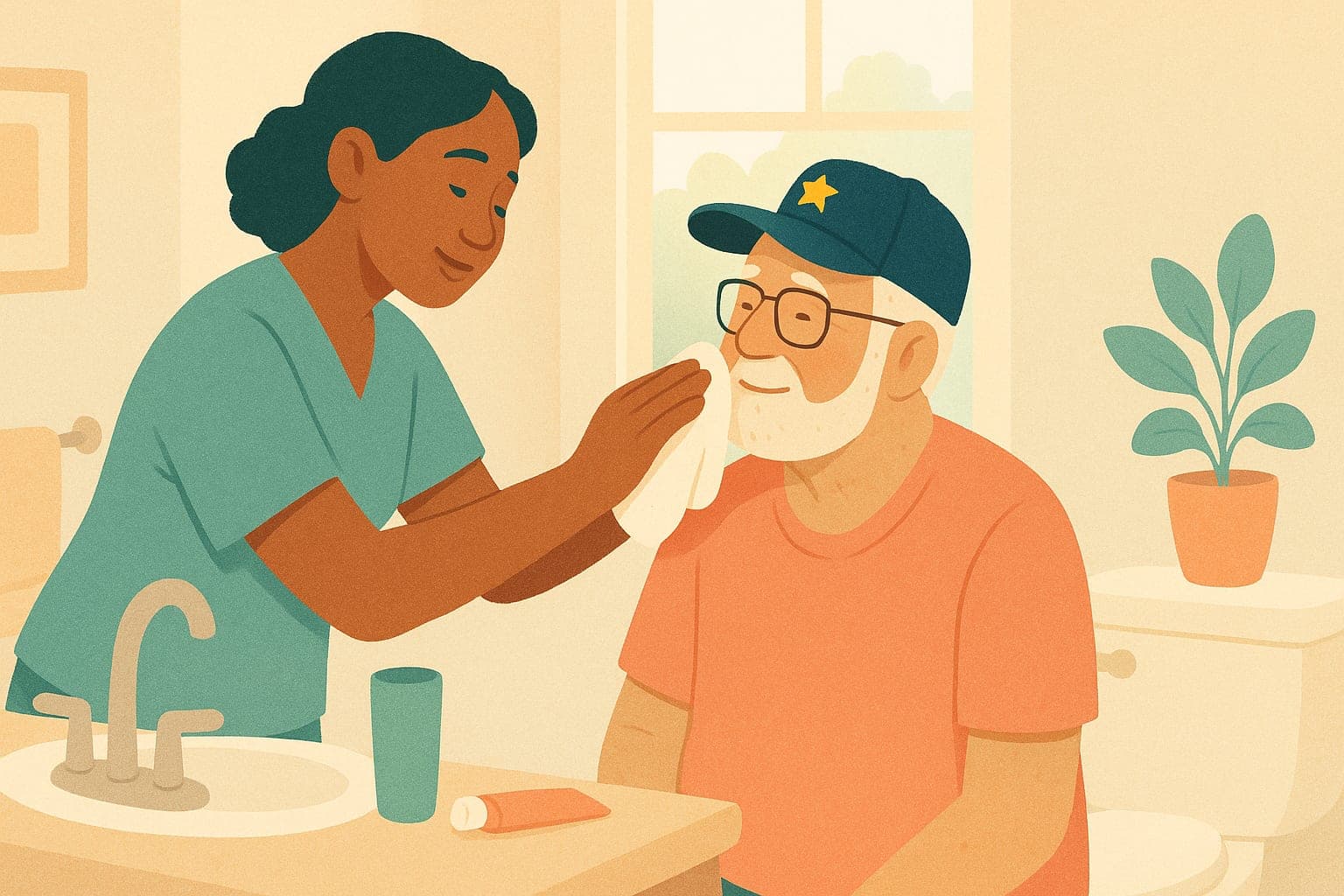
VA's Homemaker and Home Health Aide (H/HHA) program sends a trained aide into a veteran's home to help with bathing, dressing, eating, using the bathroom and moving around. The aide is not a nurse, but a registered nurse supervises the care. VA says all enrolled veterans are eligible if they are eligible for community care, meet the clinical criteria, and the service is available locally. It serves veterans of any age. A copay may apply, and VA calculates it from VA Form 10-10EC.
Key points
- An aide, not a nurse: VA's Homemaker and Home Health Aide program sends a trained aide, supervised by a registered nurse, to help with eating, dressing, grooming, bathing, using the bathroom, moving around and grocery shopping. That is everyday help Medicare generally will not buy.
- VA's stated requirements are enrollment in VA health care, community care eligibility, meeting the clinical criteria, and local availability. VA's H/HHA page does not state a nursing-home-level-of-care test, and the program serves veterans of any age. Only VA can decide eligibility.
- VA says you will not pay a copay for geriatric or extended care for the first 21 days in a 12-month period, and its long-term care page says copays are not charged until the 22nd day. After that, the copay is based on the level of care and the financial information on VA Form 10-10EC, and a compensable service-connected disability is one of several exemptions.
- For the first 180 days, federal regulation has VA look at income, not assets. Even after day 180, a veteran receiving only non-institutional care has their primary residence excluded from countable fixed assets, with the same condition-based exclusion applied to a vehicle.
- Ask for Veteran-Directed Care by name if you want a family member or neighbor paid. VA says that program helps veterans develop a spending plan and hire workers, including their own family member or neighbor.
- Free help is real help. VA states that services an accredited VSO representative provides on your VA benefit claims are always free, California County Veterans Service Officers charge nothing, and VA's Accreditation and Recognition Search lets you verify anyone before you sign a fee agreement.
What do most veteran families miss?
These are the easy-to-miss angles — the early-eligibility rules and quiet ways veteran families leave help on the table. Each one is explained in full below.
- A compensable service-connected disability is one of the categories exempt from extended care copay requirements under 38 CFR 17.111. Many families assume every VA service comes with a bill and never ask.
- VA says the first 21 days of geriatric or extended care in a 12-month period carry no copay, and its long-term care page says copays are not charged until the 22nd day. For families who only need help in short bursts, such as after a hospital stay or during a caregiver's trip, that may mean no cost at all.
- For the first 180 days, federal regulation has VA count income, not assets. Assets are not counted until day 181, and even then a veteran receiving only non-institutional care keeps their primary residence out of countable fixed assets, with the same condition-based exclusion applied to a vehicle. Families sell things they may never have needed to sell.
- Extended care furnished through the Veterans Community Care Program has a $0 copayment at the time the non-VA provider furnishes it. VA assesses any copay later, capped at the published daily amount. An agency demanding cash at the door is a red flag.
- Copay exemptions people rarely check: income below the 38 U.S.C. 1521(b) pension threshold, catastrophically disabled status, Medal of Honor, care for military sexual trauma, care under the special Agent Orange, radiation, Gulf War and Camp Lejeune authority, care related to a mental illness, and care for a 0% noncompensable service-connected condition.
- Veterans who meet the federal definition of Indian or urban Indian are exempt from copays for adult day health care, non-institutional respite care and non-institutional geriatric evaluation furnished on or after January 5, 2022. Submit VA Form 10-334, and VA says it will review and reimburse eligible copays already paid back to that date.
- Report changes that affect your copay obligation within 10 days. A drop in income can lower or eliminate the copay, but only once VA knows about it.
- Say "Veteran-Directed Care" out loud. VA says it helps veterans develop a spending plan and hire workers, including their own family member or neighbor, and most families never hear the program name from anyone.
- The aide can double as respite. VA says H/HHA services can be used as part of an alternative to nursing home care and to get respite care at home for a veteran and their family caregiver, so you may not have to give up the aide to get the caregiver a break.
- Non-institutional extended care sits in VA's shorter community care access standard: a 30-minute average drive time or a 20-day wait time, versus 60 minutes or 28 days for specialty care. If VA cannot meet that, ask directly whether it makes you community care eligible.
- Age is not a barrier, and neither is a modest disability rating. VA says the program serves veterans of any age, and the stated test is community care eligibility plus clinical criteria plus availability, not a percentage.
- If the veteran is not enrolled in VA health care yet, that is the true first step. VA says veterans must be enrolled before applying for long term care services, and VA notes that receiving disability compensation does not automatically enroll you. An accredited VSO or County Veterans Service Officer will help with the paperwork for free.
- Hospice is separate and free of copays. VA states that copays are not charged for hospice care provided in any setting.
What is the VA Homemaker and Home Health Aide program?
VA describes a Homemaker or Home Health Aide as a trained person who can come to a veteran's home and help the veteran take care of themselves and their daily activities. The aides are not nurses, but a registered nurse supervises them and helps assess the veteran's daily living needs.
The aides work for an organization that has a contract with VA. So this is a VA-purchased community service: VA decides the veteran needs it, VA authorizes it, and a contracted agency sends the aide. Your VA social worker is usually the person who arranges it.
VA says the program is for veterans who need personal care services and help with activities of daily living, and also for veterans who are isolated or whose caregiver is experiencing burden. It serves veterans of any age, and VA says a veteran can continue to receive an aide's services for as long as they need extra help with their daily activities.
VA also says Homemaker or Home Health Aide services can be used as part of an alternative to nursing home care, and to get respite care at home for a veteran and their family caregiver.
What can a VA home health aide do?
Services are based on the veteran's assessed needs, not a fixed menu. VA's program page lists these examples of daily activities an aide may help with:
If your loved one needs something that is not on this list, ask the social worker directly rather than assuming the answer is no. The care plan is built from the assessment.
- Eating
- Getting dressed
- Personal grooming
- Bathing
- Using the bathroom
- Moving from one place to another
- Grocery shopping
What is the aide not allowed to do?
Because homemakers and home health aides are not nurses, they are not the right people for skilled medical tasks. If your loved one needs wound care, catheter care, IV antibiotics or home infusion, or physical, occupational or speech therapy, VA covers that under a different benefit called Skilled Home Health Care. VA says that care is delivered by a community based home health agency that has a contract with VA, and that it is aimed at veterans needing short-term care as they move from a hospital or nursing home back home.
If the veteran needs an in-home team to manage ongoing disease and illness, ask about Home Based Primary Care instead. VA describes it as team-based in-home support, and the team can include physicians, nurse practitioners, physician assistants, nurses, social workers, rehabilitation therapists, psychologists, nutritionists and pharmacists.
These programs are not necessarily either/or. VA presents Homemaker and Home Health Aide care as one of several home and community based services, and what is available varies by location. Ask your social worker what combination your loved one may be approved for.
Who qualifies for VA Homemaker and Home Health Aide care?
VA's program page states that all enrolled veterans are eligible for Homemaker and Home Health Aide care if they are eligible for community care, meet the clinical criteria for the service, and it is available. VA's long-term care pages use the same three-part framing: you are signed up for VA health care, VA concludes you need the service, and the service is available near you.
In plain terms, four things generally have to line up:
None of this is a promise. Only VA can apply these rules to a specific veteran, and only after an assessment.
- The veteran is enrolled in VA health care. VA states that veterans must be enrolled in VA health care before applying for VA long term care services. VA also notes that receiving VA disability compensation does not automatically enroll you in VA health care.
- A VA clinician documents the clinical need, usually meaning real difficulty with activities of daily living, or a caregiver who is stretched past their limit.
- The veteran is eligible for community care. VA's community care criteria include VA not offering the service, access standards based on drive time and wait time, and a joint best-medical-interest decision by the veteran and the VA provider.
- The service is actually available in that area, from an agency under contract with VA.
What are the community care drive-time and wait-time standards?
This matters more than most families realize, because non-institutional extended care sits in the shorter of VA's two access standards.
VA publishes average drive time and wait time access standards. For primary care, mental health care and non-institutional extended care services, VA lists a 30-minute average drive time standard or a 20-day wait time standard. For specialty care, VA lists a 60-minute average drive time standard or a 28-day wait time standard. Meeting one of those standards is one of the ways a veteran can become eligible for community care.
VA also lists other paths, including needing a service VA does not provide at any VA facility, living in a state or territory without a full-service VA medical facility, certain grandfathered 40-mile eligibility from June 6, 2018, VA not meeting its own quality standards for that service line, and a shared best-medical-interest decision.
Ask the social worker in writing which community care pathway your loved one was found eligible under, or why they were not.
Do you have to be "nursing home level of care" to get an aide?
Not necessarily, and this is where families often talk themselves out of asking. VA's H/HHA page does not state a nursing-home-level-of-care test. It states a clinical-criteria test, and it describes the aide as something that can be used as part of an alternative to nursing home care.
A related program, Veteran-Directed Care, is described by the Administration for Community Living as serving veterans of all ages at risk of nursing home placement. So a higher level of need can open more options. But a lower level of need does not automatically shut the door on H/HHA.
VA also does not publish a fixed number of hours for this program. VA says services are based on assessed needs, and that an aide may come several times a week or just once in a while. Ask your social worker what hours were authorized and get it in writing.
This article is educational. Only VA can decide eligibility, and only after an assessment.
Will there be a copay, and how much?
VA's H/HHA page says a copay for Homemaker and Home Health Aide services may be charged based on your VA service-connected disability status. VA does not publish a single flat price for this service, because the amount depends on the level of care and on the veteran's financial picture.
Two rules matter most. First, VA says you will not need to pay a copay for geriatric care or extended care for the first 21 days of care in a 12-month period. VA's long-term care page puts it the other way around: long term care copays are not charged until the 22nd day of care. Second, from that point the copay is based on the level of care you are receiving and the financial information you provide on VA Form 10-10EC, Application for Extended Care Services.
VA's published long-term care copay rates, effective January 1, 2026, are up to $97 per day for an inpatient level of care, up to $15 per day for an outpatient level of care, and up to $5 per day for domiciliary care for homeless veterans. Federal regulation at 38 CFR 17.111 sets matching per-day figures for the specific extended care services it lists: $15 for adult day health care, $15 for non-institutional respite care, $15 for non-institutional geriatric evaluation, $5 for domiciliary care, $97 for institutional respite care, $97 for institutional geriatric evaluation, and $97 for nursing home care.
One honest caveat: VA does not publish a per-day copay line item named "Homemaker and Home Health Aide care." In-home aide services are non-institutional care, which is why families are usually quoted at the lower outpatient-level figure, but the actual determination is VA's. VA benefit figures also change, most often on December 1 or January 1. Confirm the current amount, and your own amount, with VA before care starts.
One protection worth knowing: for extended care furnished through the Veterans Community Care Program, 38 CFR 17.111 says the copayment amount at the time the non-VA entity or provider furnishes the care is $0. VA determines and assesses the copay at the end of its billing process, and it cannot exceed the published per-day amount. If a contracted agency tries to collect money from you at the door, stop and call VA.
Who is exempt from VA long-term care copays?
Federal regulation at 38 CFR 17.111 lists categories of veterans and care that are not subject to the extended care copay requirements. Several of these are missed all the time:
If you think one of these fits your family, say so on the record and ask VA to check it. An accredited VSO representative can help you do this for free.
- A veteran with a compensable service-connected disability
- A veteran whose annual income is below the VA pension threshold set in 38 U.S.C. 1521(b)
- Care for a veteran's noncompensable zero percent service-connected disability
- Care authorized under the special authority for Vietnam-era herbicide-exposed, radiation-exposed, Persian Gulf War, and Camp Lejeune veterans
- Care for military sexual trauma, and certain head and neck cancer care
- Care related to treatment of a mental illness, as described in the regulation
- A veteran VA determines to be catastrophically disabled, who is exempt for adult day health care, non-institutional respite care, and non-institutional geriatric evaluation
- A veteran awarded the Medal of Honor
- A veteran who meets the federal definition of Indian or urban Indian, exempt for adult day health care, non-institutional respite care and non-institutional geriatric evaluation furnished on or after January 5, 2022. VA still charges copays for domiciliary care, institutional respite care, institutional geriatric evaluation and nursing home care. You submit VA Form 10-334, the Tribal Documentation Form, and VA says it will review and reimburse eligible copays already paid on or after January 5, 2022.
- An episode of extended care that began on or before November 30, 1999
How does VA calculate the copay from Form 10-10EC?
The rules are more forgiving than most families expect, especially early on. Under 38 CFR 17.111, for the first 180 days of extended care, VA looks at the income of the veteran and the veteran's spouse, minus a veterans allowance of $20 per day, a spousal allowance of $20 per day counted only if the spouse resides in the community rather than being institutionalized, and allowable expenses.
Assets only enter the picture at 181 days or more. Even then, the regulation excludes the primary residence from countable fixed assets when the veteran is receiving only non-institutional services, which is what an in-home aide is, and it applies the same condition-based exclusion to a vehicle. If a spouse is living in the community, the regulation also protects liquid assets up to a spousal resource protection amount tied to the maximum Community Spouse Resource Standard published by CMS as of January 1 of the current year. VA lists the 2026 community spouse resource allowance as $162,660.
The regulation caps the copay for any month at the per-day amount multiplied by the number of days in that month, and VA can charge less if you supply information showing the copay should be reduced or eliminated.
You must submit a completed VA Form 10-10EC when you first request extended care, again after a break in services of more than 30 days, and annually along with VA Form 10-10EZ. You also have to report changes that affect your copay obligation within 10 days of the change. A drop in income can lower your bill, but only if VA hears about it.
VA also states that copays are not charged for hospice care provided in any setting.
How is this different from Veteran-Directed Care?
Homemaker and Home Health Aide care sends you an aide who works for a VA-contracted agency. Veteran-Directed Care hands the veteran the steering wheel instead.
VA describes Veteran-Directed Care as giving veterans of all ages the chance to receive home and community based services in a consumer-directed way, with help developing a spending plan and hiring workers, including the option to hire their own family member or neighbor. The Administration for Community Living adds that veterans manage their own flexible budgets, decide what mix of goods and services best meets their needs, and hire and supervise their own workers, with an options counselor at an Aging and Disability Network Agency providing facilitated assessment, care planning, fiscal management arrangements and ongoing support. ACL says it partnered with the Veterans Health Administration to launch the program in 2008, and that it serves veterans of all ages at risk of nursing home placement.
Eligibility language mirrors H/HHA. VA says all enrolled veterans are eligible for Veteran-Directed Care if they are eligible for community care, meet the clinical criteria for the service, and it is available. Referral runs through your VA social worker.
If being able to pay a daughter, a son, or a trusted neighbor matters to your family, say the words "Veteran-Directed Care" out loud to the social worker. Many families never learn it exists.
How is this different from Medicare's home health aide coverage?
This is the single biggest source of confusion, and the difference is real money.
Medicare pays for a home health aide only as an add-on. Federal regulation at 42 CFR 409.45 makes home health aide services a dependent service: they may be covered only if the beneficiary needs skilled nursing care on an intermittent basis, or physical therapy or speech-language pathology services, or has a continuing need for occupational therapy. Under 42 CFR 409.42, the beneficiary must also be confined to the home, be under the care of a physician or allowed practitioner who establishes the plan of care, and need at least one of those skilled services.
There is also an hours ceiling. Federal law at 42 U.S.C. 1395x defines part-time or intermittent services as skilled nursing and home health aide services furnished on any number of days per week, as long as the combined total is less than 8 hours each day and 28 or fewer hours each week, or up to 35 hours per week subject to case-by-case review of the need for care. Because the benefit is part-time or intermittent by definition, it is not a route to round-the-clock help at home.
Medicare's home health benefit also excludes purely supportive help. 42 CFR 409.49 excludes services whose sole purpose is to let the beneficiary keep living at home, giving cooking, shopping, Meals on Wheels, cleaning and laundry as examples. That is exactly the help many aging veterans need, and exactly what Medicare will not buy.
VA's H/HHA program is built for that gap. It exists to help with activities of daily living, with no requirement that skilled nursing be happening at the same time. If your loved one is a veteran and Medicare just ended their home health, this is the call to make.
How do I request Homemaker and Home Health Aide care?
There is no separate public application form for the aide itself. The path runs through VA's social work staff.
Free, accredited help exists at every one of these steps. VA states that the services an accredited VSO representative provides on your VA benefit claims are always free.
- Make sure the veteran is enrolled in VA health care. VA states veterans must be enrolled before applying for VA long term care services. If not enrolled, apply with VA Form 10-10EZ, or get free help from an accredited VSO representative or a County Veterans Service Officer.
- Ask the VA primary care team, or call the VA medical center and ask for social work service, to request an assessment for Homemaker and Home Health Aide care. Say those exact words.
- Ask the social worker for the Veteran Decision Aid for Care at Home or in the Community, and the Caregiver Self-Assessment. VA offers both free and walks through four steps: consider needs, explore options, involve others, take action. VA suggests bringing the completed Decision Aid, and the Caregiver Self-Assessment if it applies, to your next visit.
- Expect a clinical assessment of activities of daily living, and a registered nurse's involvement in the care plan.
- Complete VA Form 10-10EC, Application for Extended Care Services, so VA can determine your copay. Do this even if you think you are exempt, because exemptions are applied through this process.
- If VA says the service is not available locally, ask in the same conversation about Veteran-Directed Care, Respite Care, Adult Day Health Care, Skilled Home Health Care, and Home Based Primary Care.
- If community care is denied, ask what the appeal or review options are at that facility, and ask an accredited representative to help.
What should I ask the VA social worker?
Go in with a written list. Social workers are stretched thin, and the questions you do not ask usually do not get answered.
- Does my loved one meet the clinical criteria for Homemaker and Home Health Aide care, and if not, what is missing?
- Which community care pathway did we qualify under, or fail to qualify under?
- How many hours per week are being authorized, and for how long before it is re-reviewed?
- Which contracted agency will be assigned, and who do I call if an aide does not show up?
- Exactly what tasks is the aide allowed to do, and what will they decline to do?
- Which registered nurse supervises, and how often will they reassess?
- What is my copay, starting what day, and am I in any of the exempt categories?
- Have I filed VA Form 10-10EC, and does my file reflect my current income and expenses?
- Can we combine this with respite care so my family caregiver gets a real break? VA says nursing home respite care is available for a maximum of 30 days per calendar year.
- Am I eligible for Veteran-Directed Care, and is it offered in this area?
- Should we also be looking at the Program of Comprehensive Assistance for Family Caregivers?
- If I lose the aide or hours are cut, what are my appeal or review options?
Where can I get free help, and what should I watch out for?
Accredited Veterans Service Organization representatives help with VA benefit claims for free. VA states that the services an accredited VSO representative provides on your VA benefit claims are always free. County Veterans Service Officers in California do the same at no charge. VA also states that an accredited attorney or claims agent can charge you fees for their services, and those fees are regulated, with fee agreements required to be filed with VA.
Be careful with anyone who advertises "VA benefits help" for an up-front fee, especially around Aid and Attendance. If someone will not tell you their accreditation status, that is your answer. You can look them up yourself in VA's Accreditation and Recognition Search, run by the VA Office of General Counsel, before you sign anything.
Useful free phone numbers: 1-800-MyVA411 (1-800-698-2411), VA's main information line, available 24 hours a day, 7 days a week. The VA Caregiver Support Line at 1-855-260-3274, Monday through Friday, 8:00 a.m. to 8:00 p.m. ET. And the Veterans Crisis Line: dial 988, then select 1, available 24/7.
SoCal Home Health is an independent educational resource. We are not part of the VA, not affiliated with the VA, and not endorsed by the VA. Nothing here is a promise of benefits. Only VA can decide what a veteran qualifies for.
Frequently asked questions
Can the VA aide give my father his medications or change his dressing?
No. VA states that homemakers and home health aides are not nurses, although a registered nurse supervises them and helps assess daily living needs. Wound care, catheter care, IV antibiotics or home infusion, and physical, occupational or speech therapy fall under a different VA benefit, Skilled Home Health Care, which VA says is delivered by a community based home health agency under contract with VA. Ask your VA social worker whether your loved one needs both.
Can my daughter be paid to be the aide under this program?
Not under Homemaker and Home Health Aide care, because those aides work for an organization that holds a contract with VA. But ask about Veteran-Directed Care, where VA says veterans get help developing a spending plan and hiring workers, including their own family member or neighbor. Also ask about the Program of Comprehensive Assistance for Family Caregivers, which pays a monthly stipend directly to an approved primary family caregiver. VA lists PCAFC eligibility as a single or combined service-connected disability rating of 70% or more, plus a need for in-person personal care services for a minimum of six continuous months. An accredited VSO representative can help you apply for free.
How many hours a week will we actually get?
VA does not publish a set number. VA says services are based on your assessed needs, and that an aide may come several times a week or just once in a while. Because it varies by assessment and by what is available locally, ask the social worker for the authorized hours in writing, and ask when they will be re-reviewed.
Do we have to spend down our savings or sell the house to get this?
For the first 180 days of extended care, federal regulation has VA look at the income of the veteran and spouse minus allowances and expenses, not assets. Assets only come in at 181 days or more, and even then, for a veteran receiving only non-institutional care, the primary residence is excluded from countable fixed assets, with the same condition-based exclusion applied to a vehicle. If a spouse is living in the community, liquid assets are also protected up to a spousal resource protection amount tied to the CMS Community Spouse Resource Standard, which VA lists as $162,660 for 2026. Confirm the current figures and your own situation with VA.
Won't Medicare just pay for a home health aide instead?
Usually not for this kind of help. Federal regulation makes the home health aide a dependent service: it is covered only if the person also needs intermittent skilled nursing, physical therapy or speech-language pathology, or has a continuing need for occupational therapy, and the person must be confined to the home. Federal law defines part-time or intermittent as skilled nursing and aide services combined at less than 8 hours each day and 28 or fewer hours each week, or up to 35 hours a week subject to case-by-case review. Medicare's home health benefit also excludes services whose sole purpose is to let someone keep living at home, such as cooking, shopping, meal delivery, cleaning and laundry. VA's H/HHA program is designed to help fill exactly that gap for enrolled veterans.
Is this the same as Aid and Attendance?
No. VA describes Aid and Attendance as monthly payments added to the amount of a monthly VA pension, handled on the benefits side. Applying involves VA Form 21-2680, Examination for Housebound Status or Permanent Need for Regular Aid and Attendance, which a medical examiner must complete, and VA Form 21-0779 if the veteran is in a nursing home. Homemaker and Home Health Aide care is a VA health care service arranged by VA social work. They are different programs run by different parts of VA, and it is worth asking an accredited VSO representative, for free, how both could apply to your family.
The agency wants to bill us directly. Is that right?
Be cautious. Federal regulation says that for extended care furnished through the Veterans Community Care Program, the copayment amount at the time the non-VA entity or provider furnishes the care is $0, and VA determines and assesses any copay at the end of its billing process, never above the published per-day amount. If a contracted agency asks you for money at the door, do not pay on the spot. Call the VA medical center's billing office or MyVA411 at 1-800-698-2411.
Need care at home? We will connect you.
Skilled nursing, therapy, personal care, and recovery help — right at home, from trusted local providers. Tell us what you need and we will take it from there. Free, no obligation.
Get home-health careSources
- VA Geriatrics and Extended Care - Homemaker and Home Health Aide Care
- VA fact sheet (PDF) - Homemaker and Home Health Aide Care
- VA Geriatrics and Extended Care - home page
- VA Geriatrics - Home and Community Based Services
- VA Geriatrics - VA Long Term Care Services (enrollment requirement, 22nd day, hospice)
- VA Geriatrics - Veteran-Directed Care
- VA Geriatrics - Skilled Home Health Care
- VA Geriatrics - Home Based Primary Care
- VA Geriatrics - Respite Care (30-day nursing home respite limit)
- VA Geriatrics - Veteran Decision Aid for Care at Home or in the Community
- VA - Nursing homes, assisted living, and home health care (long-term care eligibility)
- VA - Current VA health care copay rates (2026 long-term care rates, effective January 1, 2026)
- VA - About VA Form 10-10EC, Application for Extended Care Services
- 38 CFR 17.111 - Copayments for extended care services (current CFR text, Cornell LII)
- VA - Copay exemptions for American Indian and Alaska Native Veterans (VA Form 10-334)
- 42 CFR 409.42 - Medicare home health beneficiary qualifications (Cornell LII)
- 42 CFR 409.45 - Medicare home health dependent services requirements (Cornell LII)
- 42 CFR 409.49 - Services excluded from the Medicare home health benefit (Cornell LII)
- 42 U.S.C. 1395x - definition of part-time or intermittent services (8 hours/day, 28 hours/week)
- VA Community Care - eligibility for community care (drive-time and wait-time standards)
- VA - Get help from an accredited representative (VSO services are free)
- VA Office of General Counsel - Accreditation
- VA Office of General Counsel - Accreditation and Recognition Search
- VA Caregiver Support Program - PCAFC benefits and eligibility
- VA - Aid and Attendance and Housebound allowances
- VA - Helpful VA phone numbers
- Administration for Community Living - Veteran-Directed Care Program
Related guides
- VA Aid and Attendance: Extra Monthly Money for Veterans and Spouses Who Need Help at Home
- VA Caregiver Support: The PCAFC Stipend and Free PGCSS Help, Explained
- Medicare Home Health Care: Who Qualifies and What It Costs
- How California Families Pay for Home Care
- Respite Care: How Family Caregivers Get a Much-Needed Break
- How to Get Paid as a Family Caregiver in California
- Benefits and Eligibility Shortcuts Many California Families Miss
- How to Choose a Good Home Health Agency in Southern California
- Bringing an Older Parent Home From the Hospital or Rehab: A Southern California Family Guide
- Where to Start: California Aging & Disability Help
This guide is educational and is not medical advice. In an emergency, call 911.