
Paying for care
How to Apply for IHSS in California: A Step-by-Step Guide
Last reviewed July 29, 2026
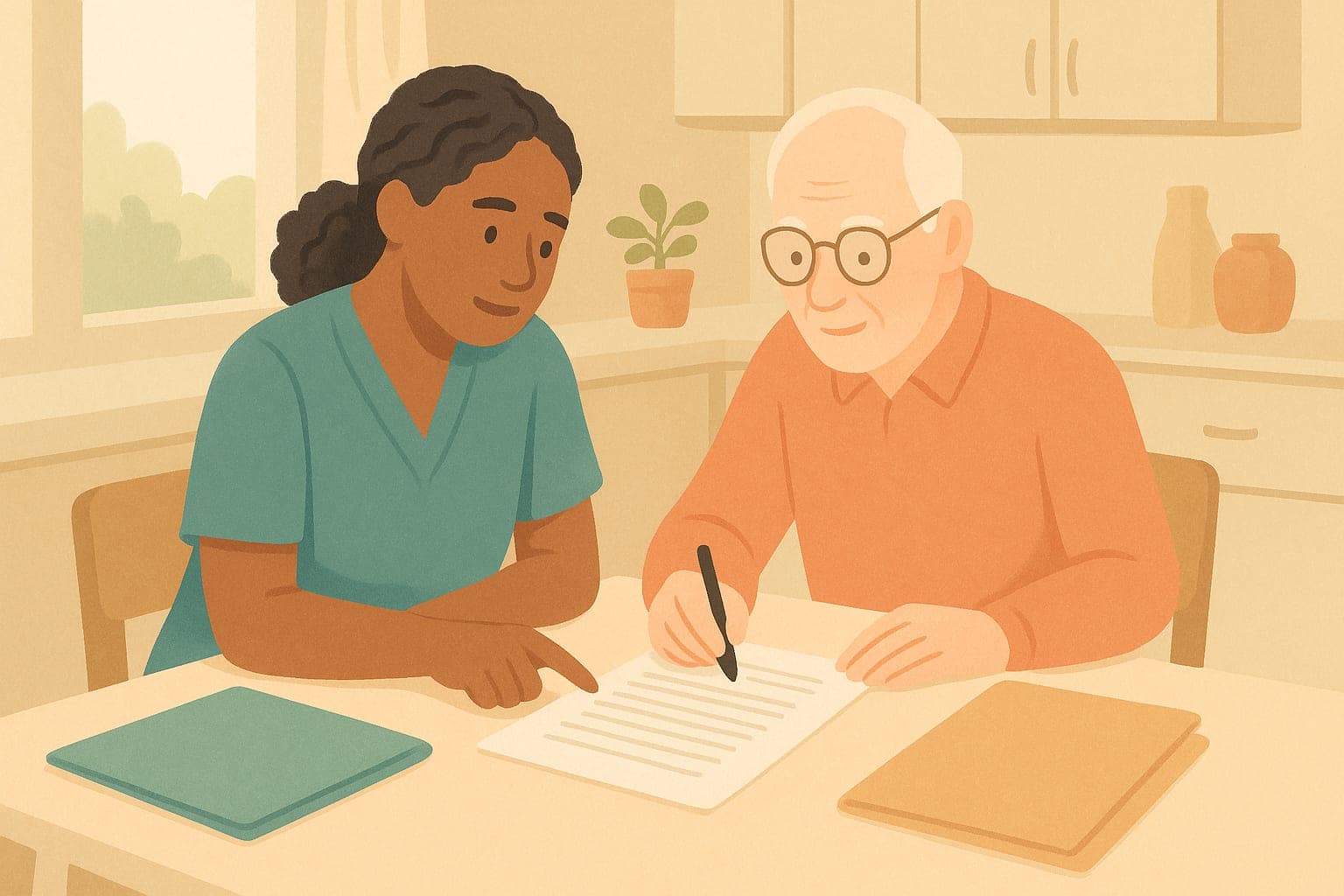
To apply for IHSS, contact your county IHSS or social services office and ask for an application. You'll need Medi-Cal and a doctor's certification. A county social worker then visits your home to assess your needs and authorize monthly hours. You hire a provider — often a family member — who submits timesheets and is paid by the state.
Key points
- Applying for IHSS is free. You must have full-scope Medi-Cal and a licensed health care professional's certification that you need help to stay safely at home.
- Start by contacting your county IHSS office. A county social worker will visit your home in person to decide which services you qualify for and how many hours.
- Monthly hours are capped at 283 (severely impaired) or 195 (non-severely impaired). Most people receive fewer, and your case is reassessed at least once a year.
- A family member — including many adult children and relatives — can be your paid provider after enrolling, completing a background check, and attending orientation.
- Providers submit electronic timesheets, check in and out (Electronic Visit Verification), and are paid twice a month by the state.
- You can appeal any denial or hours decision by requesting a state hearing, generally within 90 days of your Notice of Action.
What is IHSS, and who qualifies?
In-Home Supportive Services (IHSS) is a California Medi-Cal program run by the state Department of Social Services (CDSS) together with your county. It pays for help at home so that someone who is older, blind, or disabled can stay safely in their own home instead of moving to a nursing facility. For many families in Southern California, it is the main way to get ongoing, paid in-home care.
IHSS covers non-medical help with everyday life: personal care such as bathing, dressing, grooming, and using the bathroom; help with meals, laundry, shopping, and housework; accompaniment to medical appointments; and protective supervision for people who cannot safely be left alone because of memory or cognitive problems. It does not provide skilled nursing or medical treatment — that comes from a home health agency or a doctor.
To qualify, the person needing care generally must:
- Live in California and live in their own home (a house, apartment, or a relative's home — not a hospital, nursing home, or licensed care facility)
- Have full-scope Medi-Cal, or be eligible for it (you can apply for Medi-Cal at the same time)
- Be 65 or older, OR legally blind, OR have a disability
- Need help with daily activities to remain safely at home, as certified by a licensed health care professional
How do I apply through my county?
IHSS is applied for county by county, so the first step is to reach the IHSS or Adult Services office in the county where the person lives — Los Angeles, Orange, San Diego, Riverside, San Bernardino, Ventura, or Imperial, for example. CDSS keeps a directory of every county office and its phone number. You can usually apply by phone, in person, or by mail; you do not need a caregiver picked out yet.
Here is the typical path from first call to approval:
- Contact your county IHSS office and ask to apply. Give the person's name, address, and basic information.
- Make sure Medi-Cal is in place. If the person isn't enrolled yet, apply for Medi-Cal through your county human services office or Covered California — IHSS can't be authorized without it.
- Complete the Health Care Certification Form (SOC 873). The county mails this to you. A licensed health care professional — a doctor, nurse practitioner, physician assistant, and others — must sign it, confirming the person needs help and is at risk of out-of-home placement. Return it, usually within 45 days; the county can grant an extension.
- Schedule the in-home assessment. Once your paperwork is in, the county sets up a home visit with a social worker.
What happens during the in-home assessment?
A county social worker comes to the home in person. This visit is the heart of the process — it decides what services are approved and how many hours. The social worker talks with the applicant (and with you, as the family caregiver), looks at how the person moves around the home, and rates the person's ability to do each task, from fully independent to unable to do it at all.
This is the moment to be honest and specific. Describe a real, ordinary day and its hardest moments — not the person's best day. Mention safety worries directly: falls, leaving the stove on, wandering, confusion, incontinence, trouble getting out of bed. If the person has dementia or another condition that makes it unsafe to leave them alone, ask about protective supervision, which can add significant hours. It helps to keep a short list of concerns ready before the visit.
After the assessment, the county mails a Notice of Action (NOA). This official letter states whether IHSS is approved, which services are authorized, and the number of monthly hours. Keep this letter — you'll need it, and it's what you appeal from if you disagree.
How are my authorized hours decided?
Hours are built up task by task, based on how much help the person needs and how long each task reasonably takes. The social worker uses standard functional rankings, so the number reflects assessed need rather than a flat allowance. State law sets the ceilings: up to 283 hours per month for people who are severely impaired, and up to 195 hours per month for those who are non-severely impaired. Many recipients receive well under these maximums.
Your case is reassessed at least once a year, and you can request a new assessment sooner if the person's condition changes — for example, after a hospital stay, a new diagnosis, or a decline in mobility. If needs go up, hours can go up.
A note on cost: applying and receiving IHSS is free for most people. If the person's income is above the Medi-Cal limit, they may have a monthly 'share of cost' — an amount they contribute before Medi-Cal (and IHSS) fully covers the rest. Your county can explain whether a share of cost applies to your situation.
How do I, or a family member, become the paid caregiver?
IHSS is consumer-directed, which means the recipient hires, trains, schedules, and supervises their own provider. That provider can be a family member. Adult children and many other relatives can be paid; spouses and parents of a minor child can also be paid under specific programs and rules. If you don't have someone in mind, your county can give you a provider registry of screened caregivers.
Before a provider can be paid, they must enroll with the county. The steps are the same whether you're a relative or not:
- Complete the provider enrollment form (SOC 426) and sign the Provider Enrollment Agreement (SOC 846)
- Attend a provider orientation (offered by the county)
- Get fingerprinted (Live Scan) and pass a Department of Justice and FBI background check
- Show valid identification and provide a Social Security number
- Wait for the county to confirm the enrollment is complete before starting paid work
How do timesheets work, and how are caregivers paid?
Once enrolled and linked to a recipient, the provider records hours worked on an electronic timesheet through the IHSS Electronic Services Portal (etimesheets.ihss.ca.gov) or by phone using the Telephonic Timesheet System. The recipient reviews and approves each timesheet before it's submitted. This approval step is what triggers payment, so both people need their own account.
Federal rules require Electronic Visit Verification (EVV): most providers 'check in' when they start and 'check out' when they finish, using the app, the website, or the phone system. Providers who live in the same home as the person they care for are treated as live-in and are not required to record a location.
Providers are paid twice a month by the state, with direct deposit available. The hourly wage is set county by county — always at least the local minimum wage, and often higher through union agreements — so the exact rate depends on where you live. Providers also earn paid sick leave, and overtime is possible within weekly hour limits. Because IHSS wages are earned income, keep good records for tax time; some family providers who live with the recipient may qualify for special tax treatment, so ask a tax professional about your situation.
Frequently asked questions
How long does it take to get approved for IHSS?
After you apply and return the signed Health Care Certification (SOC 873), the county schedules the home visit and then mails your Notice of Action. It commonly takes several weeks — often within about 45 days — so return every form quickly and keep copies to avoid delays.
Can I be paid to care for my parent or spouse?
Often, yes. Adult children and many relatives can be paid IHSS providers. Spouses, and parents of a minor recipient, can be paid under specific programs and conditions. In every case, the caregiver must enroll with the county, pass a background check, and attend orientation before being paid.
Do I need to have a caregiver lined up before I apply?
No. You can apply first and find a provider later. If you don't have a family member or friend to hire, your county IHSS office can share a provider registry of screened caregivers you can contact.
What if I'm denied, or given fewer hours than I need?
You have the right to appeal. Request a state hearing — generally within 90 days of the date on your Notice of Action. You can also ask the county for a reassessment at any time if the person's needs increase, such as after a hospitalization.
Is IHSS the same as Medicare home health care?
No. Medicare home health is short-term, skilled care (like nursing or physical therapy) ordered by a doctor after an illness or injury. IHSS is ongoing, non-medical personal care and help around the home, funded through Medi-Cal, to help someone live safely at home long term.
Does IHSS cost me anything?
Applying and receiving services is free for most recipients. If the person's income is above the Medi-Cal limit, they may have a monthly 'share of cost' they pay before Medi-Cal covers the rest. Your county can tell you whether that applies to you.
Need care at home? We will connect you.
Skilled nursing, therapy, personal care, and recovery help — right at home, from trusted local providers. Tell us what you need and we will take it from there. Free, no obligation.
Get home-health careSources
Related guides
This guide is educational and is not medical advice. In an emergency, call 911.