
Caregiver support
Long-Distance Caregiving: How to Support an Aging Parent From Far Away
Last reviewed July 29, 2026
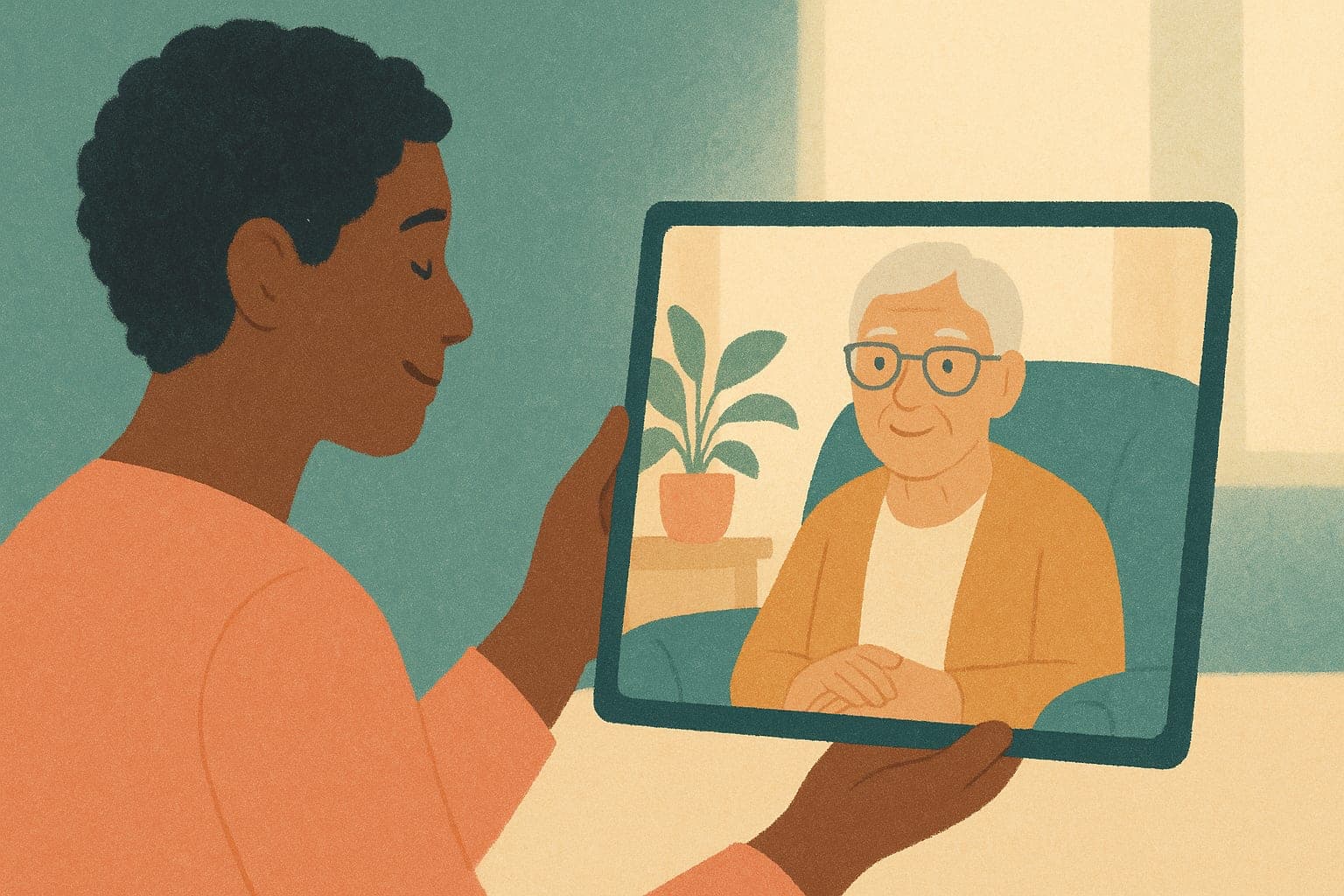
You can be a real, effective caregiver even if you live hundreds of miles from your parent. When you can't be there in person, your job shifts from doing the daily hands-on tasks to organizing them: coordinating care, finding trustworthy local help, keeping the right information and legal documents in place, and staying connected through simple technology. Start with one free phone call to the Eldercare Locator (1-800-677-1116), which connects you to the Area Agency on Aging that serves your parent's neighborhood. Build a small local support team (a neighbor, a home care aide, a lead sibling or a professional care manager), get financial and health-care legal documents signed while your parent can still make decisions, and put a clear emergency plan on paper. Just as important: protect yourself. Distance often comes with extra guilt, and the caregivers who last are the ones who share the load and take real breaks. This guide walks through each piece, with California-specific resources.
Key points
- You don't have to do everything yourself. From a distance, your most valuable role is usually organizing care, not physically providing it — managing bills, insurance, appointments, and the people who help on the ground.
- One free call connects you to local help. The Eldercare Locator at 1-800-677-1116 links you to the Area Agency on Aging that serves your parent's ZIP code, which knows the meal programs, transportation, and in-home services near them.
- Get the legal documents done early. A financial power of attorney, an advance health-care directive, and a HIPAA release must be signed while your parent still has the capacity to decide — waiting until a crisis is often too late.
- Keep one shared, always-current information sheet. Doctors, medications, insurance numbers, neighbors, and account access — in a shared document your family can all see — save precious time in an emergency.
- Simple technology closes the distance. Video calls, an automatic pill dispenser, a medical alert device, and proxy access to your parent's patient portal let you stay informed without moving in.
- Guilt is normal, but it is not a to-do list. Share responsibilities with family, use respite and paid help, and set realistic limits so you can keep going for the long haul.
What does long-distance caregiving actually involve?
A long-distance caregiver is anyone helping care for an older adult from an hour or more away — a different city, county, state, or country. If that's you, know this first: distance does not make you less of a caregiver. It changes what your help looks like.
When you're not there for the daily routine, your role becomes the coordinator and organizer. The National Institute on Aging describes long-distance caregivers doing exactly this kind of work — managing money, insurance, and bills; arranging in-home care or care management; ordering medical supplies and medications; keeping everyone's information in one place; and helping with advance care planning. Much of it can be done by phone, mail, and computer.
It helps to be honest early about what you can and can't do from afar, and to agree on it with the rest of the family. Maybe you handle the finances and paperwork while a nearby sibling handles doctor visits. Maybe you're the researcher who finds services and the one who flies in for big appointments or to give the local caregiver a break. There's no single right split — only the one your family can actually sustain.
- Money and paperwork: bills, insurance claims, benefits applications, and monitoring accounts for fraud.
- Care coordination: hiring and overseeing in-home aides, scheduling appointments, ordering equipment and medications.
- Information keeping: maintaining the master list of doctors, medications, contacts, and documents.
- Emotional support and check-ins: regular calls and video chats with your parent and with the local caregiver.
- Relief: traveling in to cover appointments or give the on-the-ground caregiver time off.
How do I coordinate care and build a local support team?
No one can do this alone from a distance — the goal is to build a small team of people who are physically near your parent. Start by mapping who's already there: nearby family, trusted neighbors, friends from a faith community, and your parent's own doctors. A neighbor who agrees to be an emergency contact and 'eyes on the ground' is worth a great deal.
Then decide who leads. Families do best when one person is the primary point of contact for doctors and agencies, even if others share the tasks. If there's no nearby family member to lead, you can hire a professional. An Aging Life Care professional (sometimes called a geriatric care manager) is a paid specialist who lives near your parent, assesses their needs, arranges and supervises services, and reports back to you. It's an out-of-pocket cost, but for a distant family it can replace many stressful trips.
For hands-on help at home, you'll likely work with a home care agency (which sends aides for bathing, dressing, meals, and companionship) or, when a doctor orders skilled care after a hospital stay, a Medicare-covered home health agency. Keep communication tight: a shared calendar and a group text or care-coordination app keep everyone — including you — on the same page. The Family Caregiver Alliance has practical guides on organizing family help and sharing the load.
What local resources can I use in Southern California?
The single most useful starting point is the Eldercare Locator, a free public service of the federal Administration for Community Living. Call or text 1-800-677-1116 (or visit eldercare.acl.gov) and give your parent's ZIP code. It connects you to the Area Agency on Aging (AAA) that serves that community — in Southern California these agencies coordinate services county by county and are the front door to most local aging programs.
Through the local AAA and 2-1-1 (dial 211 anywhere in California for health and social service referrals), you can find meal delivery (such as Meals on Wheels), senior transportation, adult day programs, friendly-visitor and check-in programs, and family caregiver support services. Many offer help in Spanish and other languages.
If your parent has low income and needs help with personal care at home, California's In-Home Supportive Services (IHSS) program may pay for a caregiver — and in many cases a family member can be the paid provider. IHSS is run through each county's social services office. And when medical care is needed, Medicare's own tools at medicare.gov let you compare local home health agencies, hospitals, and nursing facilities by quality ratings — useful when you're vetting providers you can't visit in person.
- Eldercare Locator — 1-800-677-1116 or eldercare.acl.gov: connects you to your parent's local Area Agency on Aging.
- 2-1-1 California — dial 211: local referrals for meals, transportation, and caregiver support.
- IHSS (cdss.ca.gov) — county-run in-home care for low-income adults; a family member may be paid to provide it.
- Meals on Wheels and senior nutrition programs — through the local AAA.
- Medicare Care Compare (medicare.gov) — compare home health agencies and facilities by ratings before you choose.
How can technology help me stay connected and manage care?
Technology can't replace being there, but it can close much of the gap. Start simple and add only what genuinely helps — a system your parent won't use isn't a solution.
Regular video calls (on a phone, tablet, or a simplified device made for seniors) let you see your parent, not just hear them. You can notice changes in appearance, mood, or the state of the home that a phone call would hide. For medications, an automatic pill dispenser that beeps and releases the right dose — and can alert you if a dose is missed — reduces one of the biggest risks of living alone.
For safety, a medical alert device (a wearable button or an automatic fall-detection pendant) lets your parent summon help and notifies you. Ask your parent's doctor's office whether you can get proxy access to their online patient portal (like MyChart); with permission, you can see test results, message the care team, and keep up with appointments from anywhere. And as the National Institute on Aging suggests, keep a shared online document or calendar with key phone numbers and the care schedule so every family member is working from the same information.
- Video calls: see your parent and the home, not just hear a voice.
- Automatic pill dispensers: timed reminders and missed-dose alerts.
- Medical alert / fall-detection devices: one button connects to help and notifies you.
- Patient portal proxy access: view results and message doctors with your parent's permission.
- Shared calendar and contact list: everyone on the team sees the same up-to-date plan.
- A note on privacy and cameras: in-home cameras or monitors should be discussed openly with your parent — their dignity and consent come first.
Which legal and financial documents should be in place?
This is the piece families most often put off — and most often regret waiting on. These documents must be signed while your parent still has the mental capacity to make decisions. Once a crisis or significant memory loss sets in, it can be legally too late, forcing the family into a court process. This guide is educational, not legal advice; an elder law or estate attorney can prepare documents that fit your parent's wishes and California law.
At a minimum, families usually want three things. A durable power of attorney for finances lets a trusted person pay bills and manage money if your parent can't. An advance health care directive (which in California names a health care agent and records treatment wishes) lets someone make medical decisions and speak with doctors. And a HIPAA authorization gives named people the legal right to receive medical information — critical when you're calling a hospital from another state and staff won't talk to you without it.
Keep copies where you can reach them, and make sure the local caregiver and the relevant doctors and hospitals have them on file before an emergency. Alongside the legal papers, build a simple financial and information binder: bank and insurance accounts, Medicare and Social Security numbers, the pharmacy, the list of doctors and medications, and the passwords or access details your family will need. Having this ready turns a frightening 2 a.m. phone call into something you can actually act on.
How do I prepare for and handle an emergency from far away?
Emergencies feel far worse when you're distant and unprepared, so the work is to prepare in calm times. If a true emergency is happening, the first step is always the same: call 911, or have the local contact do it.
Put together an emergency plan on paper and share it with everyone on the team. It should list your parent's local emergency contacts and neighbors, their doctors and preferred hospital, their full medication list, allergies, insurance information, and where the legal documents are kept. Keep your own 'go bag' notes ready too — the fastest flights or drive route, who can cover work, and where you'd stay — so a sudden trip doesn't start from zero.
If you work, learn your rights before you need them: the federal Family and Medical Leave Act (FMLA) allows eligible employees up to 12 weeks of unpaid, job-protected leave to care for a parent with a serious health condition, and California has its own paid family leave and job-protection programs. Talk to your employer or HR about how a caregiving emergency would work. Finally, use each in-person visit strategically — schedule the doctor's appointment, do a safety walk-through of the home, meet the aides, and check that the documents and plans are still current.
How do I manage the stress and avoid burning out?
Long-distance caregivers carry a particular weight: the worry of not being there, and a guilt that no amount of effort quite settles. That guilt is understandable, but it is not a measure of how good a caregiver you are — and it is not a task you can complete. Naming it honestly is the first relief.
The caregivers who last are the ones who share the load and take real breaks. Divide responsibilities with siblings and family in writing so the work — and the appreciation — is spread fairly, and revisit the split as needs change. Lean on paid and community help rather than trying to be the only answer, and build in respite: planned time off for whoever is doing the hands-on care, and permission for yourself to have a life beyond caregiving. The local Area Agency on Aging can point you to respite programs.
You don't have to process this alone. Caregiver support groups — many now meet online, so distance is no barrier — connect you with people who understand exactly this situation. The Family Caregiver Alliance and the National Institute on Aging both offer guidance on caregiver stress and staying well. And watch for the warning signs in yourself: constant exhaustion, sleeplessness, irritability, withdrawing from things you enjoy, or your own health slipping. If those show up, treat them as a signal to get more help, not to push harder. Taking care of yourself is part of taking care of your parent.
Frequently asked questions
I live in another state and my sibling near our parent does everything. How can I really help from far away?
Take over the pieces that don't require being physically present. Manage the bills, insurance claims, and benefits paperwork; be the one who researches and hires services; keep the master information sheet updated; and handle phone calls with doctors and agencies (you'll need a HIPAA authorization or health care agent status to do that). Just as valuable: fly in periodically to cover appointments so your sibling gets a genuine break, and make sure they feel appreciated. Sharing the load in writing prevents the resentment that builds when one person quietly carries it all.
Who do I call first to find help near my parent in Southern California?
Start with the Eldercare Locator at 1-800-677-1116 (call or text) or eldercare.acl.gov. Give your parent's ZIP code and it connects you to the local Area Agency on Aging, which knows the meal, transportation, in-home, and caregiver-support programs in that community. You can also dial 2-1-1 anywhere in California for health and social service referrals. Both are free.
Can a family member get paid to care for my parent in California?
Possibly, through In-Home Supportive Services (IHSS). IHSS is California's program that helps pay for in-home personal care for eligible low-income older and disabled adults, and in many cases a family member can be hired as the paid provider. It's administered by each county's social services office; you apply through the county where your parent lives. As a distant relative you generally can't be paid for coordinating from afar, but you can help your parent apply and set up a local family member or aide as the paid caregiver.
How do I get access to my parent's medical information from another state?
You need legal permission. A signed HIPAA authorization lets named people receive medical information from providers; an advance health care directive that names you as health care agent lets you make decisions and speak with doctors if your parent can't. Ask your parent's doctor's office to add you as an authorized contact, and request proxy access to their online patient portal so you can see results and message the care team. Set these up before a crisis — hospitals often won't share anything without them.
How often should I visit, and does it matter that I can't come often?
There's no required schedule, and quality matters more than frequency. Use visits with purpose: schedule the doctor's appointment during your trip, do a walk-through of the home for safety and any changes, meet the aides and neighbors in person, and confirm the legal documents and emergency plan are current. Between visits, regular video calls and a reliable local contact keep you informed. Many devoted caregivers see their parent only a few times a year and still coordinate excellent care.
Need care at home? We will connect you.
Skilled nursing, therapy, personal care, and recovery help — right at home, from trusted local providers. Tell us what you need and we will take it from there. Free, no obligation.
Get home-health careSources
Related guides
This guide is educational and is not medical advice. In an emergency, call 911.