
Veterans
VA Community Care: How the VA Pays a Home Health Agency to Come to Your Home
Last reviewed August 3, 2026
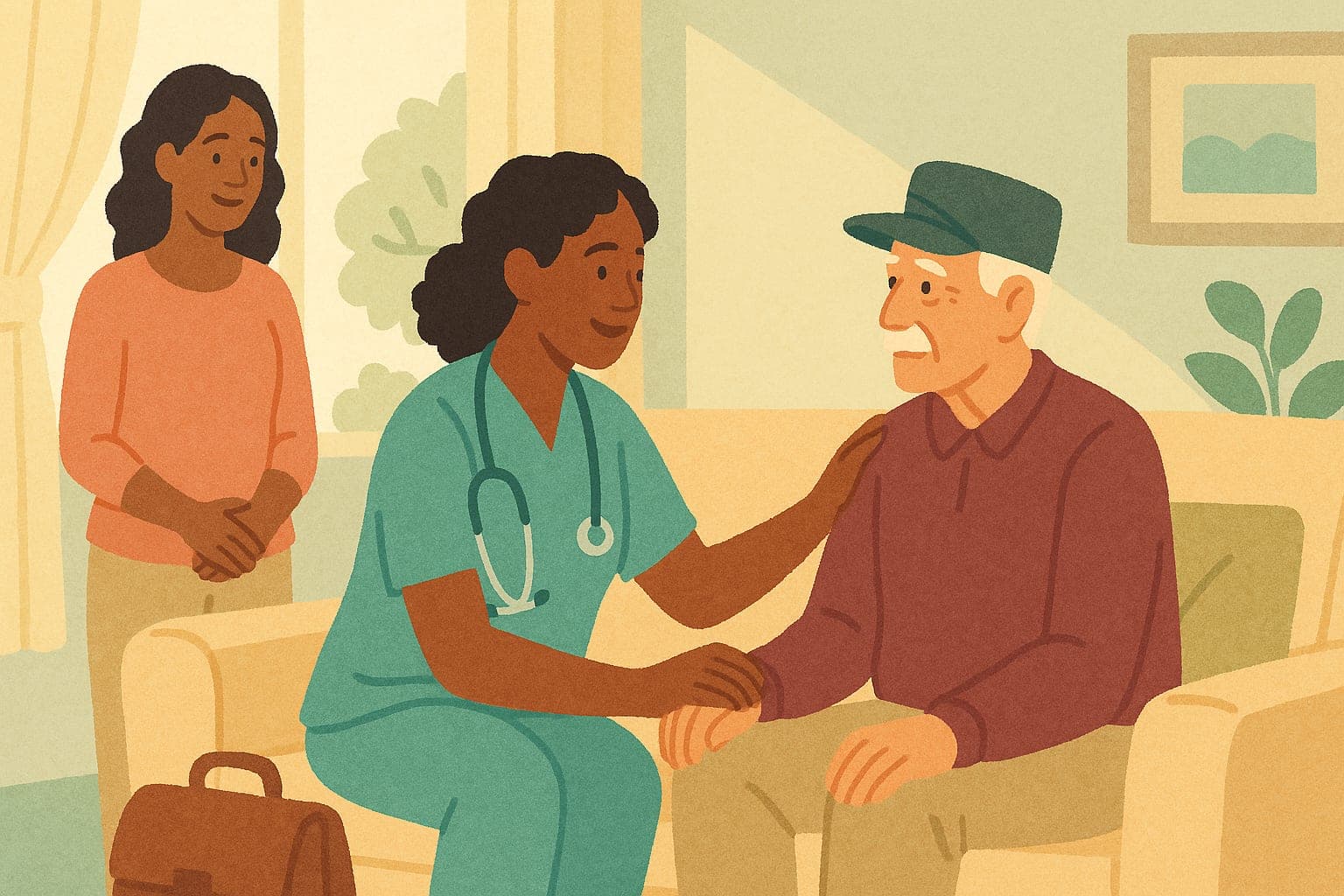
If your loved one is enrolled in VA health care, the VA can pay a non-VA ("community") home health agency to send a nurse, therapist, or home health aide to the house. This is the Veterans Community Care Program, created by the MISSION Act. The single most important rule: except for urgent and emergency care, the VA must refer and authorize the care before it starts. Care arranged on your own is usually not covered.
Key points
- Get the VA's approval first. Except for cases like urgent care and true emergencies, the VA must refer and authorize community home health before it starts — care you arrange on your own is generally not paid for.
- Home health falls under the tighter access standard. Non-institutional extended care uses the 30-minute drive time / 20-day wait time standard, not the 60-minute / 28-day specialty standard.
- Start with the VA social worker or the PACT primary care team, and ask by name for a community care referral for home health. The referral step can take up to 14 days.
- Keep the authorization letter. The VA says it lists the approved provider, the care approved, and how long care can continue before another referral is needed — ask for a renewal before it lapses.
- Never pay the community provider directly. The agency bills the VA. If a copay is owed, the VA bills you; call 877-881-7618 if a provider bill shows up.
- In California the network is run by TriWest (CCN Region 4), but TriWest does not decide eligibility — the VA care team does.
- Free help exists: accredited VSO representatives (free on VA benefit claims, per the VA) and California County Veterans Service Offices. Be wary of anyone charging a fee to 'maximize' VA benefits.
- Nothing on this page is a guarantee of benefits. Only the VA can decide eligibility, and copay rates change each calendar year — confirm current figures with the VA.
What do most veteran families miss?
These are the easy-to-miss angles — the early-eligibility rules and quiet ways veteran families leave help on the table. Each one is explained in full below.
- Home health is classified as non-institutional extended care, which means the 30-minute / 20-day access standard applies — not the 60-minute / 28-day specialty standard. If the nearest VA facility that can actually deliver the service is more than 30 minutes' average drive time away, or the wait is more than 20 days, that is a concrete eligibility argument to raise with the care team.
- The 'best medical interest' criterion is not a mileage formula. The regulation lets the veteran and the referring VA clinician agree that community care is better — weighing distance, timeliness, continuity, quality, and whether traveling to VA would be an unusual or excessive burden. Ask your clinician to document that reasoning in the record.
- Ask what the authorization letter covers and how long care can continue before another referral is needed, and calendar a reminder to request a renewal referral early. Families routinely have home visits stop cold because an authorization ran out and nobody asked for a new one.
- Ask about Veteran-Directed Care by name. The veteran gets a budget for services and, with a counselor, hires their own workers — which the VA says may include a family member or neighbor. The VA notes availability varies by location, and it is rarely volunteered.
- Hospice at home through a VA-contracted organization has no copay at all, per the VA. If the veteran has a terminal condition with less than six months to live and is no longer seeking curative treatment, this is one of the few cost-free routes to significant in-home support.
- Extended care has a 21-day grace period: the VA says there is no copay for the first 21 days of long-term care services in a 12-month period. Ask the social worker how that applies to the specific service being authorized.
- Enrollment in VA health care — not a service-connected rating — is the gate for these home services. A veteran who never filed a disability claim may still qualify. Applying is free and uses VA Form 10-10EZ.
- Community care home health is separate from the Aid and Attendance pension increase and from VA caregiver programs. A household may be able to use more than one. Ask a VSO or County Veterans Service Officer to map all of them at once rather than applying for one and stopping.
- If you self-schedule with an in-network agency, tell the VA team within 14 days. Doing it yourself can be faster than waiting for the VA to schedule — but if you skip the notification, the coordination and records transfer may not happen.
- When a hospital discharge is coming, raise home health with the VA social worker days before discharge, not on discharge day. The referral step alone can take up to 14 days.
- If your loved one goes to a non-VA emergency room, make sure someone notifies the VA within 72 hours — through the VA emergency care reporting portal or at 844-724-7842. Missing that window does not auto-deny the claim, but the care then has to meet the harder 'unauthorized emergency care' requirements.
What is VA Community Care, and can it really pay for home health care?
VA Community Care is the VA's way of buying care for a veteran from a provider who does not work for the VA. The VA calls these "community providers." The program covers many kinds of care, and the VA's own list of community care programs includes a category for home, health, and hospice care.
So yes — a private home health agency near you can come to your loved one's house, and the VA can pay for it. The agency bills the VA, not the family.
The VA is clear about the condition attached to this. Its community care overview says community care must first be authorized by VA before a veteran can receive care from a community provider. That sentence is the whole ballgame, and we come back to it below.
Two related VA services often get confused with each other. Skilled Home Health Care is short-term or ongoing clinical care (nursing, therapy) delivered by a community agency under VA contract — the VA describes it as especially useful for veterans moving from a hospital or nursing home back home. Homemaker and Home Health Aide Care is a trained aide, supervised by a registered nurse, who helps with bathing, dressing, grooming, eating, using the bathroom, moving around, and grocery shopping. Both are "purchased" services — the VA pays an outside organization to provide them.
Who qualifies for community care, and what are the drive-time and wait-time standards?
There are two things every veteran must have, plus at least one more reason from a list.
The two basics: the veteran is enrolled in (or eligible for) VA health care, and the VA health care team approves the care before it happens. The exception is urgent and emergency care, covered further down.
Then at least one of the following must also be true.
One of those criteria is the "designated access standards," and the numbers matter. Federal regulation (38 CFR 17.4040) sets them at 30 minutes average drive time from the veteran's residence, or 20 days from the date of request, for primary care, mental health care, and non-institutional extended care — and 60 minutes or 28 days for specialty care. Home health is non-institutional extended care, so the tighter 30-minute / 20-day standard is the one to argue from, not the specialty standard. Many families do not realize this.
Nothing here is a guarantee. Meeting a criterion makes a veteran eligible to be considered for community care; the VA care team still decides, based on clinical need and what is available. A free accredited representative or County Veterans Service Officer can help you make the case.
- The VA does not offer the service the veteran needs at any VA health facility
- The veteran lives in a state or territory that does not have a full-service VA health facility
- The veteran qualified under the older 40-mile distance requirement as of June 6, 2018 and still lives in a qualifying location (the VA names Alaska, Montana, North Dakota, South Dakota, Wyoming, or another qualifying location)
- The VA cannot provide the care within its standards for drive time and wait time
- The VA cannot provide the service in a way that meets its own quality standards
- The veteran and the referring VA clinician agree that care from an in-network community provider is in the veteran's best medical interest, considering things like distance, how soon an appointment is available, continuity and quality of care, and whether getting to a VA facility would be an unusual or excessive burden
Why does the VA have to approve the care before it starts?
This is the point where families most often lose money. If you find a home health agency yourself, sign them up, and start care, the VA generally will not pay — even if your loved one would have qualified.
The VA states the rule plainly on its eligibility page: you need approval from your VA health care team before you get care from a community provider, except in certain cases such as urgent or emergency care.
Once the care is set up, the VA sends an authorization letter. According to the VA, that letter contains an authorization number, information about the approved in-network community provider, a description of the care the veteran can get, and how long the veteran can keep getting that care without needing another referral.
Read that letter carefully and keep it. Services that are not listed on it are not covered. If your loved one's needs change — more visits, a different therapy, a longer period of care — ask the VA care team for a new or expanded referral before the extra care happens, not after.
The only routine exceptions are urgent care and true emergencies, described in a later section.
What home care services can the VA authorize through community care?
Exactly what is available depends on the veteran's clinical needs and what is offered in your area, but the VA describes the following in-home services across its home and community based services pages.
Hospice care deserves a special mention: the VA works closely with community and home hospice agencies, and the VA says there are no copays for hospice care, whether the VA provides it or an organization with a VA contract does.
One more option worth asking about by name: Veteran-Directed Care. Instead of the VA choosing the agency, the veteran (or the veteran's representative) is given a budget for services and, with a counselor's help, hires their own workers — which the VA notes may include a family member or neighbor. The VA says services may vary by location, so ask a VA social worker whether it is offered where you live.
- Skilled nursing, including wound care and catheter care
- Physical therapy, occupational therapy, and speech therapy
- Home health aide help with bathing, dressing, grooming, eating, using the bathroom, moving around, and grocery shopping
- Teaching the veteran and family about medications and managing illness
- IV antibiotics or home infusion therapy
- Home safety evaluations
- Social work support and case management
- Respite care so a family caregiver can take a break
- Hospice and palliative care at home
How do we actually start the process with the VA care team?
You start with the veteran's VA health care team — the primary care team, often called the PACT (patient aligned care team) — or the VA social worker. You do not start with the home health agency.
Here is the path the VA describes.
The VA says the referral part of the process — reviewing eligibility and confirming what kind of appointment is needed — can take up to 14 days. If you schedule the appointment yourself, tell your VA health care team within 14 days so they can record it and coordinate with the agency.
If your loved one is not yet enrolled in VA health care, that is step zero. Enrollment uses VA Form 10-10EZ and can be done online, by phone at 877-222-8387 (Monday through Friday, 8:00 a.m. to 8:00 p.m. ET), by mail, or in person at a VA medical center or clinic. The VA says it aims to decide in less than one week. An accredited Veterans Service Organization representative or a County Veterans Service Officer will help you with this at no charge.
- Ask the VA primary care team or VA social worker for a home care assessment. Say plainly what is happening at home: falls, wounds, missed medications, a caregiver who cannot lift, a recent hospital stay.
- Ask directly for a community care referral for home health, and ask which access standard applies and whether the VA can meet it.
- Ask the social worker about VA Form 10-10EC, the Application for Extended Care Services, which the VA uses to work out any copay for extended care services.
- Ask the VA to identify an in-network agency, or search for one yourself and give the team the name.
- Get the appointment scheduled — either the VA team schedules it, or you schedule it yourself and tell the VA team within 14 days.
- Watch for the authorization letter the VA sends. Confirm what care it approves and how long your loved one can keep getting that care before another referral is needed.
- Before the authorization runs out, ask for a renewal referral so care does not stop.
Who is TriWest, and what does the Community Care Network do?
The VA does not contract with every home health agency one at a time. It uses a Community Care Network (CCN) built and managed by two third-party administrators. Optum (Optum Serve) handles Regions 1 through 3; TriWest Healthcare Alliance handles Regions 4 and 5.
California is in Region 4, administered by TriWest. So for a family in Southern California, the agency that comes to the house is usually one that TriWest has contracted into the network on the VA's behalf.
What this means practically: these companies build the network and process claims. They do not decide whether your loved one gets home health — the VA care team does that, through the referral and authorization. If an agency tells you they can "get you approved," be skeptical and call your VA team.
Behind the scenes, the VA manages referrals and authorizations in a system called HealthShare Referral Manager (HSRM), and follows a five-step care coordination model that runs from the initial request through assessment, a care coordination plan, carrying out that plan, and follow-up. You do not need to know the software, but it helps to know there is a tracked record — so ask your VA facility's community care office for the status of a referral by name.
Will we get a bill? How copays and billing work
The community provider bills the VA. If a bill from a community provider reaches you instead, do not pay it — call the VA. If a copay is genuinely owed, the VA sends the bill and you pay the VA at the address on that bill.
Whether there is a copay at all depends on the veteran's priority group, whether the care is for a service-connected condition, and what kind of service it is. The VA's outpatient copay rates apply to veterans who do not have a service-connected disability rating of 10% or higher, so veterans rated 10% or higher generally do not owe those outpatient copays. Hospice has no copay. Extended care copays are worked out through VA Form 10-10EC with the social worker.
The VA publishes its health care copay rates by calendar year. Under the rates the VA lists as effective January 1, 2026, outpatient primary care is $15 per visit and specialty care is $50 per visit for veterans who owe copays. For long-term (extended) care, the VA says there is no copay for the first 21 days of care in a 12-month period; after that, outpatient extended care such as adult day health care is up to $15 per day and inpatient extended care such as a nursing home stay or overnight respite is up to $97 per day. Confirm the current amounts with the VA before you count on any figure — these change.
A note on timing, because it trips people up: VA health care copay rates are set on a calendar-year basis, while VA compensation and pension amounts (including Aid and Attendance) change every December 1 with the cost-of-living adjustment. They are two different clocks.
If a bill arrives from a community provider, call the VA Community Care Contact Center at 877-881-7618 (Monday through Friday, 8:00 a.m. to 9:00 p.m. ET). For questions about a VA copay bill, call 866-400-1238 (Monday through Friday, 8:00 a.m. to 8:00 p.m. ET). TTY for both is 711.
What about urgent care and emergencies — do those need approval too?
No, and this is the important exception.
For urgent care — minor injuries and illnesses like a sprain or strep throat — the VA says you do not need a referral first. The veteran must be enrolled in VA health care and must have received care from the VA or an in-network provider in the past 24 months (2 years). Check that the urgent care clinic is in the VA network before you are seen. Under the copay rates the VA lists as effective January 1, 2026, veterans in priority groups 1 through 5 pay $0 for their first three urgent care visits and $30 for visits after that; priority groups 7 and 8 pay $30 per visit; and for priority group 6 it depends on whether the visit is for a condition covered under a special authority (such as a service-connected condition), in which case it is $0, and $30 otherwise. Do not pay at the visit — the VA sends a bill if one is owed.
For a real emergency, the VA's guidance is unambiguous: call 911 or go to the nearest emergency department, and do not check with the VA first. But someone must notify the VA within 72 hours of when the emergency care starts. The VA prefers that the provider do it, but you or someone acting for the veteran can do it — online through the VA's emergency care reporting portal at emergencycarereporting.communitycare.va.gov or by phone at 844-724-7842 (TTY: 711).
If nobody notifies the VA within 72 hours, the VA says the claim is not automatically denied — but the care then has to meet the requirements for unauthorized emergency care, which is a harder standard. If your loved one lands in an ER, make the call.
Where can we get free help figuring this out?
You do not have to navigate this alone, and you should not pay someone to do it for you.
Accredited Veterans Service Organization (VSO) representatives help with VA benefit claims for free — the VA states that the services an accredited VSO representative provides on your VA benefit claims are always free. Accredited attorneys and claims agents, by contrast, are permitted to charge fees for their services. Only VA-accredited people may represent a claimant before the VA.
In California, County Veterans Service Offices (CVSOs) are local county offices that help veterans and families prepare and submit claims and connect to local services, staffed by trained and accredited professionals. CalVet recommends working with the CVSO nearest you; every Southern California county has one, and you can find yours through CalVet's service provider search.
Inside the VA health system, the person to ask for is the VA social worker or the community care office at your VA medical center. They are the ones who can actually move a home health referral.
Be cautious with anyone who cold-calls, texts, or knocks on the door offering to "maximize" VA benefits for a fee or a share of back pay. Check accreditation first, and ask a VSO or CVSO for a second opinion before signing anything.
SoCal Home Health is an independent educational resource. We are not affiliated with, endorsed by, or acting on behalf of the U.S. Department of Veterans Affairs. Nothing here is a promise of benefits — only the VA can decide eligibility.
Frequently asked questions
Does my loved one need a service-connected disability to get home health through community care?
No. The gate is enrollment in VA health care, not a service-connected rating. The VA says all enrolled veterans are eligible for Skilled Home Health Care if they are eligible for community care and meet the clinical criteria for the service. A service-connected rating does matter for copays — the VA's outpatient copay rates apply to veterans who do not have a rating of 10% or higher. If your loved one is not enrolled, apply with VA Form 10-10EZ; the VA says it aims to decide in less than a week, and an accredited VSO representative will help for free.
Can we just hire a home health agency and send the VA the bill?
Almost never. Except for cases like urgent care and emergencies, the VA requires approval from the veteran's VA health care team before care from a community provider begins. Care you arrange on your own, without a referral and authorization, is generally not covered. If you have already started paying an agency out of pocket, stop and call the VA care team or the VA Community Care Contact Center at 877-881-7618 before spending more.
How long does it take to get approved?
The VA says the referral step — reviewing eligibility and confirming what kind of appointment is needed — can take up to 14 days. Scheduling comes after that, and the authorization letter follows. If your loved one is being discharged from a hospital and needs care immediately, say so clearly to the discharge planner and the VA social worker and ask them to flag the referral as urgent. Do not wait until discharge day to start asking.
Can we pick our own home health agency?
Often, yes, within limits. The VA says your VA health care team can help you find an in-network provider, or you can search yourself. The agency has to be in the VA's Community Care Network — in California that network is administered by TriWest (Region 4). If you have a preferred agency, give the name to your VA team early and ask whether they are in network. If you schedule the appointment yourself, tell your VA team within 14 days.
Will community care pay for someone to help with bathing and dressing every day?
It can help, but the amount is based on assessed clinical need, not on what the family would prefer. The VA describes Homemaker and Home Health Aide Care as an aide who may come several times a week or just once in a while, depending on the assessment by the supervising registered nurse. If the need is for many hours of daily personal care, ask the VA social worker about Veteran-Directed Care, respite care, and — separately — whether the veteran might qualify for the VA's Aid and Attendance pension increase, which is money the household can spend on care.
If we use a community agency, do we lose our VA doctors?
No. Community care is meant to work alongside VA care, not replace it. The VA's five-step care coordination process keeps the VA team involved, shares medical records with the community provider, and includes follow-up. Your loved one keeps their VA primary care team, and that team remains the place to go for new referrals when needs change.
What if a bill arrives from the home health agency?
Do not pay the community provider directly. Call the VA Community Care Contact Center at 877-881-7618 (Monday through Friday, 8:00 a.m. to 9:00 p.m. ET, TTY: 711). If a copay is genuinely owed, the VA will bill you and you pay the VA at the address on that bill. For questions about a VA copay bill specifically, call 866-400-1238 (Monday through Friday, 8:00 a.m. to 8:00 p.m. ET).
How much will the copay be for home health care?
There is no single answer, and you should not budget from a number you read online. Extended care copays are worked out individually using VA Form 10-10EC, the Application for Extended Care Services, with a VA social worker. The VA does say there is no copay for the first 21 days of long-term care in a 12-month period, and no copay at all for hospice care. Confirm every current amount with the VA before you rely on it — the rates are reset each calendar year.
Need care at home? We will connect you.
Skilled nursing, therapy, personal care, and recovery help — right at home, from trusted local providers. Tell us what you need and we will take it from there. Free, no obligation.
Get home-health careSources
- VA Community Care - Veteran Care Overview (home, health and hospice care; prior authorization rule)
- VA - Eligibility for community care outside VA
- VA - How to get community care referrals and schedule appointments (14 days; authorization letter contents)
- VA - About our VA community care network and covered services
- VA Community Care Network - regions and third-party administrators (Optum Regions 1-3, TriWest Regions 4-5)
- VA Community Care - Care coordination (five-step model, HSRM)
- VA Community Care - program home page
- VA Office of Community Care - Understanding the Community Care Process (customer service guide, 877-881-7618)
- VA - Helpful VA phone numbers
- VA Geriatrics - Skilled Home Health Care
- VA Geriatrics - Homemaker and Home Health Aide Care
- VA Geriatrics - Home and Community Based Services
- VA Geriatrics - Veteran-Directed Care
- VA Geriatrics - Hospice Care (no copays)
- VA - Nursing homes, assisted living, and home health care (long-term care)
- VA - Current VA health care copay rates (effective January 1, 2026)
- VA - Pay your VA copay bill (866-400-1238)
- VA - Getting urgent care at VA or in-network community providers
- VA - Getting emergency care at non-VA facilities (72-hour notification)
- VA Emergency Care Reporting portal
- VA - How to apply for VA health care (VA Form 10-10EZ, 877-222-8387)
- VA - About VA Form 10-10EC (Application for Extended Care Services)
- VA - Get help from an accredited representative (VSO help is free)
- VA Office of General Counsel - Accreditation
- 38 CFR 17.4010 - Veteran eligibility (GovInfo)
- 38 CFR 17.4040 - Designated access standards (GovInfo)
- CalVet - County Veterans Service Offices
- CalVet - Find a service provider (locate your county CVSO)
- VA - About VA health benefits
Related guides
- VA Aid and Attendance: Extra Monthly Money for Veterans and Spouses Who Need Help at Home
- VA Caregiver Support: The PCAFC Stipend and Free PGCSS Help, Explained
- Medicare Home Health Care: Who Qualifies and What It Costs
- How California Families Pay for Home Care
- How to Choose a Good Home Health Agency in Southern California
- Respite Care: How Family Caregivers Get a Much-Needed Break
- Bringing an Older Parent Home From the Hospital or Rehab: A Southern California Family Guide
- Hospice, Palliative Care, and Home Health: What's the Difference?
- Benefits and Eligibility Shortcuts Many California Families Miss
- Where to Start: California Aging & Disability Help
This guide is educational and is not medical advice. In an emergency, call 911.