
Veterans
VA Hospice and Palliative Care at Home: A Family Guide
Last reviewed August 3, 2026
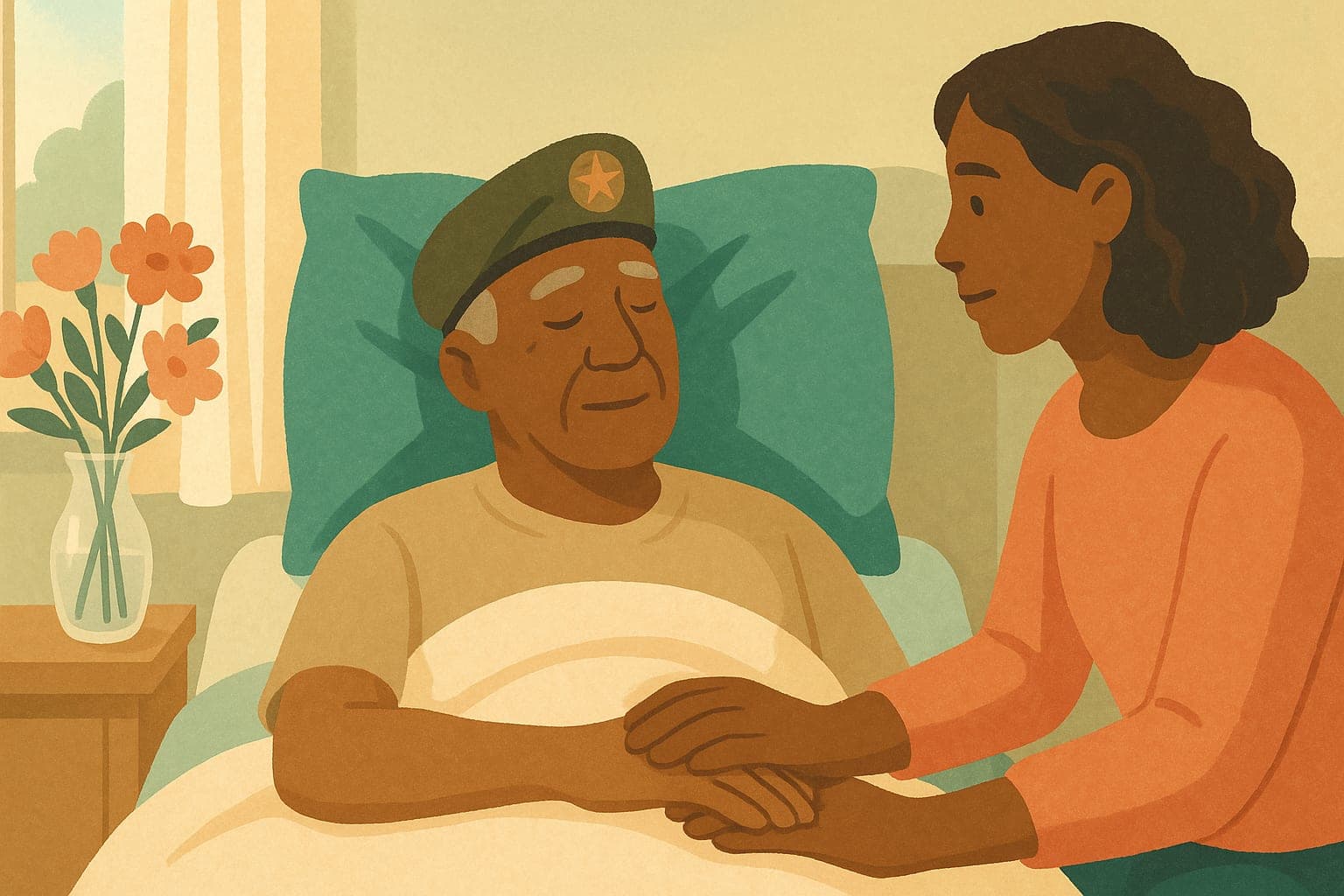
VA states there are no copays for hospice care, whether VA provides it or pays a VA-contracted agency in your home. Palliative care is broader — it has no six-month rule and can run alongside treatment. If your loved one is enrolled in VA health care and has a serious illness, you can ask a VA provider or social worker for a palliative care consult today, without waiting for a crisis or a hospice decision.
Key points
- VA states there are no copays for hospice care, whether VA provides it or an organization with a VA contract provides it — and 38 CFR 17.108(e)(15) lists hospice care among services exempt from VA copayments.
- Palliative care is not hospice. VA states it does not require a six-month prognosis and can be combined with treatment aimed at curing or controlling the illness, so families should ask for a palliative care consult long before a hospice conversation.
- An enrolled veteran can choose VA as the payer for hospice even if he or she is also eligible for hospice under Medicare or Medicaid.
- Electing the Medicare hospice benefit does not cut off VA benefits. VA reissued its national policy on September 9, 2022 specifically to correct that myth, and offers concurrent palliative care alongside a community hospice plan.
- Hospice at home covers the team visits, medications, supplies, and durable medical equipment written into the plan of care — not just a nurse dropping by.
- Bereavement support for the family is part of the benefit, and under Medicare hospice rules must be made available for up to one year after the death. Most families never use it.
- Accredited VSO representatives and County Veterans Service Officers help for free. VA warns against paying anyone to file an initial claim, and points families to VSAFE.gov to report unlawful fees.
- Every dollar figure in this guide changes over time. Confirm current copay amounts with VA and current Medicare hospice coinsurance with Medicare before you plan around them.
What do most veteran families miss?
These are the easy-to-miss angles — the early-eligibility rules and quiet ways veteran families leave help on the table. Each one is explained in full below.
- You do not have to wait for hospice. VA states palliative care does not require an imminently terminal condition and can be combined with treatment aimed at curing or controlling the illness — families routinely wait a year or more longer than they needed to.
- VA hospice has no copay at all, including when VA pays a community agency to come to your home. Medicare hospice can carry small drug and respite coinsurance. If both are on the table, VA-paid hospice may cost your family less.
- The veteran chooses the payer. VA states its offer to purchase or provide hospice applies even if the veteran is eligible for hospice under Medicare or Medicaid. Most families never learn they had a choice.
- Electing Medicare hospice does not end VA benefits. VA reissued national policy on September 9, 2022 to kill this exact myth, and will offer 'concurrent palliative care' on top of the community hospice plan when a VA team identifies the need.
- VA's hospice criteria say comfort-focused goals 'do not exclude disease modifying treatments,' while VA's public hospice page sounds stricter. Ask the VA team, item by item, which treatments can continue — and get it written into the care plan.
- Bereavement support is prepaid and, under Medicare hospice rules, must be made available for up to a year after the death. Almost no family uses it. Ask the agency what their program includes before you need it.
- Ask whether the hospice agency participates in We Honor Veterans — the program VA created with NHPCO (now the National Alliance for Care at Home) for agencies trained in veteran-centered end-of-life care.
- Medicare hospice election can be revoked at any time during an election period and re-elected later. A veteran who stabilizes is not trapped in the decision.
- VA policy requires access to basic palliative and hospice services 24 hours a day, 7 days a week at VA facilities offering inpatient services. Get the after-hours number for your community agency too, in writing.
- VA policy directs Palliative Care Consult Teams to promote education for veterans and families on burial and survivorship benefits — ask them, rather than starting that research alone after the death.
- Interpreter services are free. Call MyVA411 at 800-698-2411 (TTY: 711), select 0, and tell the agent you want an interpreter to join. Use one for goals-of-care conversations even if your English is good.
- If the veteran is a family caregiver's veteran and the family is in the Program of Comprehensive Assistance for Family Caregivers, ask the Caregiver Support Program team about REACH VA Bereavement and the Annie text program — both are grief-specific and rarely offered unprompted.
- Never pay to file an initial VA claim. VSO representative services are always free per VA, County Veterans Service Officers help free, and VA warns about 'claims predators' who charge unlawful fees. Report at VSAFE.gov or 1-833-38V-SAFE.
What is the difference between palliative care and hospice care at the VA?
Families often hear these two words together and assume they mean the same thing. They do not, and the difference matters a great deal for when you ask for help.
VA describes palliative care as the broader of the two. Its Palliative and Hospice Care fact sheet states that palliative care "is a broader term that includes hospice care but does not require the presence of an imminently terminal condition (prognosis of 6 months or less)" and "may include a balance of comfort measures and life-prolonging interventions." VA's palliative care page says the same thing in plainer words: "Palliative Care can be combined with treatment that is aimed at curing or controlling your illness. It can be started at the time of your diagnosis and may be provided throughout the course of the illness."
In plain terms: your loved one can be actively treating an illness and still have a palliative care team helping with pain, breathing, nausea, anxiety, family stress, and decisions.
Hospice sits inside that same continuum, at the end of it. VA's national policy defines hospice as care for someone with a prognosis of six months or less if the disease runs its normal course, as determined by a VA physician, where the veteran or a surrogate makes an informed decision to receive it and the focus is comfort and quality of life.
Both can be delivered where your loved one already lives. VA's fact sheet lists home, community, outpatient, VA Community Living Centers, and inpatient settings as places palliative and hospice care are provided.
- Palliative care: any stage of a serious illness, no six-month prognosis needed, can run alongside treatment aimed at the disease.
- Hospice: terminal condition with a prognosis of about six months or less as determined by a VA physician, goals focused on comfort.
- Both: interdisciplinary teams, both address physical, psychological, emotional, social, and spiritual needs, both include support for the family.
- Both: available at home, not only in a hospital or facility.
Does the VA charge veterans a copay for hospice care at home?
VA's Geriatrics and Extended Care hospice page is direct about this. It states: "There are NO COPAYS for Hospice Care, whether it is provided by the VA or an organization with a VA contract." That page does not publish an effective date, so treat it as VA's current published position rather than a dated rate — and confirm it with VA before you plan around it.
The copayment regulation points the same way. 38 CFR 17.108(e) lists services that are not subject to copayment requirements for inpatient hospital care, outpatient medical care, or urgent care, and item (15) on that list is simply "Hospice care."
Palliative care is treated differently. Hospice care and palliative care are both part of VA's medical benefits package under 38 CFR 17.38(a)(1)(xi)(A), but VA's palliative care page states plainly that "Copays may be charged for Palliative Care."
VA's published copay rates, effective January 1, 2026, show $15 for a primary care outpatient visit and $50 for a specialty care outpatient visit for veterans who owe copays at all. Many veterans owe nothing. VA's rate page notes that veterans with a service-connected disability rating of 10% or higher do not pay outpatient or inpatient copays, and that veterans in Priority Group 1 do not pay medication copays. For veterans in priority groups 2 through 8 who do owe medication copays, VA caps those at $700 per calendar year under the same January 1, 2026 rates.
Copay rules and dollar amounts change, and VA updates them separately from its December 1 benefit-rate changes. Confirm the current amounts with VA before you plan around them, and ask specifically whether your loved one's priority group owes any copay at all.
- VA hospice care: no copay, whether delivered by VA staff or a VA-contracted community agency (va.gov).
- VA palliative care: part of the medical benefits package; VA states copays may be charged.
- Outpatient copay rates effective January 1, 2026: $15 primary care visit, $50 specialty care visit.
- Medication copay cap: $700 per calendar year for priority groups 2-8, effective January 1, 2026.
- Many veterans owe nothing — a 10% or higher service-connected rating means no outpatient or inpatient copays; Priority Group 1 means no medication copays.
- Always confirm current figures with VA — do not assume a number you read anywhere, including here, is still current.
Who can get VA hospice care at home, and who decides?
VA states that all enrolled veterans are eligible for hospice care if they meet the clinical need for the service. Enrollment in VA health care is the gateway; the clinical judgment comes from a VA physician.
VA's Palliative and Hospice Care fact sheet says hospice care in all settings is a benefit for all enrolled veterans as part of the VA medical benefits package, and lists three criteria. Read the second one carefully — it is more flexible than most families expect.
Notice the tension between the second and third criteria. VA's own wording says the comfort-focused goal "does not exclude disease modifying treatments," while also saying the veteran makes an informed decision to forego curative treatment for the terminal condition. Meanwhile VA's public hospice page describes hospice as being for veterans who are "no longer seeking treatment other than palliative care." This is worth a direct question to the VA team: which specific treatments can continue, and which stop? Do not assume. Ask, and ask them to write the answer in the care plan.
Nothing here is a promise. Eligibility is decided by VA, not by a website, and this guide is not affiliated with or endorsed by the Department of Veterans Affairs. Use "we may qualify" language when you call, and let the VA team make the determination.
- Life expectancy deemed by a VA physician to be 6 months or less if the disease runs its normal course — VA notes this is consistent with the Medicare hospice prognosis requirement.
- Treatment goals focused on comfort rather than cure — "though this does not exclude disease modifying treatments."
- The veteran makes an informed decision to choose hospice care and to forego curative treatment for the terminal condition. VA policy notes the veteran or a surrogate makes this decision.
- Plus: the veteran must be enrolled in VA health care.
What does the hospice team actually do in the home?
This is the question families ask once the word "hospice" stops frightening them. The answer is more concrete than most people expect.
VA states that hospice care, including VA-purchased community hospice care, covers hospice diagnosis-related visits by interdisciplinary staff, medications, supplies, durable medical equipment, and ancillary services as outlined in the plan of care. That means the hospital bed, the oxygen, the comfort medications, and the nurse who comes to the house are part of the benefit, not separate purchases.
On the palliative side, VHA Directive 1139 requires that each VA medical facility have a fully functioning Palliative Care Consult Team with enough dedicated staff to meet the needs of veterans with serious illness and their families. VA describes that team as an interdisciplinary group from medicine, nursing, social work, mental health, and chaplaincy, which may also include clinical pharmacists, dietitians, and physical, occupational, creative art, recreational, and music therapists, plus community health nurse coordinators.
VA also requires that access to primary (basic) palliative and hospice services be available 24 hours a day, 7 days a week at VA medical facilities that offer inpatient services. If you are with a community hospice agency instead, ask that agency directly what its after-hours and weekend coverage looks like — that is the number you will need at 2 a.m.
- Visits from the hospice interdisciplinary team related to the hospice diagnosis.
- Medications related to the hospice condition.
- Medical supplies and durable medical equipment (hospital bed, oxygen, commode, and similar).
- Ancillary services as written into the plan of care.
- Bereavement support for the family — VA's fact sheet states community hospices provide this.
- Chaplain and spiritual support, and social work help with practical and family issues.
How does VA hospice work with the Medicare hospice benefit?
Many older veterans have both VA health care and Medicare. This creates a real choice, and one of the most valuable facts in this whole guide.
VA states that it must offer to purchase or provide palliative and hospice care for veterans determined to need it, and that if an enrolled veteran chooses VA to be the payer, VA is responsible for purchasing or providing hospice services. VA's fact sheet adds that this choice of payer "applies even if the Veteran is eligible for hospice under Medicare or Medicaid." VHA Directive 1139 also notes veterans may choose to receive this care through a non-VA payment source such as Medicare.
The Medicare hospice benefit works differently on cost and on treatment. Under 42 CFR 418.400, a Medicare hospice patient may owe coinsurance of about 5 percent of the cost of each palliative drug or biological prescription, and that per-prescription coinsurance "may not exceed $5." There is also coinsurance equal to 5 percent of Medicare's payment for each respite care day, and the regulation caps the individual's respite care coinsurance during a hospice coinsurance period at the inpatient hospital deductible for the year the period began. Confirm the current respite cap amount with Medicare, since the inpatient hospital deductible changes every year.
Electing Medicare hospice also means waiving Medicare payment for services related to treating the terminal condition or a related condition, other than through the chosen hospice, another hospice under arrangement with it, or the attending physician. Medicare hospice runs in an initial 90-day period, a second 90-day period, then an unlimited number of 60-day periods, and it can be revoked at any time during an election period and re-elected later.
Here is the part VA went out of its way to correct in writing. VHA Directive 1139 was reissued on September 9, 2022 specifically to address "the myth that terminally ill Veterans electing the Medicare Hospice Benefit are no longer eligible to access their VHA benefits." VA policy states that enrolled veterans have full access to their VA medical benefits whether they are receiving hospice care or not, and that VA will offer to provide or purchase specialized "concurrent palliative care" on top of a community hospice plan when a VA team identifies the need — as long as it does not duplicate what the hospice is already providing.
- Ask the VA team directly: can VA be the payer for hospice, and what would that change for us?
- If VA pays: VA states there is no copay, whether VA staff or a VA-contracted agency provides the care.
- If Medicare pays: expect possible small drug coinsurance (capped at $5 per prescription) and 5 percent respite coinsurance under current rules — confirm current figures with Medicare.
- Medicare hospice election can be revoked at any time and re-elected later — nobody is locked in.
- Either way: enrolled veterans keep access to their VA benefits, and VA may add concurrent palliative care alongside a community hospice.
How do we request a palliative care consult or hospice at the VA?
There is no single form to fill out. VA policy defines a palliative care consult as a request to the VA medical facility Palliative Care Consult Team by physicians, other health care providers, or care teams — which means your job is to ask a VA provider or the care team to place the consult.
VA's own guidance for both services is simple and human: talk with your VA social worker, or for palliative care, talk with your primary care provider. Social workers at VA medical centers are the people who know which local agencies have VA contracts and how to move a request forward.
You do not have to wait for the doctor to raise it. VA policy says palliative care consults may include assessments and recommendations related to prognosis, pain and symptom management, goals of care and associated treatment decisions, advance care planning, psychosocial and spiritual concerns, family meetings, and referrals to hospice and other VA and community services. Any one of those is reason enough to ask.
If the veteran is not yet enrolled in VA health care, that comes first. Enrollment uses VA Form 10-10EZ and can be done online at va.gov. You never have to pay for help with this — accredited VSO representatives, County Veterans Service Officers, and state veterans agencies all assist free of charge.
- Step 1: Make sure the veteran is enrolled in VA health care (VA Form 10-10EZ, online at va.gov). Free help is available from an accredited VSO representative or a County Veterans Service Officer.
- Step 2: Call the VA medical center and ask for the social worker, or tell any VA provider or care team member you want a palliative care consult placed.
- Step 3: Say plainly what you need help with — pain, breathing, exhaustion, decisions, or all of it. Use the words "palliative care consult."
- Step 4: Ask who the Palliative and Hospice Care Team Coordinator is at that facility.
- Step 5: Ask whether VA can be the payer for hospice, and whether the agency they suggest has a VA contract.
- Step 6: Ask for an interpreter if English is not the family's first language. VA interpreters are free — call MyVA411 at 800-698-2411 (TTY: 711), select 0 to reach an agent, and tell the agent you want an interpreter to join the call. The line is open 24 hours a day, 7 days a week.
What support is there for the family, before and after the death?
Bereavement support is written into the benefit, not added on as a courtesy. VA policy defines hospice as including bereavement support for families, and its fact sheet notes that community hospices provide bereavement support for the family. Under the Medicare hospice rules that govern most community agencies, the hospice must make bereavement services available to the family and other individuals in the bereavement plan of care for up to one year following the death.
Very few families use that year. It is already paid for. Ask the hospice agency, before the death if you can, exactly what their bereavement program includes and who will call you.
VA offers additional bereavement help, though the eligibility rules are specific and worth checking rather than assuming. VA's Vet Center materials describe bereavement counseling for the surviving spouse, child, or parent of a service member who died while serving. The Vet Center eligibility page also lists bereavement services for families of reservists and National Guard members who die while on duty, for family members of a veteran who was receiving Vet Center services at the time of death in defined circumstances, and for families of veterans and service members who die by suicide. Contact the Vet Center Call Center at 877-927-8387 or vetcenter.bereavement@va.gov to ask whether your family qualifies — do not assume either way.
For caregivers, the VA Caregiver Support Line is 1-855-260-3274, Monday through Friday, 8 a.m. to 8 p.m. ET, and every VA facility has Caregiver Support Program staff. VA also offers chaplain services to religious and non-religious families alike. VA lists two grief-specific supports for family caregivers enrolled in the Program of Comprehensive Assistance for Family Caregivers: REACH VA Bereavement, a four-session program with a coach, and the Annie text message program. Ask your Caregiver Support Program team about both. If anyone in the family is in crisis, the Veterans Crisis Line is 988, then press 1 (text 838255, TTY 1-800-799-4889).
How do we start this conversation in a family that does not talk about dying?
In many families — and this is especially common in immigrant households — talking openly about death feels like inviting it, or like giving up on someone you love. Adult children are sometimes told directly by elders not to say the word. That instinct deserves respect, not correction.
VA's own policy language leaves room for this. VHA Directive 1139 states that the goal of palliative and hospice care is relief of suffering, control of symptoms, and restoration of functional capacity "while remaining sensitive to personal, cultural and religious values, beliefs and practices," and that VA medical facilities are required to identify veterans who may be appropriate for this care and determine their specific preferences for care.
A practical way in: do not open with hospice. Open with comfort. "Dad is in pain and not sleeping. There is a VA team whose whole job is making him comfortable, and it does not mean stopping his treatment." That is an accurate description of palliative care, and it is usually a door people will walk through.
It also helps to name who decides. VA policy says the veteran, or a surrogate if the veteran cannot decide, makes the informed decision about hospice — not the wider family, not the doctor. Saying that out loud often lowers the temperature, because nobody feels they are being asked to give up on their father or husband.
Ask for a chaplain if faith is part of your family's life. VA describes its chaplains as supporting both religious and non-religious people and as members of the patient care team. And ask for an interpreter every time — precision matters most in exactly the conversations that are hardest to have.
Who can help us for free, and who should we not pay?
Accredited Veterans Service Organization representatives help with VA claims free of charge. VA states that the services an accredited VSO representative provides on your VA benefit claims are always free, while an accredited attorney or claims agent can charge fees for their services. County Veterans Service Officers, which many California counties operate, also provide help at no cost and know the local landscape; CalVet recommends working with the CVSO nearest you.
VA warns plainly about people who charge for this. Its fraud page describes "claims predators" as bad actors who try to unlawfully charge veterans a fee to help process claims with VA, often promising faster processing or higher ratings in exchange for high fees, and urges veterans to use only VA-accredited attorneys, claims agents, and VSO representatives when filing for benefits. You should not pay anyone to file an initial claim for benefits.
If someone pressures you for a fee, promises a faster decision, or asks for a cut of a retroactive payment, report it at VSAFE.gov or call the VSAFE Fraud Hotline at 1-833-38V-SAFE (833-388-7233).
One more free resource worth knowing: We Honor Veterans is a program created by VA together with the National Hospice and Palliative Care Organization (now the National Alliance for Care at Home) to help community hospice agencies provide veteran-centered end-of-life care. VA reports that more than 80 percent of community hospice agencies nationwide have made a commitment through it. When you are choosing an agency, it is a fair question to ask whether they participate.
This guide is an independent educational resource. It is not affiliated with, authorized by, or endorsed by the Department of Veterans Affairs, and nothing here decides eligibility. Only VA can do that.
Frequently asked questions
Does my father have to stop all treatment to get VA hospice at home?
Not necessarily, and this is worth a direct conversation with the VA team. VA's criteria say the veteran chooses hospice and agrees to forego curative treatment for the terminal condition, and that treatment goals focus on comfort rather than cure — but VA's own fact sheet adds that this "does not exclude disease modifying treatments." VA's public hospice page uses stricter-sounding wording, so the two do not read identically. Ask the VA Palliative Care Consult Team exactly which of his current treatments would continue and which would stop, and ask for the answer in writing in the care plan. Do not assume either way.
We already have Medicare. Should we use Medicare hospice or VA hospice?
You may have a genuine choice. VA states that if an enrolled veteran chooses VA to be the payer, VA is responsible for purchasing or providing hospice services, and that this choice applies even if the veteran is eligible for hospice under Medicare or Medicaid. VA also states there are no copays for VA hospice, including through a VA-contracted agency. Under current Medicare rules there can be small coinsurance amounts — capped at $5 per palliative drug prescription, plus 5 percent for respite care days. Ask the VA social worker to walk you through both options for your specific situation before you sign anything, and confirm current Medicare amounts with Medicare.
If we elect the Medicare hospice benefit, do we lose VA health care?
No. VA reissued its national policy on September 9, 2022 specifically to correct what it called the myth that terminally ill veterans electing the Medicare Hospice Benefit are no longer eligible to access their VHA benefits. VA policy states that enrolled veterans have full access to their VA medical benefits whether they are receiving hospice care or not, and that VA will offer to provide or purchase specialized concurrent palliative care alongside a community hospice plan when a VA team identifies the need, as long as it does not duplicate services the hospice is already providing.
My mother is very sick but nobody has said six months. Is it too early to ask for anything?
No — this is exactly when to ask for palliative care. VA describes palliative care as broader than hospice and states it does not require the presence of an imminently terminal condition with a prognosis of six months or less. VA also says palliative care can be combined with treatment aimed at curing or controlling the illness and can start at diagnosis. Ask any VA provider or care team member to place a palliative care consult, or ask the VA social worker. Waiting for a hospice conversation means going without help you could have had for months or years.
What happens to our family after he dies? Does the support just stop?
It should not. VA policy defines hospice as including bereavement support for families, and VA's fact sheet says community hospice agencies provide it. Under the Medicare hospice rules that most community agencies follow, the hospice must make bereavement services available to the family for up to one year after the death. Ask your hospice agency what their bereavement program includes. Separately, ask the Vet Center Call Center at 877-927-8387 or vetcenter.bereavement@va.gov whether your family qualifies for Vet Center bereavement counseling — the rules are specific, so ask rather than assume.
How much does a palliative care visit cost at the VA?
It depends on the veteran's priority group and service-connected status, and many veterans owe nothing. VA lists palliative care in the medical benefits package and states that copays may be charged for it. VA's published rates effective January 1, 2026 show $15 for a primary care outpatient visit and $50 for a specialty care outpatient visit for veterans who do owe copays; veterans with a service-connected rating of 10% or higher owe no outpatient copays. Hospice care is different — VA states there are no copays for hospice at all. Confirm current amounts with VA, since these figures change.
Do we have to pay someone to help us apply for VA benefits?
No. VA states that the services an accredited Veterans Service Organization representative provides on your VA benefit claims are always free, and County Veterans Service Officers also help at no cost. Accredited attorneys and claims agents may charge fees in certain circumstances. VA warns about "claims predators" who unlawfully charge veterans fees to help process claims, and urges veterans to use only VA-accredited attorneys, claims agents, and VSO representatives. You should not pay anyone to file an initial claim. Report pressure or unlawful fees at VSAFE.gov or 1-833-38V-SAFE (833-388-7233).
Need care at home? We will connect you.
Skilled nursing, therapy, personal care, and recovery help — right at home, from trusted local providers. Tell us what you need and we will take it from there. Free, no obligation.
Get home-health careSources
- VA Geriatrics and Extended Care — Hospice Care ("NO COPAYS for Hospice Care")
- VA Geriatrics and Extended Care — Palliative Care ("Copays may be charged")
- VA Fact Sheet — Palliative and Hospice Care (PDF): hospice criteria, payer choice, what hospice covers
- VHA Directive 1139 — Palliative Care Consult Teams and VISN Leads (September 9, 2022)
- VA Geriatrics — Home and Community Based Services
- VA — Nursing homes, assisted living, and home health care (long-term care)
- VA — Current VA health care copay rates (effective January 1, 2026)
- 38 CFR 17.38 — Medical benefits package, (a)(1)(xi)(A) hospice and palliative care
- 38 CFR 17.108 — Copayments; (e)(15) lists hospice care as exempt
- 42 CFR 418.21 — Duration of Medicare hospice election periods
- 42 CFR 418.24 — Medicare hospice election statement and waiver of other benefits
- 42 CFR 418.28 — Revoking the Medicare hospice election
- 42 CFR 418.400 — Medicare hospice coinsurance for drugs ($5 cap) and respite care
- 42 CFR 418.64 — Medicare hospice core services, bereavement up to 1 year after death
- VA Vet Centers — Eligibility, including bereavement counseling categories
- VA Caregiver Support — Bereavement Counseling caregiver sheet (PDF, updated January 2025)
- VA Caregiver Support Program — Caregiver Support Line 1-855-260-3274
- VA — Get help from a VA accredited representative or VSO (VSO services always free)
- CalVet — VA claims help through County Veterans Service Offices (free)
- VA — Protecting Veterans from fraud (claims predators, VSAFE)
- VA Community Care — Programs for Veterans (includes home health and hospice care)
- VA — Health care eligibility and how to apply (VA Form 10-10EZ)
- VA — Apply for VA health care online (Form 10-10EZ)
- VA — How to get free language assistance from VA (MyVA411, select 0, 24/7)
- We Honor Veterans (created by VA with NHPCO; now a program of the National Alliance for Care at Home)
- VA — Find VA locations (medical centers and Vet Centers)
- Veterans Crisis Line — call 988 then press 1
Related guides
- Hospice, Palliative Care, and Home Health: What's the Difference?
- VA Community Care: How the VA Pays a Home Health Agency to Come to Your Home
- VA Home Based Primary Care (HBPC): A Doctor's Team That Comes to the House
- VA Caregiver Support: The PCAFC Stipend and Free PGCSS Help, Explained
- Using VA Benefits and Medicare Together for Care at Home
- VA Health Care for Older Veterans: Who Qualifies and How to Enroll
- Respite Care: How Family Caregivers Get a Much-Needed Break
- VA Aid and Attendance: Extra Monthly Money for Veterans and Spouses Who Need Help at Home
- Medicare Basics for Family Caregivers (2026)
- Caregiver Burnout: How to Spot It and Get Real Help in Southern California
This guide is educational and is not medical advice. In an emergency, call 911.