
Veterans
VA Home Based Primary Care (HBPC): A Doctor's Team That Comes to the House
Last reviewed August 3, 2026
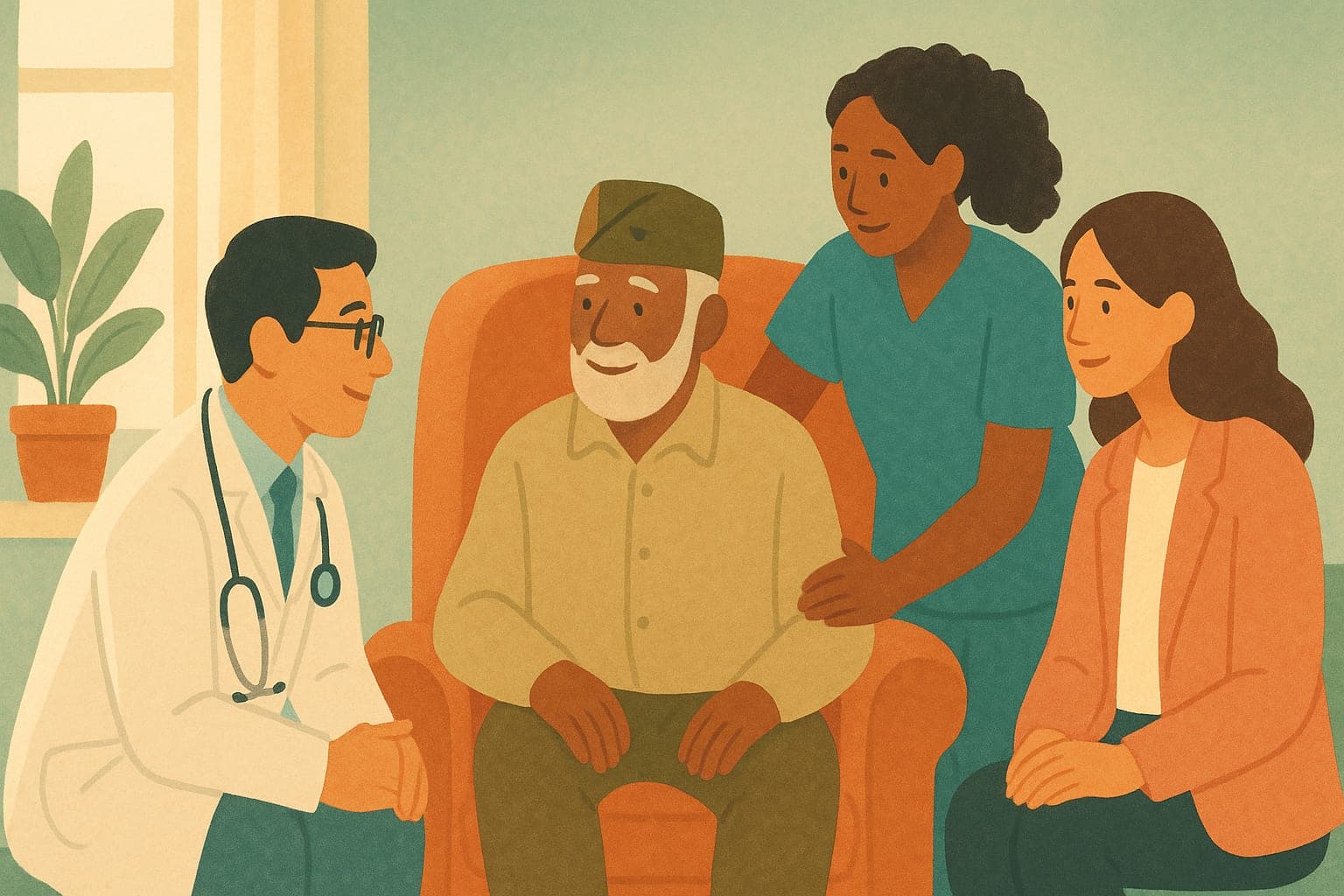
VA Home Based Primary Care (HBPC) sends a VA medical team into the veteran's home to manage complex, ongoing illness — primary care visits, care management, social work, rehabilitation, psychology, nutrition, and pharmacy. VA says veterans are "often homebound, but that is not required." HBPC is part of the VHA Standard Medical Benefits Package, so there is no separate claim to file: ask the VA primary care team or a VA social worker for a referral. Copays depend on service-connected status and income. Availability varies by location.
Key points
- HBPC brings a VA medical team into the veteran's home for ongoing primary care — VA lists primary care visits, care management, social work, rehabilitation, psychology, nutrition, and pharmacy — not a short course of home health after a hospital stay.
- You do not have to be homebound. VA states that HBPC veterans are "often homebound, but that is not required."
- Caregiver strain counts as a reason. VA says the program also serves veterans who are "isolated, or their caregiver is experiencing burden."
- There is no separate claim to file. HBPC is part of the VHA Standard Medical Benefits Package — you ask your VA primary care team or a VA social worker for a referral.
- Cost is usually modest. Service-connected care is free; otherwise a home visit is billed like a clinic visit ($15 primary care copay effective January 1, 2026, for veterans without a 10%+ rating — confirm the current figure with the VA). Any compensable service-connected disability exempts a veteran from extended care copays under 38 CFR 17.111.
- Availability is the real catch. VA's eligibility rule ends with "and it is available," and teams have geographic and staffing limits. Ask your local VA medical center directly — no website can tell you whether you qualify.
- Free help exists: VA social workers, accredited VSO representatives (VA says their services on VA benefit claims are always free), the patient advocate at your VA medical center, and the Caregiver Support Line at 1-855-260-3274.
What do most veteran families miss?
These are the easy-to-miss angles — the early-eligibility rules and quiet ways veteran families leave help on the table. Each one is explained in full below.
- Homebound status is NOT required. VA's Home Based Primary Care page says veterans are "often homebound, but that is not required." Families constantly self-disqualify because they confuse HBPC with Medicare home health, which does require the person to be confined to the home.
- Caregiver burnout is a stated reason for referral. VA says the program also serves veterans who are "isolated, or their caregiver is experiencing burden." If you are the exhausted daughter, say that out loud to the VA social worker — it is on-topic, not a complaint.
- There is no claim to file and nothing to pay a representative for. HBPC is a clinical referral inside the Standard Medical Benefits Package, so anyone charging a fee to "get you HBPC" is selling you something you can ask for free.
- People overestimate the cost. VA frames the HBPC home visit as a clinic-visit copay, not a daily long-term-care rate. And VA charges no copay for the first 21 days of geriatric or extended care in a 12-month period — which makes trying respite or adult day health care low-cost to test.
- Even a 10% compensable service-connected rating exempts a veteran from extended care copays under 38 CFR 17.111. So do annual income below the amount in effect under 38 U.S.C. 1521(b), a noncompensable zero percent service-connected disability, catastrophic disability (certain non-institutional services), and the Medal of Honor. Ask before you assume you will be charged.
- Ask about the pharmacy service specifically. An in-home medication review across every bottle in the house routinely catches duplicates, expired drugs, and interactions that no clinic visit surfaces — and pharmacy is a listed HBPC service.
- HBPC stacks. VA says it "can be used in combination with other Home and Community Based Services," so a veteran can have HBPC for the medicine and a homemaker/home health aide for bathing and dressing at the same time.
- Ask for the "Veteran Decision Aid for Care at Home or in the Community" and the "Caregiver Self-Assessment" by name. They are free VA tools that document need in writing — useful when a referral is borderline.
- Veteran-Directed Care can pay a family member. VA states the veteran can hire "their own family member or neighbor" with the managed budget. Ask about it separately from HBPC.
- Enrollment is the hidden gate. Many older veterans never enrolled in VA health care because they assumed their income disqualified them. VA Form 10-10EZ is free, VA says a decision usually takes less than 1 week, and accredited VSO help is free.
- A referral is not a decision. One VA facility states that "Referral for HBPC evaluation does not constitute acceptance into the program" — so if the first answer is no, ask what would change it and ask to be re-referred after the next hospitalization or fall.
- If HBPC is not offered in your area, ask about VA Home Telehealth as a partial substitute. VA says there is no copay for telehealth services (though in-home video visits provided in addition may carry one).
- HBPC is not age-limited. It targets medical complexity, so a younger veteran with severe chronic disease may qualify even though the program lives inside VA's geriatrics and extended care office.
What is VA Home Based Primary Care (HBPC)?
Home Based Primary Care is a VA program that brings a VA medical team to the veteran's home instead of asking the veteran to travel to a clinic. VA describes it as "health care services provided to Veterans in their home."
This is real, ongoing primary care — the HBPC team becomes the veteran's regular medical home. It is not a one-time visit and it is not a short course of therapy after a hospital stay. VA says the program is for veterans who "need team based in-home support for ongoing diseases and illnesses" that affect their health and daily activities.
HBPC is part of the VHA Standard Medical Benefits Package. In plain language: it is ordinary VA health care, just delivered at the kitchen table. There is no separate benefit application, no claim number, and no filing fee.
To give a sense of scale, a 2025 review of the program in the Journal of the American Geriatrics Society (published in the January 2026 issue) reported that VA HBPC operated more than 400 sites across 139 VA medical centers and served more than 50,000 veterans, with a mean enrollee age of 78.5 and high rates of chronic illness. Research findings describe the program overall — they do not predict what any one family will be offered.
Who is on the HBPC team, and what do they actually do at your house?
HBPC is interdisciplinary, which means several kinds of professionals share one care plan for the same veteran. VA's Home Based Primary Care page lists these services available through the program:
In practice, that can mean a nurse practitioner examining your mother in her own recliner, a pharmacist going through every pill bottle in the cabinet at once, a physical therapist watching how she actually gets from the bed to the bathroom, and a social worker who knows what else the VA can send. The exact staff mix varies by VA medical center — ask your local team who is on theirs.
There are real limits, and it helps to know them before you start. HBPC is not an emergency service, it is not around-the-clock nursing, and it is not personal care. One VA medical center's HBPC page states plainly that the program does not cover emergency care, daily nursing care, daily therapy, housekeeping or chore services, or personal care. For an emergency, call 911. For a mental health crisis, dial 988 and press 1 for the Veterans Crisis Line.
- Primary care visits at home by a physician, nurse practitioner, or physician assistant
- Care management through a nurse practitioner, physician assistant, or nurse
- Social work
- Rehabilitation (such as physical, occupational, or speech therapy)
- Psychology
- Nutrition
- Pharmacy
Who qualifies for VA Home Based Primary Care?
VA's rule is short and it has two halves. Because HBPC is part of the Standard Medical Benefits Package, VA says "all enrolled Veterans are eligible IF they meet the clinical need for the service and it is available." Both halves have to be true.
Here is what VA describes as the typical picture:
One point deserves emphasis because families disqualify themselves over it: you do not have to be strictly homebound. VA's Home Based Primary Care page says veterans "are often homebound, but that is not required." That is a meaningful difference from Medicare's home health benefit, which does require the person to be confined to the home.
Local criteria vary, and some VA medical centers describe a narrower picture than the national page does. One VA facility, for example, describes eligible veterans as those who have difficulty making and keeping clinic visits because of the severity of their illness, are often homebound, have a caregiver, and live in that team's service area. If your local page reads more strictly than the national one, ask the team directly rather than assuming you are out.
No one on the internet can tell you whether your loved one qualifies — including us. Each VA medical center evaluates referrals against its own clinical criteria and its team's capacity. One VA facility notes that "Referral for HBPC evaluation does not constitute acceptance into the program." Ask the VA.
- Enrolled in VA health care (if not, that is the first step — VA Form 10-10EZ)
- Complex, ongoing health problems that clinic-based care is not managing well
- Difficulty making and keeping clinic visits because of the severity of the illness
- Often homebound — but VA states that homebound status is not required
- Veterans who are isolated, or whose caregiver is experiencing burden
- Living inside the local HBPC team's service area (the team drives to you, so geography matters)
- Any age — this is about medical complexity, not about turning 65
How is HBPC different from home health, and from a home health aide?
These get mixed up constantly, and the difference decides who shows up at your door.
HBPC is VA's own team, providing ongoing medical primary care in the home, as part of standard VA health benefits.
VA Skilled Home Health Care is different. VA describes it as being "for Veterans needing short-term care as they are moving from a hospital or nursing home back to their home," delivered by "a community based home health agency that has a contract with VA." It can include nursing, physical, occupational, and speech therapy, patient education, IV antibiotics or home infusion, home safety evaluations, and social work. VA says enrolled veterans are eligible "IF they are eligible for community care and meet the clinical criteria for the service."
Homemaker and Home Health Aide services are different again. VA describes a homemaker or home health aide as "a trained person who can come to a Veterans home and help the Veteran take care of themselves and their daily activities." VA states these aides "are not nurses, but they are supervised by a registered nurse." They help with eating, getting dressed, personal grooming, bathing, using the bathroom, moving around, and grocery shopping. This also requires community care eligibility plus clinical criteria plus availability.
Medicare home health is a separate thing that many veterans also have. Under federal rules at 42 CFR 409.42, Medicare requires that the beneficiary be confined to the home, be under a plan of care established by a physician or allowed practitioner, need intermittent skilled nursing or physical, speech-language, or (in certain circumstances) occupational therapy, and receive the services from a participating home health agency. That homebound requirement is a real difference from HBPC.
The good news: these can stack. VA states that "Home Based Primary Care can be used in combination with other Home and Community Based Services."
What does HBPC cost, and will there be a copay?
Care for a service-connected condition is free. VA states: "You can get free VA health care for any illness or injury that we determine is connected to your military service." Beyond that, it depends on the veteran's service-connected disability status and financial information.
VA's Home Based Primary Care page says: "A copay for Home Based Primary Care may be charged based on your VA service-connected disability status and financial information." The mental model VA uses is a clinic visit copay, not a daily long-term-care bill. VA's published outpatient copay rates effective January 1, 2026 list primary care at $15 per visit and specialty care at $50 per visit, and those rates apply to veterans who do not have a service-connected disability rating of 10% or higher. Rates change — VA updates them, so confirm the current amount with the VA.
Extended care (long-term care) copays run on a separate schedule and are worth knowing because families often mix them up with HBPC. Effective January 1, 2026, VA charges no copay for the first 21 days of geriatric or extended care in a 12-month period. After that, adult day health care and other outpatient (non-institutional) extended care is up to $15 per day, inpatient or nursing home care is up to $97 per day, and domiciliary care is up to $5 per day.
Federal regulation 38 CFR 17.111 lists broad exemptions from extended care copays. These include a veteran with a compensable service-connected disability; a veteran whose annual income is less than the amount in effect under 38 U.S.C. 1521(b); care for a noncompensable zero percent service-connected disability; catastrophically disabled veterans (for certain non-institutional services); Medal of Honor recipients; care for sexual trauma under 38 U.S.C. 1720D; care for psychosis or another mental illness; and care authorized under 38 U.S.C. 1710(e) for Vietnam-era herbicide-exposed, radiation-exposed, Persian Gulf War, post-Gulf War combat-exposed, and Camp Lejeune veterans. Ask the VA whether an exemption applies to you — many families who assume they will be charged are exempt.
Do not guess at your number. VA's instruction is to contact your VA social worker or case manager to complete VA Form 10-10EC to learn the amount of your copay. (VA's forms page titles this form "Application for Extended Care Services"; several VA geriatrics pages still call it the "Application for Extended Care Benefits" — it is the same 10-10EC.) Ask for the figure in writing. Medications may still carry their own copays: effective January 1, 2026, a tier 1 preferred generic is $5 for a 1-30 day supply, and once you have been charged $700 in medication copays in a calendar year you pay no more that year.
How do I ask the VA for Home Based Primary Care?
There is no application form for HBPC itself. It is a clinical referral, which means the request travels through the veteran's VA care team. Here is the path most families take:
Two things to expect. First, a referral is a request, not an approval — an HBPC nurse or provider will usually come out and evaluate. Second, if the answer is no today, it may be yes in six months. Conditions change, and so does team capacity.
You never have to pay anyone to do these steps. Accredited Veterans Service Organization (VSO) representatives help at no cost, and VA social workers are free. Nothing on this list requires a paid preparer.
- 1. Make sure the veteran is enrolled in VA health care. If not, apply with VA Form 10-10EZ online, by mail, in person at a VA medical center, or by calling VA's toll-free line at 877-222-8387, Monday through Friday, 8:00 a.m. to 8:00 p.m. ET. VA says the decision usually takes less than 1 week. A free accredited VSO representative can help you file it.
- 2. Tell the VA primary care team, using the program's name: "I would like a referral for Home Based Primary Care." Ask at the next appointment, through secure messaging, or by calling the clinic.
- 3. Ask to speak with a VA social worker. VA says your VA physician or social worker can tell you whether a Home Based Primary Care program is available in your area. VA publishes a directory of social work leaders by state.
- 4. Bring the facts. Missed or cancelled appointments, falls, ER visits and hospital stays in the last six months, a full medication list, and how many hours a day someone is helping.
- 5. Ask for the "Veteran Decision Aid for Care at Home or in the Community" and the "Caregiver Self-Assessment." These are free VA tools that put the need — including the caregiver's strain — in writing.
- 6. Ask about copays before the first visit, and complete VA Form 10-10EC with the social worker to learn your actual amount.
- 7. If you are turned down, ask why, ask what would change the answer, and ask to be re-referred if the veteran's condition worsens. Your VA medical center's patient advocate can help you push.
What if HBPC is not available where we live, or there is a wait?
We want to be straight with you about this. VA's own eligibility sentence ends with the words "and it is available." Availability is not a formality — it is part of the rule.
HBPC teams drive to homes, so every team has a geographic service radius, and staffing limits how many veterans a team can carry at once. The Journal of the American Geriatrics Society review of the program described geographic restrictions that limit rural access and staffing constraints that hold back expansion, and noted a VA plan to add 75 HBPC teams by the end of fiscal year 2026. Whether that plan was fully carried out is something to confirm with your local VA. What it means for your family is that coverage and wait times vary a lot between VA medical centers. Ask your local team directly rather than assuming either way.
While you wait — or if the answer is no — ask your VA social worker about the other home and community based services. VA Home Telehealth (remote patient monitoring) lets VA track vitals like blood pressure, blood sugar, pulse, weight, and blood oxygen from home; VA says telehealth is part of the VHA Standard Medical Benefits Package, that "there is no copay for Telehealth services," and that there may be a copay when in-home video visits are provided in addition to standard telehealth. Skilled home health care, homemaker and home health aide services, adult day health care, respite care, palliative care, hospice care, Veteran-Directed Care, and PACE are all separate doors into the same house.
Also ask whether community care applies. VA's access standards are a 30-minute average drive time or a 20-day wait for primary care, mental health, and extended outpatient (non-institutional) care, and a 60-minute average drive time or 28-day wait for specialty care. Community care must be approved by VA before you receive it, except in urgent or emergency situations — do not go out and arrange care yourself and expect VA to pay.
Can HBPC work alongside community care, an aide, or the caregiver stipend?
Yes, and this is where families leave the most on the table. VA states that "Home Based Primary Care can be used in combination with other Home and Community Based Services."
A common working combination looks like this: HBPC handles the medicine and the medical decisions; a homemaker or home health aide handles bathing, dressing, and meals; respite care gives the family a break (VA says nursing home respite is available for a maximum of 30 days per calendar year); and adult day health care gives the veteran somewhere to go and the caregiver a weekday afternoon back. Each of these has its own eligibility rules and its own copay determination.
Veteran-Directed Care is worth asking about by name. VA describes it as giving "Veterans of all ages the opportunity to receive the Home and Community Based Services they need in a consumer-directed way," with a budget managed by the veteran or the veteran's representative — and VA states the veteran can hire "their own family member or neighbor." VA says enrolled veterans are eligible if they are eligible for community care, meet the clinical criteria, and it is available.
The Program of Comprehensive Assistance for Family Caregivers (PCAFC) is a separate program with its own rules, run through VA's Caregiver Support Program. VA lists requirements including a VA disability rating (individual or combined) of 70% or higher, a need for at least 6 months of continuous, in-person personal care, and enrollment in VA health care; the caregiver must be at least 18 and either related to the veteran or living with them full time. Both sign VA Form 10-10CG. Approved primary family caregivers may receive a monthly stipend, CHAMPVA coverage if not already entitled to care under another health plan, mental health counseling, legal and financial planning assistance, travel benefits, and at least 30 days of respite care per year. VA says it will assign a decision no later than 90 days after receiving the application. Caregivers who do not qualify may still get help through the Program of General Caregiver Support Services.
Finally, many veterans also have Medicare. Medicare home health is a separate benefit with its own homebound requirement — having one does not automatically cancel the other. Ask VA and ask the Medicare plan, and get both answers before you decide.
Who can help our family for free, and what should we watch out for?
Start with the VA social worker at your VA medical center. For this particular program, that is the single most useful person you can reach — they know whether an HBPC team covers your ZIP code, what the local criteria look like, and what to ask for instead if it does not. VA states that "there is a Social Work leader in every VA health care system to help you get the care you need."
Accredited representatives can help at no cost. VA states that "the services an accredited VSO representative provides on your VA benefit claims are always free," while an accredited attorney or claims agent "can charge you fees for their services." VA runs a search tool to find an accredited representative near you, and you can call VA at 800-698-2411, ext. 0 (TTY 711) with questions about finding or appointing one.
Caregivers can call VA's Caregiver Support Line at 1-855-260-3274, which provides information on support services, counseling, and education, and can connect callers to local VA Caregiver Support Program teams. Every VA medical center also has a patient advocate whose job is to unstick things when the system is not moving.
Be careful with anyone who asks for money up front to "get you VA benefits," especially anyone wanting a cut of a retroactive payment or a fee to fill out a VA health care form. HBPC is a clinical referral, not a claim — there is nothing to pay a preparer for. Free accredited help exists. If someone is charging, verify their accreditation with VA before you sign anything.
One last thing, in the interest of honesty: SoCal Home Health is not affiliated with, endorsed by, or connected to the U.S. Department of Veterans Affairs, and nothing here is a promise of eligibility. This page is free education. Every eligibility and cost decision comes from the VA.
Frequently asked questions
Does the veteran have to be homebound to get HBPC?
No. VA's Home Based Primary Care page says veterans in the program "are often homebound, but that is not required." That is different from Medicare home health, where federal rules at 42 CFR 409.42 do require the beneficiary to be confined to the home. Many families rule themselves out over this and should not. Local VA teams still apply their own clinical criteria, so ask.
Is HBPC free?
Care for a service-connected condition is free — VA says you can get free VA health care for any illness or injury it determines is connected to your military service. Otherwise, VA says a copay for HBPC "may be charged based on your VA service-connected disability status and financial information." VA's published outpatient primary care copay is $15 per visit effective January 1, 2026, for veterans without a 10% or higher service-connected rating — confirm the current amount with the VA. Veterans with a compensable service-connected disability, or annual income below the amount in effect under 38 U.S.C. 1521(b), are exempt from extended care copays under 38 CFR 17.111. Complete VA Form 10-10EC with a VA social worker to learn your actual amount.
Will the HBPC team bathe and dress my father?
No. HBPC is medical care — the team covers primary care visits, care management, social work, rehabilitation, psychology, nutrition, and pharmacy. Help with bathing, dressing, grooming, toileting, and meals comes from VA's Homemaker and Home Health Aide services, or from Veteran-Directed Care, where the veteran manages a budget and VA says can hire "their own family member or neighbor." Those are requested separately, and VA says HBPC can be used in combination with them.
What if the VA says HBPC is not offered where we live?
Availability is written into the eligibility rule — VA says enrolled veterans are eligible "IF they meet the clinical need for the service and it is available." HBPC teams drive to homes, so rural and outlying areas are often outside a team's radius. Ask what is available instead: home telehealth, skilled home health care through community care, homemaker and home health aide services, adult day health care, respite, palliative care, or PACE. Also ask whether VA's community care access standards (a 30-minute average drive time or 20-day wait for primary care) apply to your situation.
Does having Medicare stop us from using HBPC?
No. What matters for HBPC is enrollment in VA health care. Medicare home health is a separate benefit with its own homebound requirement and its own participating agencies. Many families use VA and Medicare side by side. Talk to the VA social worker and to the Medicare plan before assuming one cancels the other.
How long does HBPC last?
It is ongoing care, not a fixed number of visits. Veterans stay enrolled as long as they meet the clinical criteria and the service remains available. HBPC teams also support palliative planning and end-of-life care at home; a 2025 review of the program in the Journal of the American Geriatrics Society reported that 62.1% of HBPC-enrolled veterans died at home. Your local team can tell you how it works there.
We asked and were told no. Is that final?
Not necessarily. One VA facility's HBPC page notes that "Referral for HBPC evaluation does not constitute acceptance into the program" — the evaluation is a real clinical step, and criteria and team capacity both change over time. Ask why the answer was no, ask what would change it, and ask to be re-referred if the veteran's condition worsens. Your VA medical center's patient advocate can help you escalate, and an accredited VSO representative can help at no cost.
Need care at home? We will connect you.
Skilled nursing, therapy, personal care, and recovery help — right at home, from trusted local providers. Tell us what you need and we will take it from there. Free, no obligation.
Get home-health careSources
- VA Geriatrics and Extended Care — Home Based Primary Care
- VA Home Based Primary Care fact sheet (PDF)
- VA Geriatrics and Extended Care — Home and Community Based Services
- VA Geriatrics — Skilled Home Health Care
- VA Geriatrics — Homemaker and Home Health Aide Care
- VA Geriatrics — Veteran-Directed Care
- VA Geriatrics — Respite Care (30-day nursing home respite limit)
- VA Geriatrics — Adult Day Health Care
- VA Geriatrics — Telehealth / Remote Patient Monitoring
- VA Geriatrics — Veteran Decision Aid for Care at Home or in the Community
- Current VA health care copay rates (effective January 1, 2026)
- VA — Long-term care benefits
- VA — Cost of care and copay exemptions
- 38 CFR 17.111 — Copayments for extended care services (GovInfo, 2024 CFR edition)
- VA Form 10-10EC — Application for Extended Care Services
- VA — How to apply for VA health care (Form 10-10EZ; 877-222-8387)
- VA Community Care — eligibility and access standards
- VA — Program of Comprehensive Assistance for Family Caregivers (PCAFC)
- VA Caregiver Support Line (1-855-260-3274)
- VA — Get help from an accredited representative (VSO help is free; 800-698-2411 ext. 0)
- VA Social Work — directory of social work leaders by state
- VA Coatesville health care — Home Based Primary Care program page (facility-level criteria and exclusions)
- 42 CFR 409.42 — Medicare home health beneficiary qualifications (GovInfo, 2024 CFR edition)
- Home-Based Primary Care in the Department of Veterans Affairs: Past, Present, and Future — J Am Geriatr Soc, 2025 (January 2026 issue), PubMed Central
- VA Greater Los Angeles health care — health services (geriatrics, caregiver support, social work)
Related guides
- VA Caregiver Support: The PCAFC Stipend and Free PGCSS Help, Explained
- VA Aid and Attendance: Extra Monthly Money for Veterans and Spouses Who Need Help at Home
- Medicare Home Health Care: Who Qualifies and What It Costs
- How California Families Pay for Home Care
- Respite Care: How Family Caregivers Get a Much-Needed Break
- Caregiver Burnout: How to Spot It and Get Real Help in Southern California
- Bringing an Older Parent Home From the Hospital or Rehab: A Southern California Family Guide
- Managing Medications Safely for an Older Adult at Home
- Caring for Someone With Dementia at Home: A Southern California Caregiver's Guide
- Hospice, Palliative Care, and Home Health: What's the Difference?
- Benefits and Eligibility Shortcuts Many California Families Miss
- Where to Start: California Aging & Disability Help
This guide is educational and is not medical advice. In an emergency, call 911.