
Veterans
VA Adult Day Health Care: A Safe, Structured Day for Your Veteran — and Hours Back for You
Last reviewed August 3, 2026
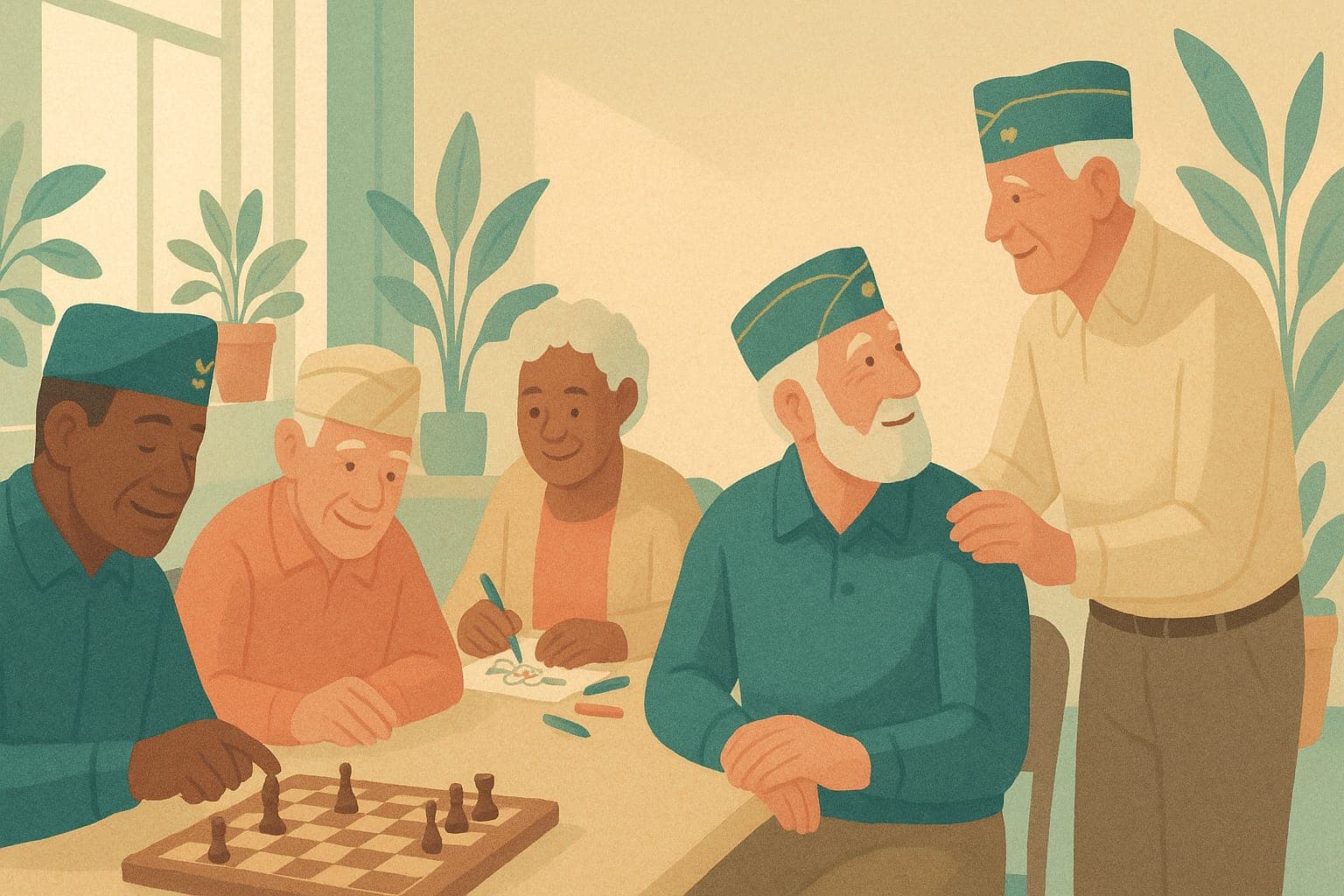
VA Adult Day Health Care (ADHC) is a supervised daytime program where an enrolled veteran gets social activities, nursing oversight, therapies and meals — while the family caregiver gets hours back. Programs run half-day or full-day, several days a week, at VA medical centers, State Veterans Homes, or community organizations. The first 21 days of extended care in a 12-month period cost nothing; after that the copay is up to $15 a day (effective January 1, 2026), based on your finances. Ask your VA social worker for a referral.
Key points
- Adult Day Health Care is a supervised daytime program — social activities, nursing oversight, therapies, and meals — and your veteran comes home at night. It is not a nursing home.
- The first 21 days of geriatric or extended care in a 12-month period have no copay at all. After that, adult day health care is billed at up to $15 per day (effective January 1, 2026) based on the level of care and your finances, and many veterans pay less or nothing. Confirm the current rate with the VA.
- Eligibility has four parts: enrolled in VA health care, eligible for community care, meets the clinical criteria, and a program is actually available near you. The last one is the most common roadblock — and only the VA can decide any of them.
- Your VA social worker is the door. The VA says the social worker can help find a center near your home and assist with arrangements — you do not need to find one yourself first.
- Ask about transportation before you enroll. VA says help "may" be available; California's CBAS centers are required to provide it. The two programs are not the same.
- In California, "ADHC" under Medi-Cal ran through February 2012 and became CBAS in April 2012. A veteran with both VA health care and Medi-Cal should ask both systems separately — neither will check the other.
- Help with the paperwork is free. Accredited VSO representatives and County Veterans Service Officers charge nothing, and attorneys generally cannot charge for an initial claim. Be wary of anyone who wants a fee or a percentage.
What do most veteran families miss?
These are the easy-to-miss angles — the early-eligibility rules and quiet ways veteran families leave help on the table. Each one is explained in full below.
- The 21 free days reset on a rolling 12-month basis, not per admission. A family attending one day a week gets roughly five months of care before any copay starts — enough to test whether the program works before spending a dollar.
- "Up to $15 a day" is a cap, not a price. The VA bases your copay on the level of care plus the financial information on VA Form 10-10EC. Families who skip the form or assume the worst often never find out they owe far less — or nothing.
- Whole categories of veterans are exempt from extended care copays under 38 CFR 17.111 — including veterans with a compensable service-connected disability, veterans with income below the 38 U.S.C. 1521(b) threshold, catastrophically disabled veterans (for certain non-institutional services), Medal of Honor recipients, and veterans who meet the definition of Indian or urban Indian for non-institutional care on or after January 5, 2022. Ask the VA to check your exemption status in writing rather than assuming.
- If your veteran is married and the spouse still lives at home, the community spouse resource allowance shields household assets from the copay calculation — the VA lists $162,660 for 2026, up from $157,920 in 2025. Married families who never mention the spouse can end up quoted a higher copay than they owe. Confirm the current figure with the VA.
- Under 38 CFR 17.111, a change in your financial circumstances should be reported to a VA medical facility within 10 days — and it can lower your copay. Most families think of the 10-10EC as a one-time hurdle.
- State Veterans Homes are an overlooked venue. The VA pays state homes a per diem specifically for adult day health care (38 U.S.C. 1741 and 1745; 38 CFR Part 51), so a state home near you may run a day program even though your veteran does not live there.
- Adult day attendance is one of the VA's recognized ways to deliver respite care. If you are being told respite is not available, ask whether an adult day program can serve the same purpose.
- In California, a veteran on both VA health care and Medi-Cal has two separate doors — VA ADHC and Medi-Cal CBAS. Some families use one while the other is being sorted out. Neither system will check the other on your behalf.
- Ask whether a half-day schedule is an option. For a veteran who tires easily or resists the idea at first, half days are often the difference between a program that sticks and one that gets abandoned in week two.
- Beneficiary travel pay is a separate benefit from the center's van. Veterans with a 30% or higher rating, or income below the maximum annual VA pension rate, among others, may be reimbursed for mileage, parking, and tolls — but the VA says claims filed after 30 days are usually denied.
- Keep the community care approval letter and note its expiration. Care lapses most often because nobody requested renewal in time, not because eligibility ended.
- PACE (age 55+, eligible for nursing home care, able to live safely in the community) includes day-center care but becomes the sole source of Medicare and Medicaid services for enrollees. Worth knowing about — and worth reading carefully before enrolling.
- The California statewide aging line is 1-800-510-2020, not the 1-800-677-1116 number that circulates online. That second number is the national Eldercare Locator, which the California Department of Aging lists for people outside California.
What is VA Adult Day Health Care, and what does a day there actually look like?
The VA describes Adult Day Health Care as "a program Veterans can go to during the day for social activities, peer support, companionship, and recreation." It is not a nursing home and it is not an overnight stay. Your loved one goes in the morning, spends the day in a supervised setting with other people, and comes home.
The VA says the program is for veterans who need "help with activities of daily living. Examples include help with bathing, dressing, or fixing meals," and that "health services such as care from nurses, therapists, social workers, and others may also be available." Federal regulation (38 CFR 17.111) defines adult day health care as "a therapeutic outpatient care program that provides medical services, rehabilitation, therapeutic activities, socialization, nutrition and transportation services to disabled veterans in a congregate setting."
Schedules are flexible. The VA states: "Adult Day Health Care can be a half-day or full-day program. Usually, you would go to an Adult Day Health Care center several times a week." That structure is the point — it is predictable enough that a family caregiver can hold a job, sleep, go to their own doctor, or simply rest.
Exact activities vary a lot from center to center, so treat the list below as what these programs commonly include rather than a guarantee. Ask each program what it actually offers.
- Supervision and personal care during the day — help with toileting, walking, eating, and safety
- Nursing oversight: medication reminders, blood pressure and blood sugar checks, watching for changes
- Therapies where offered — physical, occupational, or speech therapy
- Structured social time: group activities, music, exercise, holidays, conversation in the veteran's own language where the center supports it
- Meals and snacks, often with attention to diabetic, low-sodium, or cultural diets
- Social work support for the veteran and the family
- Transportation to and from the center in many (not all) programs
- A built-in break for the family caregiver — the VA counts adult day programs as one way to deliver respite care
Who qualifies for VA Adult Day Health Care?
The VA's own wording is short and worth reading carefully: "All enrolled Veterans are eligible for Adult Day Health Care IF they are eligible for community care and meet the clinical criteria for the service and it is available."
That sentence has four separate conditions in it, and each one is a place where families get stuck. Nobody on a website can tell you whether your veteran qualifies — that is a VA clinical decision. Nothing here is an eligibility determination. But knowing the four gates helps you ask better questions.
The last condition — "and it is available" — is the one families are least prepared for. VA long-term care services vary by location, and there may not be a program with an open seat near you. Ask your VA social worker directly whether a program exists in your ZIP code and whether there is a waiting list.
Adult Day Health Care is part of VA's standard long-term care offerings, alongside geriatric evaluation, homemaker and home health aide care, respite care, and skilled home health care. You do not need a service-connected disability rating to be considered — but your rating and income do affect what you pay. If you want help with any of this, an accredited Veterans Service Organization representative will assist you for free.
- Enrolled in VA health care. The VA says veterans "must be enrolled in VA health care before applying for VA long term care services."
- Eligible for community care, if the program is run by a non-VA organization. VA community care eligibility can rest on things like drive-time and wait-time standards (a 30-minute average drive time or 20-day wait for primary and mental health care; 60 minutes or 28 days for specialty care), a service not being available at any VA health facility, or you and your VA provider agreeing it is in your best medical interest.
- Meets the clinical criteria — a VA clinician documents that the veteran needs this level of daytime care. This typically means help with activities of daily living, cognitive changes, isolation, or significant caregiver strain.
- A program is actually available near you and has capacity.
Is the program run by the VA, or by a community organization?
Both, depending on where you live. The VA states the program "may be provided at VA medical centers, State Veterans Homes, or community organizations." These three routes look different to a family, and the difference matters for cost, paperwork, and travel time.
A VA-run program sits inside or next to a VA medical center. A community program is a private or nonprofit adult day center that the VA contracts with, which usually means the referral goes through VA community care. A State Veterans Home program is a third path: under the VA's State Home Per Diem Program, the VA pays state veterans homes a daily rate for nursing home care, domiciliary care, and adult day health care, under authorities including 38 U.S.C. 1741 and 1745 and 38 CFR Part 51.
If the program is a community one, expect the VA community care referral process: your VA health care team reviews the request to confirm you are eligible — the VA says "this part of the process can take up to 14 days" — and the VA then sends an approval letter with an authorization number, information about the approved in-network provider, a description of the care you can get, and how long you can keep getting care before another referral is needed. Keep that letter. Families lose weeks re-requesting care they were already approved for.
In Southern California, community adult day centers are often the practical answer simply because of traffic and distance. Ask whether the VA has an existing contract with a center near you — a center that already bills the VA is far easier than one that has never done it.
Will we have to pay? The first 21 days and the daily copay cap
This is the part most families get wrong, and it usually works in your favor. The VA's copay page states that you will not need to pay a copay for geriatric care (also called elder care) or extended care (also called long-term care) for the first 21 days of care in a 12-month period. Those 21 days are free, and the clock runs on a rolling 12-month basis.
Starting on the 22nd day, the VA says it bases your copay on two things: the level of care you are receiving, and the financial information you provide. Adult day health care is billed as outpatient extended care, and the published rate is up to $15 per day, effective January 1, 2026. For comparison, inpatient extended care — a nursing home or community living center stay, or overnight respite — is up to $97 per day, and domiciliary care for homeless veterans is up to $5 per day, both effective January 1, 2026. The same three figures applied for calendar year 2025, so those amounts have been stable — but VA copay rates are reviewed each year, so always confirm the current figure with the VA before you plan around it.
The words "up to" are doing real work. The VA sets your amount from the financial information you provide on VA Form 10-10EC, Application for Extended Care Services (revision date July 2017). Many veterans pay less than the cap, and some pay nothing at all. Federal rule 38 CFR 17.111 exempts several groups from extended care copays entirely — including veterans with a compensable service-connected disability, veterans with annual income below the threshold in 38 U.S.C. 1521(b), catastrophically disabled veterans (for certain non-institutional services), Medal of Honor recipients, and veterans who meet the definition of Indian or urban Indian for non-institutional care provided on or after January 5, 2022. Other exemption categories exist as well. Do not assume you are or are not exempt — ask the VA to check your status in writing.
If your veteran is married and the spouse still lives at home and is not also receiving extended care, the community spouse resource allowance (CSRA) protects household assets from the copay calculation. The VA lists the 2026 CSRA as $162,660. This figure is adjusted annually — the 2025 amount was $157,920 — so confirm the current amount with the VA.
- Ask your VA social worker or case manager to help you complete VA Form 10-10EC — do not guess at it alone. An accredited VSO representative can also help, at no charge.
- Ask specifically: "Am I exempt from extended care copays, and why or why not?"
- Track your 21 free days. Going one day a week, they last roughly five months.
- Under 38 CFR 17.111, if your financial circumstances change you are expected to report the change to a VA medical facility within 10 days — and a change could lower your copay.
- Adult day health care is billed at the outpatient rate, not the $97 inpatient rate. If you get a bill at the higher rate, question it.
How does my loved one get to and from the program?
The VA says: "You may be able to get assistance with transportation to and from an Adult Day Health Care center." That is deliberately soft language — transportation depends on the program and your VA facility, so make it one of your very first questions rather than an afterthought.
Many community adult day centers run their own vans, and door-to-door pickup is often the single feature that makes the program workable for a family. California's CBAS program requires its centers to provide "transportation to and from the participant's residence" — the VA has no equivalent blanket requirement, so ask.
Separately, VA beneficiary travel pay may reimburse mileage, parking, and tolls for travel to a VA health facility or for VA-approved care at a non-VA facility. Veterans may qualify if they meet at least one criterion, such as having a VA disability rating of 30% or higher, being treated for a service-connected condition, receiving a VA pension, having income below the maximum annual VA pension rate, or being unable to afford the travel. Ambulance or specially equipped vehicle transport ("special mode") needs advance approval from a VA provider except in emergencies. The VA says you can still file a claim after 30 days, "but claims filed after the 30-day limit are usually denied." Confirm the current mileage rate and any deductible with the travel office at your VA facility — we could not confirm a current published rate.
If neither works, ask your county Area Agency on Aging about local senior transportation. The California Department of Aging lists an information and assistance contact for every county, plus a statewide number, 1-800-510-2020. (The often-quoted 1-800-677-1116 is the national Eldercare Locator, which the Department of Aging lists for people outside California.)
How is VA Adult Day Health Care different from California's CBAS program?
This confuses almost every California family, because California used to have a Medi-Cal program literally called Adult Day Health Care — and it no longer exists. Per the Department of Health Care Services, ADHC was an optional Medi-Cal benefit "through February 29, 2012," and Community-Based Adult Services (CBAS) "became effective on April 1, 2012." So in California, "ADHC" now almost always means the VA program, and "CBAS" means the Medi-Cal one.
CBAS is described by the California Department of Aging as "a community-based day health program that provides services to older adults and adults with chronic medical, cognitive, or behavioral health conditions and/or disabilities that make them at risk of needing institutional care." CBAS centers provide professional nursing; physical, occupational and speech therapies; mental health services; therapeutic activities; social services; personal care; hot meals with nutritional counseling; and transportation to and from the participant's residence. Participants must be 18 or older, meet medical necessity criteria, and have current Medi-Cal eligibility under a qualifying aid code. DHCS states that eligibility "is determined by the beneficiary's Medi-Cal Managed Care Plan," and that other beneficiaries who cannot enroll in managed care may be found eligible "through the Los Angeles Medi-Cal Field Office, or its designee."
In practice: VA ADHC is a VA benefit tied to VA enrollment and clinical need, with a possible VA copay. CBAS is a Medi-Cal benefit tied to Medi-Cal eligibility and medical necessity, decided by your health plan. A veteran who has both VA health care and Medi-Cal may be able to look at both doors. Ask the VA social worker and the Medi-Cal managed care plan separately — neither one will automatically check the other.
There is a third option worth naming: PACE, the Program of All-Inclusive Care for the Elderly. The VA says you must be age 55 or older, live in the service area of a PACE organization, be eligible for nursing home care, and be able to live safely in the community — and that "the PACE program becomes the sole source of services for Medicare and Medicaid eligible enrollees." That last point is important: joining PACE changes how all of your care is delivered, so read carefully before enrolling. Original Medicare generally does not pay for ongoing adult day programs; confirm coverage directly with Medicare or your plan before assuming.
How do we ask for VA Adult Day Health Care, step by step?
The VA is direct about the starting point: your VA social worker can help you find an Adult Day Health Care center near your home, if one is available, and assist with making arrangements. The social worker is the door. You do not need to find a center yourself first.
Do not wait for a crisis. Adult day programs are most useful when the veteran can still enjoy them and the caregiver still has enough energy to make the schedule work. Waiting until after a fall or a hospital stay narrows your options.
If you are stuck, the VA health benefits hotline is 877-222-VETS (877-222-8387), and MyVA411, the main VA information line, is 800-698-2411. The VA Caregiver Support Line is 1-855-260-3274, Monday through Friday, 8:00 a.m. to 8:00 p.m. Eastern Time — that line can connect you to your local Caregiver Support Team, who often know exactly which adult day programs your VA works with. Free, accredited help with any VA paperwork is also available through a Veterans Service Organization representative or your County Veterans Service Office.
- Make sure the veteran is enrolled in VA health care. If not, enroll first (VA Form 10-10EZ, or apply online) — the VA says enrollment is required before applying for VA long term care services.
- Ask the VA primary care team or a VA social worker for an Adult Day Health Care evaluation. Say plainly what is happening at home: the wandering, the falls, the missed medications, the fact that you cannot leave the house.
- Ask for the clinical assessment that documents the need. This is what unlocks the service.
- Complete VA Form 10-10EC (Application for Extended Care Services) with the social worker or a free accredited representative to establish your copay — including whether you are exempt.
- If the program is in the community, expect a community care referral. The VA says that review can take up to 14 days; you will get an approval letter with an authorization number, the approved provider, the care approved, and how long the approval lasts.
- Tour at least two centers before choosing. Bring someone else with you.
- Start with a trial schedule — often one or two days a week — and increase it once your veteran settles in.
- Save the authorization letter and note when it expires, so you can request renewal before care stops.
What should I ask when I tour an adult day program?
A tour tells you more in an hour than any brochure. Go at midday when the program is busy, not at 8 a.m. when it is empty. Watch the room before you talk to the director: are people engaged, or parked in front of a television? Do staff use participants' names? Does it smell clean?
Bring a written list. Under stress, families forget to ask the questions that turn out to matter most — transportation, language, bathroom help, and what happens on a bad day.
One more thing to check quietly: does the center know how to bill the VA? A center that has never worked with VA community care can create months of confusion, even if the program itself is lovely.
- Are you contracted with the VA, and have you served VA-referred veterans before?
- Do you provide transportation from my ZIP code, and what is the pickup window?
- What staff are on site — a registered nurse? A social worker? Therapists? What is the staff-to-participant ratio?
- What languages do your staff speak, and what foods do you serve?
- How do you handle toileting and incontinence? Bathing?
- Can you give medications, insulin, or tube feedings?
- What is your plan if my loved one becomes agitated, tries to leave, or falls?
- What experience do you have with dementia, stroke recovery, Parkinson's, or whatever my loved one has?
- What is a typical day's schedule? Can I see today's activity calendar?
- Half-day and full-day options — what do the hours actually look like?
- How do you communicate with families about a bad day, a refusal, or an injury?
- Are you licensed and inspected, and can I see your most recent inspection results?
- What would I owe if the VA authorization runs out or is not renewed?
Who can help us for free — and what should we watch out for?
You do not have to figure this out alone, and you should not pay someone to do it. VA-accredited Veterans Service Organization representatives help with VA benefit claims at no charge — the VA states plainly that "the services an accredited VSO representative provides on your VA benefit claims are always free." The VA also notes the contrast: "an accredited attorney or claims agent can charge you fees for their services." You can find an accredited representative through the VA's own search tool.
In California, County Veterans Service Offices (CVSOs) are locally funded offices that help veterans and their families obtain benefits and connect to local resources, and CalVet recommends working with the CVSO nearest you. Every Southern California county has one — Los Angeles, Orange, San Diego, Riverside, San Bernardino, Ventura, Santa Barbara, and Imperial — and their help is free.
Be cautious with anyone who cold-calls, knocks on your door, or advertises that they will "get you VA benefits" for a fee or a percentage. Under 38 CFR 14.636, an accredited attorney or claims agent generally may not charge a fee for preparing an initial claim; fees are permitted only after VA has issued an initial decision and a power of attorney and fee agreement are on file. Accredited VSO representatives never charge for claims help at all. Nobody should be asking for your bank details or a share of a future benefit to enroll you in an adult day program.
Two more free resources: the VA Caregiver Support Line at 1-855-260-3274 (Monday–Friday, 8:00 a.m.–8:00 p.m. ET), and your county's Area Agency on Aging, reachable through the California Department of Aging's county list or the statewide number 1-800-510-2020.
SoCal Home Health is an independent educational resource. We are not affiliated with, endorsed by, or acting on behalf of the U.S. Department of Veterans Affairs, CalVet, or any state agency, and nothing here is an eligibility determination. Always confirm your own situation with the VA.
Frequently asked questions
Is Adult Day Health Care the same as a nursing home?
No. Adult Day Health Care is a daytime program — your loved one comes home at the end of the day. The VA treats it as non-institutional, outpatient extended care, and 38 CFR 17.111 defines non-institutional care as care that does not include an overnight stay. That distinction matters for cost too: the VA lists outpatient adult day health care at up to $15 per day versus up to $97 per day for inpatient nursing home care, both effective January 1, 2026. Confirm current rates with the VA.
Does my veteran need a service-connected disability rating to qualify?
No. The VA says all enrolled veterans are eligible if they are eligible for community care, meet the clinical criteria, and the service is available. A disability rating is not one of those four gates. However, your rating and your income do affect your copay — 38 CFR 17.111 exempts veterans with a compensable service-connected disability from extended care copays, among other groups. Ask the VA to confirm your specific status; an accredited VSO representative can help you do that for free.
How much will this cost us?
The first 21 days of geriatric or extended care in a 12-month period have no copay. After that, adult day health care is billed at up to $15 per day, effective January 1, 2026. The word "up to" matters — the VA sets your actual amount from the level of care and the financial information on VA Form 10-10EC, and many veterans pay less or nothing. VA copay rates are reviewed annually, so confirm the current rate and your own amount with the VA.
Can this count as respite so I can take a break?
Yes, that is one of its recognized uses. The VA lists attending an Adult Day Health Care center as one of the ways respite care is delivered, alongside a paid home health aide coming to the home and a stay in a nursing home. The VA notes that nursing home respite specifically is available for a maximum of 30 days per calendar year; no equivalent annual limit is published for adult day respite. Ask your VA social worker how adult day attendance and respite days interact in your case.
We live in California and someone told us about CBAS. Which one do we want?
They are two different programs. California's Medi-Cal Adult Day Health Care benefit ran through February 29, 2012 and Community-Based Adult Services (CBAS) became effective April 1, 2012. CBAS requires Medi-Cal eligibility under a qualifying aid code plus medical necessity, is generally decided by your Medi-Cal managed care plan, and CBAS centers must include transportation. VA Adult Day Health Care is a VA benefit decided by VA clinicians. A veteran with both VA health care and Medi-Cal can ask about both — the two systems will not check each other for you.
Will the program pick my father up, or do I have to drive him?
It depends on the program. The VA says you "may be able to get assistance with transportation" to and from a center, which is not a guarantee — ask before you enroll. Many community centers run their own vans. Separately, VA beneficiary travel pay may reimburse mileage, parking, and tolls if the veteran meets at least one criterion, such as a VA disability rating of 30% or higher or income below the maximum annual VA pension rate. The VA says claims filed more than 30 days after the appointment are usually denied.
Do we have to pay someone to apply for us?
No, and you should be careful with anyone who says otherwise. The VA says the services an accredited VSO representative provides on your VA benefit claims are always free, and California's County Veterans Service Offices provide free help in every county. Under 38 CFR 14.636, attorneys and claims agents generally cannot charge for preparing an initial claim — fees are allowed only after VA issues an initial decision. And nobody needs to be paid to ask a VA social worker for an adult day health care referral.
Need care at home? We will connect you.
Skilled nursing, therapy, personal care, and recovery help — right at home, from trusted local providers. Tell us what you need and we will take it from there. Free, no obligation.
Get home-health careSources
- VA Geriatrics and Extended Care — Adult Day Health Care
- VA — Current VA health care copay rates (geriatric and extended care)
- VA — Past rates: 2025 VA health care copay rates
- 38 CFR 17.111 — Copayments for extended care services (eCFR, current)
- 38 CFR 17.111 — Copayments for extended care services (GovInfo)
- VA Form 10-10EC — Application for Extended Care Services
- VA — Long Term Care Services
- VA — Home and Community Based Services
- VA — Long Term Services and Supports Overview
- VA Geriatrics and Extended Care — Respite Care
- VA — State Home Per Diem Program
- VA Community Care — Eligibility for community care
- VA — How to get community care referrals and schedule appointments
- VA — Get reimbursed for travel pay (beneficiary travel)
- VA — Get help from an accredited representative
- VA — Find a VA accredited representative or VSO
- 38 CFR 14.636 — Payment of fees for representation (eCFR)
- VA Caregiver Support Program (Caregiver Support Line 1-855-260-3274)
- VA — Health care (health benefits hotline 877-222-VETS; MyVA411 800-698-2411)
- VA — Find VA locations
- VA Geriatrics — Program of All-Inclusive Care for the Elderly (PACE)
- California DHCS — Community-Based Adult Services (CBAS)
- California Department of Aging — Community-Based Adult Services
- California DHCS — CBAS / ADHC Transition
- California Department of Aging — Find Services in My County (statewide 1-800-510-2020)
- CalVet — County Veterans Service Offices
Related guides
- VA Caregiver Support: The PCAFC Stipend and Free PGCSS Help, Explained
- Respite Care: How Family Caregivers Get a Much-Needed Break
- CBAS: California's Adult Day Health Care Program Explained
- VA Homemaker and Home Health Aide (H/HHA) Care: How a Veteran Gets an Aide at Home
- VA Health Care for Older Veterans: Who Qualifies and How to Enroll
- Veteran-Directed Care (VDC): A VA Budget the Veteran Controls — and Family Can Be Hired
- VA Community Care: How the VA Pays a Home Health Agency to Come to Your Home
- VA Home Based Primary Care (HBPC): A Doctor's Team That Comes to the House
- Free and Low-Cost Rides to Medical Care in California
- Caring for Someone With Dementia at Home: A Southern California Caregiver's Guide
- Caregiver Burnout: How to Spot It and Get Real Help in Southern California
- VA Aid and Attendance: Extra Monthly Money for Veterans and Spouses Who Need Help at Home
This guide is educational and is not medical advice. In an emergency, call 911.